
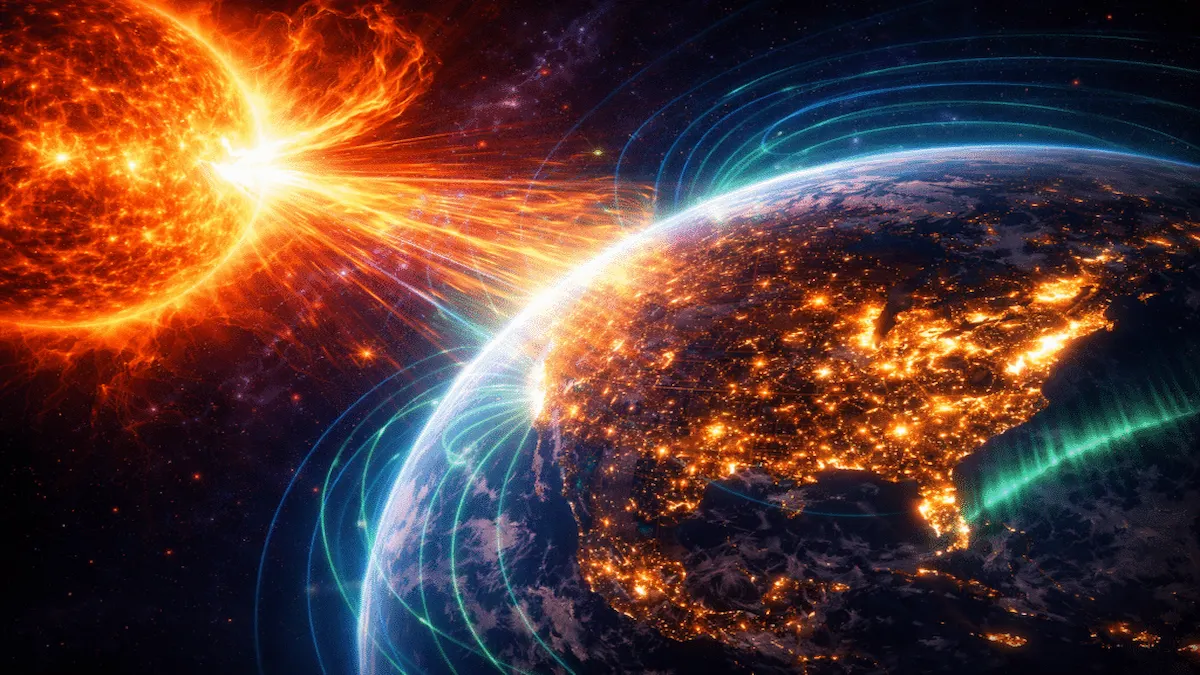
The sun is the main source of energy for us, and life does not exist on earth without the sun. From Earth, the sun is looking calm, but it does not remain the same every time. Its surface and magnetic forces are changing constantly. These changes are not limited to the sun only; they also affect our planet. This solar activity affects Earth in many ways, like it can affect our communication system, GPS, etc. Not only it creates problems for us, but it also creates a beautiful sky event named as aurora. Now our technology grows rapidly, so it is important to know more about how solar activity affects Earth. Solar activity is not only an astronomical topic; instead, it is a real problem for us because it affects communication, radio signals, GPS, navigation, and satellites, which causes a lot of trouble for us. So it is important to study and understand its whole process carefully.
What Is Solar Activity?

Solar activity is a term that refers to the changing behavior of the sun. As I told you before, it is not always calm; sometimes it becomes more active, and sometimes it becomes less active. Basically the sun goes through a natural cycle that lasts for 11 years. In this cycle the sun has phases, high active and low active. During its low active phase, sunspots are fewer and solar flares and storms become rare; this is called solar minimum. During its high active phase sunspots are higher, and solar storms and flares also increase; this is called solar maximum. When the sun becomes highly active, its solar activity also increases, which includes sunspots, solar flares, and the charged particles moving away from the sun. When solar activity increases, it affects our planet, like GPS, communication, space telescopes, and radio signals, and also creates a beautiful sky event.
How Does Solar Activity Affect Earth?
Solar activity affects Earth in many ways. Some of them are as follows:
1. Solar Activity Affects Earth’s Upper Atmosphere:
Firstly, solar activity affects the upper atmosphere of the earth with the charged particles released from the sun. Earth’s upper atmosphere contains the thermosphere and ionosphere. These layers are in direct contact with the sun’s exposure, so they are more sensitive to the sun’s changes. Due to the stream of charged particles emitted from the sun, the upper atmosphere heats, which results in the expansion of the upper atmosphere outwards. This expansion causes atmospheric drag on satellites in orbit. As a result, satellites slow down and lose height. When the solar activity increases, scientists keep observing and adjusting the satellite orbit. In this way solar activity affects Earth.
2. Effects on Satellite and Spacecraft:

Solar activity has a strong impact on the satellites and spacecraft. When the sun is in a high active phase, it releases strong radiations and streams of high-energy particles, which travel through space and interact with the earth-orbiting objects. These high-energy particles and high-energy radiation emitted from the sun have a great impact on the satellite system. In stronger cases, it can also completely damage satellite components like computer chips, solar panels, and sensors, and it can also reduce the lifespan of the satellite. During the sun’s high active period, the system may shut down to prevent permanent damage from the solar activity. This is the example of how solar activity affects Earth through technology. Even a small damage in the satellite can affect the weather forecast, television, and also the internet.
3. Disruption to GPS and Navigation System:

GPS signals get disrupted by solar activity because these systems are dependent upon the signals that travel from the upper atmosphere in space. When the sun is in a high active phase, it releases high-energy particles and radiation energy, which interact with the earth-orbiting objects. During the strong solar activity, the upper atmosphere of the earth is unstable. As a result, these signals may slow down or bend from their direction. These signals travel from the satellite to the ground; even a small delay causes a position error. Systems that are working with the help of GPS in the real world, like aeroplanes, ships, smartphones, mapping apps, etc., also get affected by the strong solar activity. Solar activity affects Earth in this way also.
4. Radio Communication and Signal Interference:
Solar activity can also affect radio communication by disturbing the layer of atmosphere in which radio signals travel. When the sun releases strong solar flares, they can interfere with the radio signals, and they cause them to fade or slow down. By this interference, radio signals get lost or fade for a short time. It causes trouble for people who use radio signals for communication. We face these problems during the high solar activity. This shows solar activity affects Earth in other ways also that go beyond space-based technology.
5. Aurora: A Visible Effect of Solar Activity

Solar activity not only harms us, but it also gives a beautiful sky event named as aurora. Aurora is also known as northern and southern lights. This beautiful event happens when the strong charged particles emit from the sun, and then they interact with the earth’s atmospheric gases. As a result, it releases energy in the form of lights. It creates a beautiful glowing pattern in the sky. When solar activity increases, it becomes brighter. This event is known as northern light (aurora borealis) in the north and southern light (aurora australis) in the south. This shows that solar activity affects Earth in dramatic yet harmless ways.
6. Does Solar Activity Affect Earth’s Climate?
Yes, solar activity affects earth’s climate, but its effect is little as compared to other factors. As we know, the sun’s energy is very essential for life, but the sun changes its energy in its natural cycle of 11 years. When it becomes highly active, it produces more energy, and when it becomes less active, it decreases its solar activity. These changes affect the upper atmosphere of Earth, but their impact is very little on Earth’s climate. Scientists observe that solar activity affects Earth through space weather, not long-term climate change.
7. Impact on Power Grid and Infrastructure:
Power grids and infrastructure are also affected by solar activity. During high solar activity, the sun sends highly charged energy particles toward earth, and they create disturbances in earth’s magnetic field. By this disturbance, electric current is induced in the ground, which is called geometrically induced current. This extra current puts more stress on electrical instruments, which causes them to overheat or sometimes fail. Other infrastructures are also affected by the solar activity, like pipelines, railway signal systems, communication signals, etc. To avoid this risk, space agencies always monitor solar activity. This is another way solar activity affects Earth.
Conclusion
As we know, the sun is very far from us, but its activity impacts us in many ways. The sun has both sides; it is essential for life, and it also produces harm. If the sun enters its active phase, it creates strong solar activity like strong solar flares, high-charge energy particles, and stronger radiation. This solar activity affects Earth in many ways, as we discussed above. To avoid this danger and to secure their modern systems, scientists keep observing solar activity more carefully.
Pingback: 2026 Eclipses and Celestial Events: A Complete Guide to the Year Ahead
Pingback: Best Places to See Northern Lights in the USA in 2026 (Real Viewing Spots & Tips)