
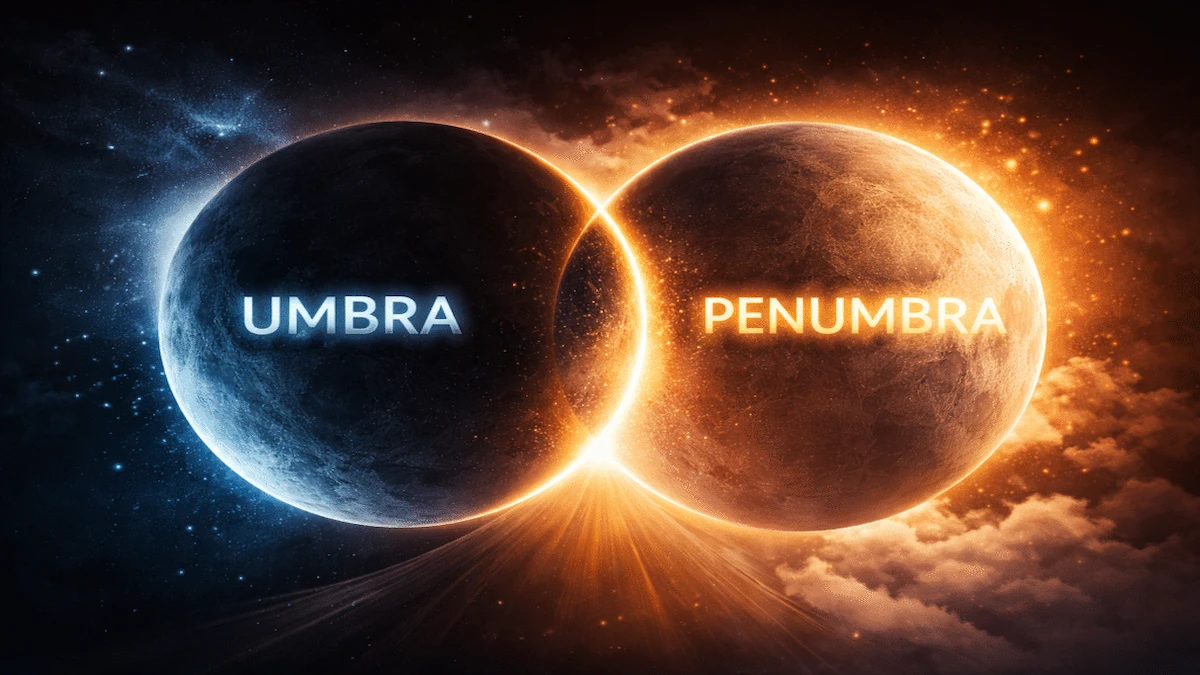
As you all know about the space event Eclipse. All of you think that in a lunar eclipse the moon becomes red and in a solar eclipse the sun disappears or hides behind the moon. But no one knows the real reason behind these eclipses. Both solar and lunar eclipses depend upon the umbra and penumbra shadow regions. Umbra and penumbra play an important role in solar and lunar eclipses. If you are searching for the eclipse information, then firstly you have to understand these two terms: “umbra” and “penumbra.” When you understand about umbra and penumbra, then it is very easy to understand eclipse. In this article we’ll explain about umbra and penumbra. After reading this article, you’re ready to explore every eclipse.
What Are Umbra and Penumbra?
Umbra and penumbra are the two different shadows of one object when it blocks the light. To understand umbra and penumbra, think about an object that is placed in front of a light source and blocks the light emitted from the source. After that, it does not create only one shadow; instead, it creates two shadows. These are called umbra and penumbra shadow regions. The dark part of the shadow region of the object is called the umbra. From this part light is fully blocked. Even one ray of light does not pass, so it is the darkest region of the shadow. The lighter part of the shadow region is called the penumbra. It is the outer part of the shadow. From this region some light passes, so it is the lighter region of the shadow. These umbra and penumbra are the two parts of the shadow that are produced when an object blocks the light. This phenomenon occurs everywhere, whether it happens on earth or in space.
How Umbra and Penumbra Form in Space?

As we discussed above, umbra and penumbra are the two parts of the shadow. In space when the Moon or Earth comes in front of the sun, they block the sunlight. After this, a dark shadow forms just behind the object; this region is called the umbra. Sunlight is fully blocked in this region. Around the dark part a lighter shadow also appears. This lighter region is called the penumbra. Sunlight is partially blocked from this region. Now you may have one question: “Why two shadow forms?” This simple answer is that the sun is not any point of light. It is a huge source of light. It has a very large diameter, so when any object blocks sunlight, some of them are blocked fully, forming the umbra region. But some of them are partially blocked by the penumbra region that forms. In simple terms, “Because of the sun’s large diameter, more than one shadow region forms.”
Umbra and Penumbra in a Lunar Eclipse
A lunar eclipse happens when the Earth comes in between the Sun and the Moon. During this event Earth’s shadow covers the moon. In this lunar eclipse, umbra and penumbra play an important role. When the moon enters in the earth’s penumbra, we can see a penumbral lunar eclipse or partial lunar eclipse. In this phase we can notice that the moon gets dimmer than its natural form. After this phase, the moon begins to enter the earth’s umbra. When the umbra covers the moon completely, then we can see a total lunar eclipse. In this phase the moon does not disappear; instead, it becomes red in color. This red moon is also called a blood moon. The sunlight does not reach directly to the moon. First it enters the earth’s atmosphere, then it bends toward the moon. This filtered sunlight causes a blood moon.
know more about total lunar eclipse March 2026
Umbra and Penumbra in a Solar Eclipse
In a solar eclipse, the moon comes in between the sun and earth. During this event the moon blocks the sunlight and casts its shadow over the Earth. This shadow has two parts; the darker part is called the umbra, and the lighter part is called the penumbra. The umbra and penumbra decide what type of eclipse people see. If you are in the region where the umbra shadow forms, then you see a total solar eclipse because the umbra shadow forms when the sunlight is completely blocked; not even a single ray passes through this region. The daylight turns into darkness. If you are in the region where the penumbra shadow forms, then you experience a partial solar eclipse. In this region the sun is not completely covered. Some sunlight passes through this region. Hence, umbra and penumbra play an important role in casting a total eclipse or partial eclipse.
Why Penumbral Eclipses are Hard to Notice?

When the eclipse happens, many people don’t even notice the penumbral eclipse because the penumbral eclipse is too weak. Its reason is hidden in the umbra and penumbra. In the penumbra region, sunlight is not completely blocked. Some of the light passes through it. So the brightness difference is too weak, especially to the human eyes. If you observe an eclipse very carefully and you know how to watch and when to watch, then you may notice a penumbral eclipse. If you don’t have any instrument like a telescope, then you should face some problems to watch a penumbral eclipse.
Why Do Umbra and Penumbra Matter in Astronomy?
Umbra and penumbra are not just only for eclipses or to experience any interesting view. They also help scientists to expand their knowledge about space science. By studying umbra and penumbra, researchers can learn about the size, shape, or motion of the space objects. By measuring the time duration of moon stays in the umbra, scientists can estimate the orbital speed. During the lunar eclipse, the light passes through Earth’s atmosphere before reaching the moon. By studying this filtered light, scientists can know about the earth’s atmosphere, dust, and pollution. So topics like umbra and penumbra are not just for the experience or the educational purpose; they are scientifically valuable.
Conclusion
In this article we discuss all about the umbra and penumbra. They played a very crucial role in the eclipse. Every eclipse we see on the earth is controlled by the umbra and penumbra. These are two main regions of the earth’s shadow. The darker region of the shadow is the umbra, and the lighter region of the shadow is the penumbra. If you understand these two shadow regions, then you can understand eclipses completely without any difficulty. Whether it’s a total eclipse or partial eclipse, everything starts with the umbra and penumbra and also ends with them.
Pingback: Total Lunar Eclipse March 2026: Blood Moon Explained