
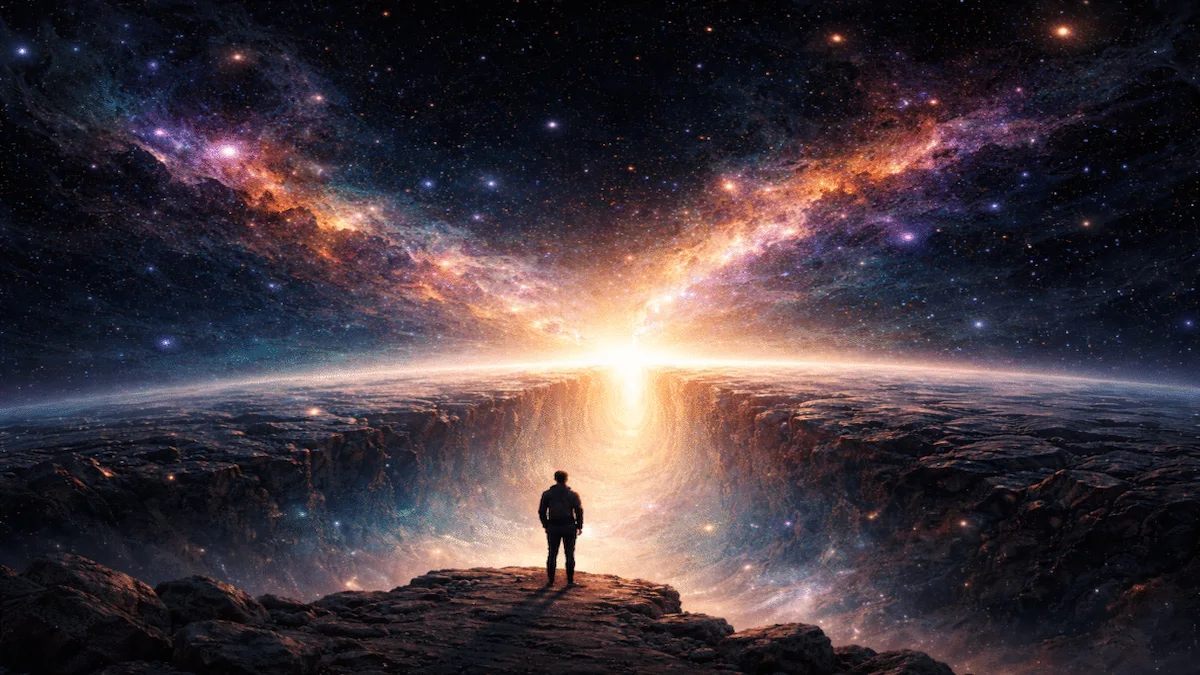
When you look up in the sky, you see a huge space. One question might come to your mind: can space ever end, or does it go on forever? This idea contains a lot of mysteries in itself. It is very strange if we think of our daily life; whatever we see has its end. Like a room where we live has its walls, a road has an end, a city has an end, a country has an end, and even large oceans also meet lands. So it is a very usual thing to ask, “Can space ever end?” or “Is it infinite with no end?”
In this article we will discuss all about space and its endless journey. We will try our best to reach a good conclusion to this question and make you satisfied with our answer.
What We Mean By “Space” in Science
Before discussing “Can space ever end?” we have to understand what space means in science. When you hear the word “space,” a dark place filled with planets, stars, and galaxies appears in your mind. But it is completely wrong; this is not what space exactly is. According to science, space is a 3-dimensional framework where everything exists and moves. If there is no space, then location, distance, size, and motion—all these terms—are meaningless. All the activities, like changing position, travelling through space, planets revolving around the sun, and space objects moving, are happening because space provides a stage for motion. Without space, all these activities are impossible.
The most important point is that “space can never be empty.” Even in the emptiest region between the galaxies, where stars and planets do not exist, there is also space. Space contains energy, radiation, gravity, magnetic fields, and also the invisible particle. That means everything that is present in existence is contained by the space. That’s why scientists say that empty space is not truly empty.

According to modern science, space is connected with time. Together they form space-time. Now scientists are studying spacetime. There is a simple theory: an event does not occur without space and also does not occur without time. An object needs a place to exist, which means space and needs a moment to exist, which means time. So every object needs time and space to stay in existence. That’s why scientists combine space-time. The massive space objects like planets, stars, and black holes bend spacetime around them. This bending is gravity, which we experience.
Another surprising fact for you is that space is stretching and expanding itself. You may hear news, like black holes and galaxies are moving away in space. This does not happen because they are travelling, but it happens because space is expanding itself around them. The size of the space and the question “Can space ever end?” is now beyond human thinking. Space size is not just the size of stars, galaxies, or other space objects, but its size depends upon itself only. It is like a fabric that holds everything and provides a stage for their motion.
Can space ever end?

Human thinking has its own limits. Like if we are walking for a long time, we expect to reach somewhere. But the space challenges our thinking. When we see space through advanced telescopes, even billions of light-years away, there is complete darkness. A question arises in everyone’s mind: “Can space ever end?” After studying many years, we do not yet know for sure if space has an end. As we know, galaxies move through space. It means space around them stretches. Space keeps expanding.
Scientists have another theory that helps to find the answer to “Can space ever end?” Maybe space is finite, but it has no edge or boundary. Like our earth is finite, but if you walk in a straight line, you never find any boundary. You can walk endlessly forever. Similarly, it may be possible that space is finite but it doesn’t have any walls, and you can travel in space forever without reaching its boundary. Many theories are present that define whether space has an end or not in their own assumptions. So the question “Can space ever end?” is very difficult to have a simple one-line answer for. Some scientists believe that it may have higher dimensions, and some believe it may have a different shape that we do not understand yet. In simple words, science does not have an answer in “yes” or “no” to this question: “Can space ever end?”
Another possibility is that space is truly infinite. If we believe this possibility, then I would say “no,” space never ends. Infinite space has no center and no edge.
Does Space Have an Edge Like a Wall?
For many years scientists have been researching the hidden secrets of space and trying to reach the end of space. But from the current data, space does not have any edge or wall. Till now we do not have any proof that space ends or that it suddenly stops. If there is any boundary that exists in space, then definitely scientists caught some suspicious activity, like a change in light, unusual radiation, etc., happening near the boundary. But there is no such activity happening, and not a single piece of evidence of a space boundary is found by the scientists across the world. Now scientists came to the conclusion that maybe space does not have an ending in a simple or familiar way like a wall or edge. But it has some mysterious ending that is beyond human thinking.
What the Big Bang Really Means for Space

People think the Big Bang is a huge explosion in the empty space. But it is not like a bomb explosion or anything else. The Big Bang is the point when space began and started expanding. The Big Bang is the moment when space, time, and energy all came into existence. Before the Big Bang, there was nothing. Space is extremely hot and very dense. After the Big Bang, it begins to expand in all directions. It cooled down, and then energy formed atoms, and then stars and galaxies were formed. Space is still expanding. In simple terms, the big bang only tells us that space is dynamic, not fixed.
Final Thought
“Can space ever end?” This question remains unanswered. We talk about many theories related to the space ending. Through this article I want to deliver a message to all viewers that even if our science becomes modern or we have the latest and most advanced telescopes, we are still not capable of finding the answer to one question. That means humans are not yet capable of understanding the concept of space, and our universe still holds many mysteries waiting to be explored. Yet we don’t have an answer, but “Can space ever end?” This question pushes our modern science forward, and our scientists must find an exact answer one day.
Another question of this decade is “Why is space so scary?“
FAQ
Que 1: Can space ever end?
Ans: After studying many years, we do not yet know for sure if space has an end. Many theories are present that define whether space has an end or not in their own assumptions. In simple words, science does not have an answer in “yes” or “no” to this question
Que 2: Is space 100% empty?
Ans: No, space is NOT 100% empty, even though it looks empty to us. when we thinks about the space we thought a large black area with stars and planets. and we think it is empty where it is dark. but it is wrong, even in the emptiest parts of the space, it contains atoms, radiation, gravity, magnetic field, dark matter and dark energy. That’s why scientists say that empty space is not truly empty.
Que 3: Did space exist before the Big Bang?
Ans: Based on the scientific data, space does not exist before Big Bang. The Big Bang is the moment when space, time, and energy all came into existence. Before the Big Bang, there was nothing.
Que 4: Is space still expanding today?
Ans: Yes, space is still expanding today. Even the expansion of the space is now accelerating. Galaxies and Black Holes are moving as space around them stretches itself.
Que 5: Why is 95% of the universe invisible?
Ans: 95% of the universe is invisible because it consist of dark matter and dark energy. Dark matter contains 27% of the universe and Dark energy contains 68% of the universe. Only 5% of the universe is visible. Stars, planets, galaxies, gas clouds, and even us all together makes up only about 5% of everything that exists.
Pingback: A Mysterious Interstellar Tunnel May Be Connecting Our Solar System to Distant Stars
Pingback: Why Is Space So Scary? The Real Science Behind This Fear