
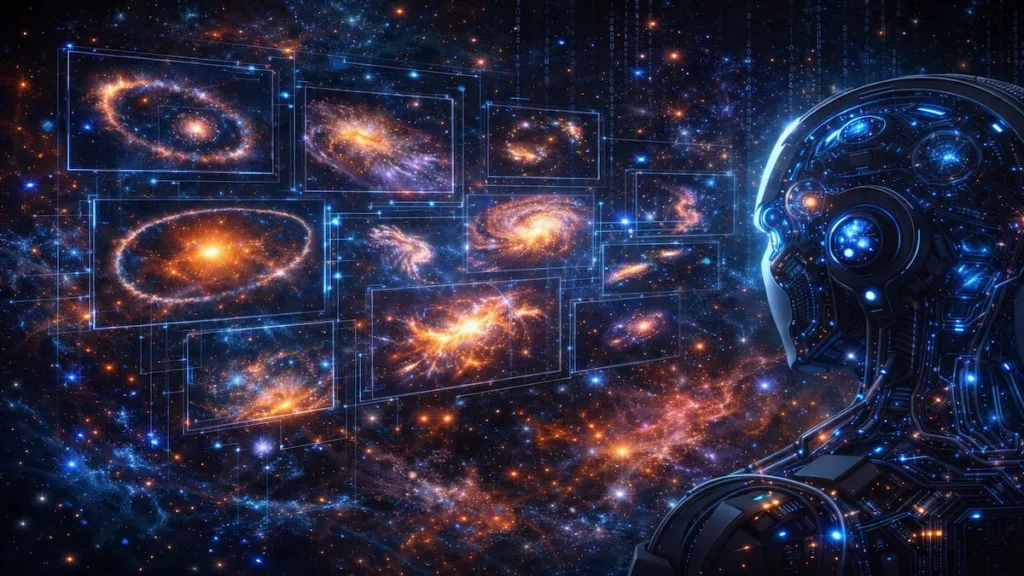
You can’t even imagine that the space anomalies that are found by the Hubble Space Telescope are not brand-new observations. Instead, they are hidden inside the old Hubble data that is missed by the researchers. Now, scientists reanalyze previous years’ Hubble data with the help of artificial intelligence (AI). They found many uncovered space anomalies.
The Hubble telescope is one of the most powerful sources for humans to get information about deep space. The Hubble telescope was launched in 1990, and it continues to give surprises to the scientists. The space anomalies discovered by the Hubble telescope now become one of the most talked-about space science topics.
Let’s break down all the latest information about the space anomalies in this article.
What Are Space Anomalies?
Space anomalies are the space objects or activity that are not explained by the current space theories (in simple terms, they do not behave like scientists expect). Space anomalies behave strangely and very unusually. Some examples of the space anomalies are unusual gravitational effects, strange deep space signals, unusual shapes, strange light patterns, dark matter, dark energy, etc.
Space anomalies do not mean that there is something that is very dangerous, like aliens or monsters in space. Space anomalies mean some space objects or activities are not understood by us, or we cannot define them by our current theories or physics laws. Whenever space anomalies come in front of us, it leads to major scientific breakthroughs, and new physics may be involved.
AI Discovery: Hundreds of Hidden Space Anomalies Found

The Hubble telescope was invented in 1990. For three decades it has collected millions of images of deep space. But scientists could only analyze a small portion of these images. Now we are living in the era of artificial intelligence (AI). With the help of modern AI technology, we can scan more data in much less time.
In 2025-2026 European Space Agency (ESA) scientists analyze the previous data of the Hubble telescope with the help of an AI tool. And it discovered many hidden space anomalies, which are hidden in the old untouched data. This AI tool analyzes over 100 million images given by the Hubble telescope, and after a few days, it discovered around 1300 mysterious cosmic objects. More than 800 of these cosmic objects were not even classified before.
This is one of the largest space anomaly discoveries we have ever made. They are all discovered by the old Hubble telescope data. This discovery made scientists realize that, if we analyze properly, then old data also gives us important information. Some examples of space anomalies are as follows:
- Ring-shaped galaxies
- Jellyfish galaxies with gas tails
- Unknown and unexplained space objects
- Merging or interacting galaxies
- Some rare gravitational lens
All these strange space activities or objects were too rare or faint to notice earlier without any artificial intelligence (AI) tools.
Artemis 2 moon mission updates
Gravitational Lens: Light Bending in Strange Ways

A gravitational lens is one of the major space anomalies found by the Hubble telescope. Gravitational lensing is the space phenomenon in which light does not travel in a straight line. Whenever light passes near a massive space object like a galaxy, black hole, etc., it bends itself. This gravitational lens phenomenon was known before, but an AI tool discovered a new unknown gravitational lens system from Hubble’s previous data. These newly discovered space anomalies help us in many ways. They are very important for studying dark matter and the expansion of the universe and also give us information about the hidden galaxies in deep space.
Why Does Light Bend in Space?
If you think the light bends because of the air or any force like gravity in space, then you are completely wrong. According to Einstein’s theory of relativity, space and time are like a stretchable fabric. Massive objects in space, like stars, galaxies, clusters of galaxies, and black holes, etc., warp this space fabric. That means the space near the massive objects is curved. So when the light travels near the massive cosmic objects through this warp space, it bends itself. This phenomenon happens because the space itself is curved.
This space curve is called gravitational lensing. With the help of gravitational lensing we can see:
- Distant galaxies may look stretched.
- Some space objects may look like arcs or rings.
- Sometimes a single galaxy may appear more than one time.
- It helps in studying dark matter (which cannot be seen directly).
Unexpected Galaxy Shapes and Collisions

Unique and unexpected shapes of galaxies and violent collisions are also a major part of the space anomalies. When you imagine a galaxy, you think it looks like a neat spiral shape or a smooth round and elliptical shape. But Hubble discovered completely strange and irregular galaxies. These irregular shapes are found when two galaxies merge together and form into one. The galaxies consist of billions of stars, and they collide with each other, triggering intense bursts of a new star. Because of the collision, some parts of the galaxies start glowing. These collisions may change the shape of the galaxy completely over millions or billions of years.
Hubble also observes the middle of the merging galaxies many times. Some of the galaxies are not fitting in the known category. They are neither spiral nor elliptical. These space anomalies suggest that galaxy evolution may be more chaotic than previously thought.
Some of the galaxies that are important part of the space anomalies.
Ring Galaxies With Near-Perfects Symmetry
Recent Hubble discoveries consist of many galaxies of almost ring-like shape. The perfect symmetry of the galaxies caught scientists’ attention immediately. These ring-shaped galaxies are formed when a small galaxy enters the centre of the larger galaxy. Because of the perfection in their symmetry, these ring-shaped galaxies are the important part of the space anomalies.
Jellyfish Galaxies with Star-Forming Tails
Jellyfish galaxies are the most visually striking space anomalies. These galaxies have a long tail of gas and a star flowing behind them. Scientists were surprised to see there was a star forming in the gas tail of these galaxies. This galaxy looks like a bright galactic head from the front and has a tentacle of gas, dust, and a newborn star. It is also the important part of Hubble’s anomalies.
Merging Galaxies with Unexpected Star Activity
In many cases Hubble observes merging galaxies. These galaxies hold an important position in the space anomalies. In some mergers the star formation is very unusual, and it refutes our existing models.
Dark Matter Clues Hidden in Space Anomalies
Dark matter is one of the biggest mysteries of deep space. Dark matter is invisible; it means scientists cannot see it directly, but they know that it exists. Most of the universe’s mass is made of dark matter. Dark matter does not emit light, and it does not reflect any light, but it has gravity. Because of this gravity, it holds galaxies and controls their movement. Scientists estimated that about 85% of the matter of the universe is the dark matter.
Some space anomalies are discovered that show dark matter does not always align perfectly with the visible matter. Scientists observe this strange behavior through the mismatches of the gravitational lens systems, strange star motion, and the clusters of galaxies behaving unusually.
Beyond Anomalies: Other Recent Hubble Discoveries
In January 2026, the Hubble telescope discovers a new mysterious cosmic object. Media gives a nickname “cloud 9” to it. It is starless, rich in gas, and dominated by a new type of dark matter.
Cloud 9 is a huge cloud of gas and dust. Cloud 9 mainly contains hydrogen, and it is situated around 14 million light-years away from our solar system near the spiral galaxy Messier 94 (M94). The structure and the size of Cloud 9 are very unusual. It contains very dense gas regions and unexpected heat and pressure. The star formation in Cloud 9 is faster than expected. The movement of the gases is very strange inside it. The unexpected behavior and structure put Cloud 9 in the category of space anomalies.
Conclusion
With the help of artificial intelligence (AI), scientists made one of the biggest discoveries of space anomalies. They completely change our understanding of the cosmos. AI performs a key role in discovering these space anomalies. Scientists only cover a small portion of Hubble’s data manually. Without AI it is impossible to analyze all the old images given by the Hubble telescope in a few days. This discovery made us realize that science is always evolving and many mysteries are still waiting to be solved in deep space.
Pingback: Underground Lava Tube on Venus: What Scientists Just Found (2026)