
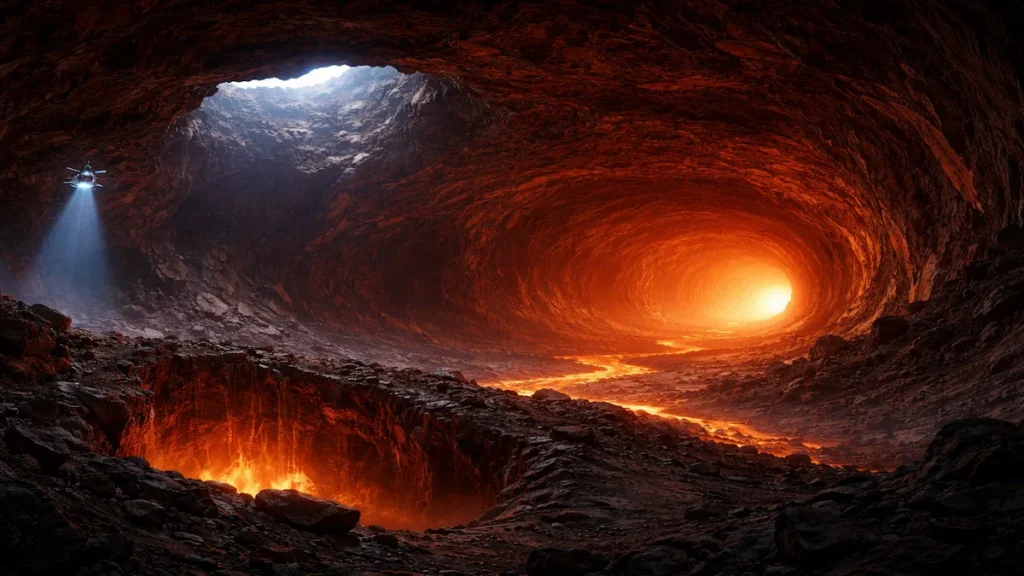
Recently scientists found clear evidence of an underground lava tube on Venus. It is a major discovery of our neighbor planet. The evidence of lava tube on Venus was announced in February 2026. This is the first time when any evidence is found of the subsurface volcanic structure on Venus.
Venus has always been a very mysterious planet in our solar system. It is very difficult to analyze its surface because it always hides behind the clouds of thick toxic gases and extreme heat. This discovery has become possible by advanced analysis of radar data given by NASA’s Magellan spacecraft. This discovery changes scientists way of thinking about the past geological conditions of Venus.
In this article I’ll break down all the information about the underground lava tube on Venus, like how it was discovered, why this matters to scientists, and how it is going to be beneficial for future Venus research.
What Is an Underground Lava Tube on Venus?
An underground lava tube on Venus is a hollow tunnel that once carried lava flow under the planet’s surface. Its structure is the same as we see on Earth, the moon, and Mars.
Imagine a river of lava is flowing. Its upper layer cools down and becomes hardened like a roof, and lava keeps flowing underneath. When the lava stops flowing. Then an empty hollow tunnel remains. This empty tunnel is called a lava tube. The process of formation of the lava tube on Venus is the same as on Earth, but it is much more extreme. The volcanic eruptions are massive on Venus. Lava flows hundreds of kilometers across the surface. When lava stopped flowing, it left a huge underground lava tube behind it. The underground lava tube on Venus is larger than the earth’s lava tube. Venus’s lava tube could be several kilometers wide, and its roof is stronger due to its gravity.
Hubbel Telescope found many space anomalies with the help of AI
How Did Scientists Discover the Lava Tube?

Scientists discovered this underground lava tube on Venus by analyzing old radar data given by NASA’s Magellan spacecraft. Magellan has revolved around Venus since the 1990s. Venus is one of the most difficult planets to explore directly on its surface. Venus’s surface is always covered by the clouds of toxic gases, sulphuric acid, and intense heat. Cameras could not reach its surface, but radar can penetrate through the clouds and reach the surface.
The researchers from the University of Trento in Italy analyze the old radar data from the Magellan spacecraft by using modern imaging techniques. While studying, they found an area where the radar reflected back in a way consistent with a large underground void. It leads to an underground lava tube on Venus.
- This underground lava tube on Venus is about 1 kilometer (0.6 miles) wide.
- The thickness of its roof is about 150 meters.
- The height of the empty cavity is about 375 meters below the surface.
This discovery is only possible through advanced analysis of the reflection of radar. It is not possible to explore it by using an optical camera.
Why Underground Lava Tube on Venus Matter
This discovery is very important from scientists perspectives. It gives us information about more scientific theories of Venus. This discovery is a big deal for several reasons:
This Discovery Reveals Venus’s Volcanic Past
For a long time, scientists suspected the volcanic activity on Venus. Underground lava tubes on Venus are direct evidence of the massive volcanic activity in the past. This discovery indicates that there was a massive flow of lava in the past. It also tells us that Venus was geologically very active. This discovery helps scientists to understand when and how Venus evolved and transformed into a super hot planet.
Impacts Future Venus Missions

As we know, this discovery of a lava tube became possible because of the old radar data given by the Magellan mission. And it proves to be an important discovery. But we do not have full information about below the surface. So that upcoming scientific missions like the European Space Agency’s EnVision and NASA’s VERITAS become very important to reveal more hidden mysteries below the surface.
ESA’s EnVision mission focuses on giving more details about Venus. It will carry advanced radar instruments. It collects information like whether there is any sign of active or present volcanism, studies the surface and its interior, and also creates high-resolution surface maps.
NASA’s VERITAS (Venus Emissivity, Radio Science, InSAR, Topography, and Spectroscopy) is NASA’s next mission towards Venus. It makes the most detailed geological map of Venus. This mission uses synthetic aperture radar (SAR) to map the Venus surface and interferometric radar (InSAR) to detect tiny surface movements.
This discovery explains strange surface features.
Underground lava tubes on Venus show many strange surface features. Scientists cannot understand these only by lava flow alone, but lava tubes explain them properly. There are very long lava channels on Venus, and they cover hundreds or thousands of kilometers. Most of them keep almost the same width throughout their length. While in the earth, lava is flowing on the surface. Lava spreads out usually and cools down quickly; that’s why it can travel this much distance and also does not have the same width throughout its length. This remains a mystery, but the presence of a lava tube explains it. With the help of a lava tube, it can flow a long distance and stay hot for a longer time.
Lava tubes also explain the pits, holes, or collapsed regions on the Venus surface. Now scientists think that, when the roof of an underground lava tube on Venus becomes weak and it falls, a collapsed region is formed on the surface. Radar gives many images of these pits and collapsed regions on the surface. The surface features of Venus would remain a mystery, but underground lava tubes give these strange features a logical explanation.
Lava Tubes Could Protect Future Venus Missions

As we all know, Venus has extreme atmospheric conditions. These underground lava tubes on Venus can give us a natural protection from the extreme climatic conditions. Venus has one of the most hostile environments, with a temperature of around 460°, a crushing pressure, and a very toxic climate. It is able to destroy our spacecraft within hours. These tubes can act as a protective barrier for our landers, rovers, and scientific instruments. It can protect from intense heat, radiation, and atmospheric pressure. These lava tubes can also be pathways for exploration. Underground lava tubes on Venus can be key assets for future space missions.
How Unique Is This Lava Tube Compared to Others?
The lava tubes that are found on Venus are far more different from the lava tubes of Earth, the moon, and Mars in various aspects like size, strength, and the environment where they are found.
Size: Venus produces a large amount of very hot and low-viscosity lava that flows on the surface for a long time without cooling. This makes lava tubes longer and wider than the tubes found on the earth. It is believed that some lava tubes may be thousands of kilometers long on Venus. While the lava on Earth cools more quickly due to air, water, and weather than on Venus.
Strength: The roof of the lava tube is stronger because of Venus’s gravity and thick crust. They remain for well over millions of years. In earth erosion, water and earthquakes damage lava tubes, but Venus lacks rain and flowing water, so the underground lava tubes on Venus remain well for a long period of time. Moon and Mars lava tubes are formed under the cold atmosphere, but the lava tubes in Venus formed under the extreme atmospheric conditions and intense heat, so their strength is greater compared to the Earth, moon, and Mars lava tubes.
Conclusion
In this article we will discuss all about the underground lava tubes on Venus. This discovery is an important scientific milestone. This discovery opens a gate to observe the volcanic activity of Earth’s sister planet. This discovery helps scientists to understand the hidden geology of Venus. It reveals the complex volcanic past under its surface. With the help of the upcoming ESA’s EnVision and NASA’s VERITAS missions, scientists confirm the underground volcanic activity of Venus. They use their advanced technology in these missions to get fruitful results. Scientists will try to map the underground feature and to know whether Venus is still geologically active today or not in future space missions.
Pingback: Why Is Venus Hotter Than Mercury? The Real Scientific Reason That Shocks Many People
Pingback: Solar Storm Warning USA 2026: Could A Powerful Solar Flare Disrupt America?