
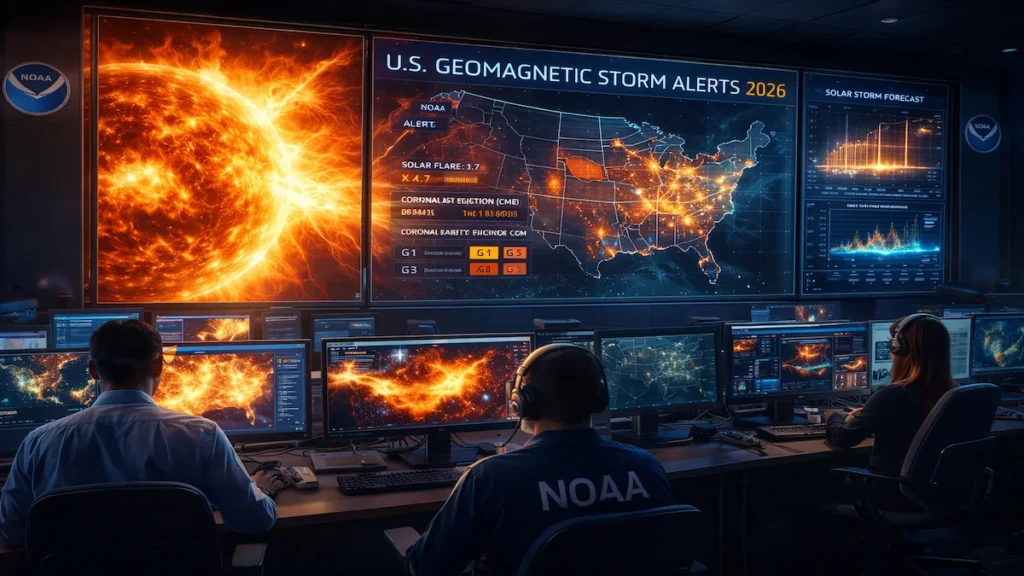
The NOAA solar storm forecast 2026 keeps people updated about increasing solar activity. Scientists believe that 2026 could be one of the most active years of the current solar cycle. Solar activity is expected to reach its peak in 2026. During this period, the sun sends more powerful solar storms and more frequent geomagnetic storms. This results in disturbance in satellites’ systems, GPS systems, navigation systems, power grids, communication signals, etc.
Americans know what a solar storm is capable of. A powerful solar storm can affect modern technology and create many problems for us. As most of the technology depends on electricity, satellite signals, etc. And these systems can be damaged by solar storms. So NOAA predicted 2026 to be more important for solar activity.
Let’s learn more about the NOAA solar storm forecast 2026 in this article. Could a strong geomagnetic storm affect the United States power grid system? And what are the preparations done by Americans to fight against solar activity?
What Is NOAA’s Role in Solar Storm Forecasting?
NOAA (National Oceanic and Atmospheric Administration) is the United States agency. NOAA plays an important role in forecasting solar storms. NOAA is the agency that tracks all the solar activity 24/7 that could be dangerous for the United States and the world. From its Space Weather Prediction Center (SWPC), NOAA monitors space weather, including geomagnetic storms, solar flares, coronal mass ejections (CMEs), sunspot activity, and radiations coming from the sun. This weather prediction center always monitors the solar activity that happens in the sun by using advanced space instruments. If any solar activity is detected, NOAA issues alerts and early warnings to power grid operators, satellite companies, airlines, and government agencies.
NOAA keeps monitoring solar activity constantly. NOAA divides space weather into three categories. These are as follows:
G-Scale
This scale is used to measure the earth’s magnetic field disturbance, which is caused by solar activity. It has 5 levels.
G1: This level has minor effects. Their impacts are very weak. They have very minor effects on power grid systems and satellites.
G2: This level has moderate effects. It has more effects than G1. It produces some issues on the satellite system.
G3: This level is strong. It affects satellite navigation problems. It can also produce auroras that can be visible in many U.S. states.
G4: This is a severe level. It can damage the technology. It can also disturb satellite communication.
G5: This level is extreme. It can give major issues to the technical systems. It causes long-lasting blackouts and some serious damage to the satellite system. It can form auroras that can be visible very far from the poles. G5 storms are very rare.
R-Scale
This scale is used to measure X-ray radiations that are coming from the solar flares. The events of the R-scale happen immediately because radiation travels at the speed of light. These X-rays can affect radio communication. This scale also has 5 levels.
R1: In this level, X-ray impacts are very low.
R2: This level is moderate. Only limited communications are disrupted.
R3: This level is strong. In this level, high-frequency radio signals are disrupted.
R4: This level is severe. In this level radiations are strong enough to disrupt radio signals for a long time.
R5: This level is extreme. In this level radiations are very strong. They can cause a complete radio blackout.
S-scale
This scale is used to measure high-energy particles from the sun. They can give serious damage to the astronauts and satellites. This scale also has 5 levels.
S1: This is a minor level. It includes energy particles that give minor effects to the satellites.
S2: This is a moderate level. In this level, the exposure of the energy particles increases.
S3: This is a strong level. In this level, energy particles give some problems to the satellites.
S4: This is a severe level. In this level, energy particles are strong enough to damage satellites and disturb communication systems.
S5: This is an extreme level. In this level, energy particles can give some serious damage to the satellites. It involves high risk of failure. S5 energy storms are very rare.
What are the solar flare 2026 effects on earth?
How Accurate Are NOAA Forecasts?
NOAA’s Space Weather Prediction Center (SWPC) always predicts space weather. NOAA uses satellite data like DSCOVR, GOES satellites, and the solar dynamics observatory to perform such predictions. NOAA is most accurate about its short-term predictions. NOAA’s predictions about any solar storm before 1 to 3 days are mostly accurate. But NOAA’s long-term predictions are less accurate. Like scientists can predict when the sun will approach the peak of its solar cycle, but they cannot predict the exact date.
Why 2026 Is So Important?

The year 2026 is extremely important for solar storms because scientists believe that the Sun’s activity will be at its highest during this time. The Sun goes through a natural 11-year cycle with fluctuations in solar activity, called Solar Cycle 25. The sun is currently at the peak of its solar cycle 25. The peak of the solar cycle is expected between 2024 and 2026. During this time, the Sun produces intense solar storms, coronal mass ejections, and solar flares. This could impact our satellites, GPS, and communication signals. In a year like 2026, our modern technology will be completely dependent on satellites and power systems. This is why the NOAA Space Weather Prediction Center monitors the Sun very closely, and 2026 is extremely important for solar storms. This makes it crucial to discuss the 2026 Solar Storm Warning in the United States.
How strong could solar activity be in 2026?
Scientists observe that sunspots are increasing, and they even surpass the early prediction. Scientists are monitoring the solar cycle closely, and they believe now the sun has approached the peak of its current solar cycle 25. During this period of sunspots, powerful solar flares increase, and coronal mass ejections become more common.
If the growing pattern of solar activity remains the same, then NOAA solar storm forecast 2026 suggests we may still see increased solar frequency, more frequent coronal mass ejections (CMEs), and geomagnetic storms that can affect the earth. It does not mean that all the solar events have a stronger effect on earth. Some solar storms only cause minor issues like temporary radio signal issues or beautiful auroras.
Could a Solar Storm Affect the U.S. Power Grid?

Most of the U.S. technology depends on electricity. So the power grid is the biggest concern of the NOAA solar forecast 2026. A solar storm can affect the power supply by interfering with the earth’s magnetic field. During this event, geomagnetic current is produced in the power lines. This extra current results in overheating, internal damage, a reduced lifetime, or sometimes completely damages the transformer. It can also change voltage in the power lines, which causes many problems like automatic system shutdowns, regional power disruption, etc.
In some rare cases, when a very powerful solar storm interferes with the earth’s surface, it could cause a temporary regional blackout. This kind of incident already happened before. In March 1989, Earth faced an extreme geomagnetic storm, which damaged the power system and caused a complete blackout for 9 hours in Quebec, Canada.
The complete blackout in the United States is not possible because the power grid is divided into many independent regions. The technology of the U.S. is now much better than it was earlier during the incident of 1989. In the United States, northern states are more at risk of geomagnetic disturbance because it is stronger at higher altitudes.
NOAA issues alerts or early warnings (usually 1 to 3 days before the solar activity happens) to the power companies and government agencies. This gives time to the companies to perform some protective measures to prevent the power system from damage. NOAA solar storm forecast 2026 helps to reduce the effects of the solar storm on the U.S. power grid.
Conclusion
The NOAA solar storm forecast 2026 helps scientists to be prepared for solar events by giving early warnings. As we approach the peak of the current solar cycle. The sun sends more powerful and frequent solar storms. In this situation NOAA solar storm forecast 2026 plays a major role in predicting their strength. The U.S. is far more prepared than in previous decades when a powerful solar storm affects Canada’s power system. It is very rare to have such a solar storm that has the potential to damage the technology of the United States. The NOAA solar storm forecast 2026 always keeps us updated.