
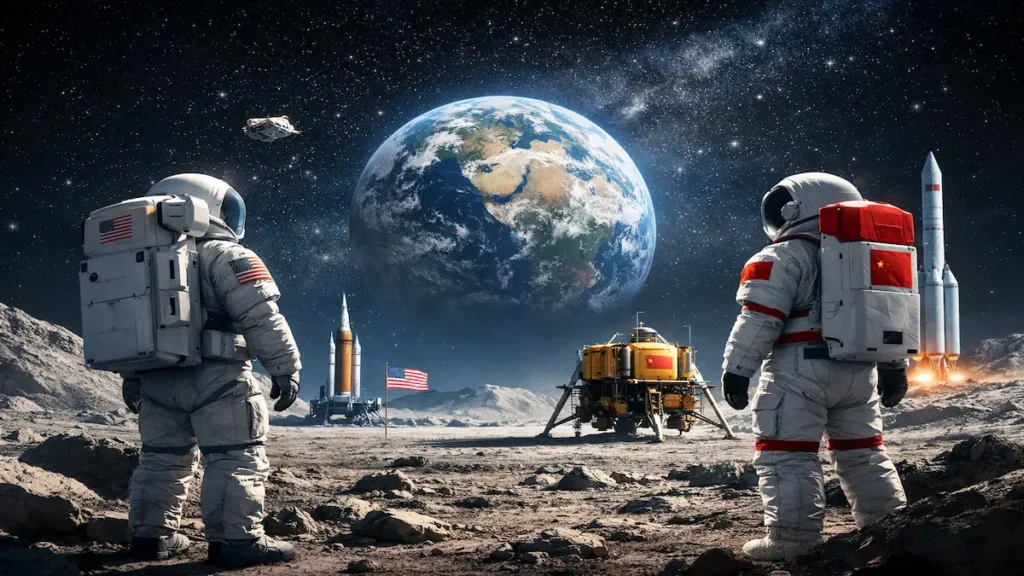
China vs. US moon race 2026 is one of the most recently searched topics. The moon gains global attention once again. After Apollo, this is the first time when two global powers are preparing to land on the moon. Both of them caught global attention. The United States already started working with NASA’s Artemis project. They want to build a long-term presence near the moon’s South Pole and bring their astronauts back to the earth. China also starts developing a heavy-lift rocket for future moon projects. This race decides future space leadership and also opens pathways to Mars.
In this article we’ll know more about the China vs. US moon race 2026 deeply, and who is actually closer to landing on the moon?
China vs. the US Moon Race 2026: Why Did the Competition Intensify?
The competition between China and the US does not begin overnight. It is the result of years of planning and technological development. NASA is moving forward with the Artemis project. NASA’s aim is to establish a long-term presence on the moon and get all the valuable information for future deep space missions. China is also preparing for its future moon missions. Both countries are planning to launch their mission before the end of this decade. This timing makes them rivals and starts a China vs. US moon race 2026.
Why the Moon Matters Again?
The moon is not just a simple destination for scientists. Both China and the United States take the moon as a first step toward Mars. Scientists use the moon as a testing ground for deep space technology, and there is a possibility of valuable sources like water or ice on the moon. China’s national space administration wants to establish a long-term lunar base on the moon, and NASA is also preparing to make a long-term presence on the moon through the Artemis project. China vs. US moon race 2026 is a major step towards modern space science. The moon is like a first step for their long journey towards deep space.
America’s Plan: Artemis Program

After decades the United States started a project called Artemis, by which the US planned to take humans to the moon and make a long presence near the moon’s South Pole. During the Apollo mission, only short exploration was done. But this time scientists focus on the long-term exploration. NASA plans to land astronauts on the south side of the moon. Scientists believe that valuable sources like water or ice are available here. NASA planned to build an infrastructure around the moon that will help in the future Mars missions.
Artemis I (2022)
Artemis I was the first mission of NASA’s Artemis project. It was an uncrewed test flight on November 16, 2022, from Florida by the space launch system (SLS) rocket to the moon, and NASA sent the Orion spacecraft around the moon. The main objective of Artemis I is to check if our modern technology works in deep space or not. They also want to check the SLS rocket and Orion spacecraft. This mission confirmed for the scientists whether astronauts can go in deep space by relying on modern technology or not.
Artemis II (first crewed mission)
After Apollo, Artemis II will be the first mission that takes astronauts to the moon. This mission is led by NASA under the Artemis project. NASA planned to send astronauts to the moon and, after their research, bring them back to earth safely. Artemis II will take four astronauts inside the Orion spacecraft. NASA selects three American astronauts and one Canadian astronaut for the mission. During the mission astronauts will not land on the moon. They will fly around the moon and test technology in deep space. Like life support systems, communication systems, crew performance, and safety. They check their surroundings and prepare for the future space mission (Artemis III). This mission will last about 10 days.
Artemis II Moon mission updates.
Artemis III
Artemis III will be the next mission under the Artemis project. In this mission NASA planned to land astronauts on the moon’s surface. Artemis III will be the first mission that actually lands astronauts on the moon after the Apollo era. During this mission, astronauts will land near the moon’s South Pole. They will explore the areas that may contain valuable sources like water or ice. NASA planned for long-term human presence on the moon in this mission. During this mission, Orion spacecraft will carry astronauts to the moon’s lunar orbit. Then the human landing system takes them to the moon’s surface. After completing their work, they will rejoin the Orion spacecraft in lunar orbit, and then they will return to the earth. The China vs. US moon race 2026 depends upon whether Artemis III stays on track for a 2026-2027 landing window.
China’s Lunar Ambition

China is one of the fastest-growing space powers in the world. China planned its long-term space strategy, and the moon is a major part of it. Space projects of China are led by the China National Space Administration (CNSA). It already completed several robotic missions to the moon. China’s lunar program is known as the Chinese Lunar Exploration Program. It is also known as the Chang’e program. According to Chinese mythology, this program was named after the goddess of the moon.
Chang’e 3
Chang’e 3 was China’s first successful moon landing mission. This mission was launched in December 2013 by the China National Space Administration (CNSA). This mission became a major step of China towards the moon. This mission carried a robotic lunar lander called Yutu (Jade Rabbit). The spacecraft landed in a region of the moon called the Mare Imbrium region.
Chang’e 4
Chang’e 4 was also a successful moon mission of China. It was launched on January 3, 2019. This mission landed softly on the far side of the moon. It was a big achievement because on the far side of the moon, the communication system does not work properly. This mission carried a lunar lander named Yutu-2 (Jade Rabbit 2). It helped to know about the geology of the moon’s far side, analyze soil and rock, and observe radiation levels.
Chang’e 5
Chang’s 5 was a big success towards space science. This mission successfully landed on the moon and collected lunar samples and brought them back to earth. It was launched in November 2020. This mission became a major achievement because after Chang’e 5, China became the third country in history, after the United States and the former Soviet Union, to get lunar samples back to the earth. The main goal of Chang’e 5 was to land on the moon and collects the rock and soil and brings them safely to the earth.
China plans for a moon landing mission that contains astronauts before 2030. In the China vs. US moon race 2026, the US timeline appears slightly faster than China’s, but the rapid development of both countries caught global attention.
Rocket Power Comparison of US and China
United States
NASA has a space launch system (SLS). It is currently the most powerful rocket in the world. It successfully launched Artemis I, and now it is being prepared for future space missions like Artemis II. This rocket produces about 8.8 million pounds of thrust at launch.
China
China is working on Long March 10. It is China’s next-generation heavy rocket. It is specially designed for crewed missions to the moon. This rocket will play an important role in the future moon landing mission. This rocket is being developed to launch lunar landers, send Chinese astronauts to the moon, and support a long-term presence on the moon. The US is currently working on the heavy rocket, so in the China vs. US moon race 2026, the US has a technical advantage, at least for now.
Why Is the Moon’s South Pole Important?
China and the US, both countries, are targeting the moon’s South Pole. Scientists believe the moon’s South Pole is one of the best regions for future landings. It is because some craters of the South Pole never confront sunlight. So these are extremely cold. Scientists believe water in the form of ice may be trapped in these craters. If scientists found water on the moon, then it will be easier to make a longer human presence on the moon. Water can help us in various ways, like it is used for drinking, it is used to make oxygen, and we can split it into hydrogen and oxygen to make rocket fuel.
Another reason is some craters of the South Pole are very old. It is possible that they contain some material from the ancient solar system. If scientists found these materials, they could get the information of ancient times. Like how the moon was formed, how the earth formed, or how universal laws worked in ancient times?
The competition over the strategic landing zones is also a part of the China vs. US moon race 2026.
Final Thought
China vs. US moon race 2026 caught global attention. Both countries are trying to launch their missions to the moon. Whoever landed first becomes the winner. China vs. US moon race 2026 decides the space leadership and also opens paths for Mars. Both countries are investing billions of dollars for their future moon missions. These missions could shape the future of human exploration. Currently NASA ahead from china because NASA already tests Space Launch System and successfully completed Artemis I mission. But we should not underestimate China because its robotic missions have great success.
Whether the United States lands first or China does, one thing is clear: humanity is returning to the moon, and this time not only one country will make its move while two countries are preparing to land on the moon’s South Pole.
Pingback: Asteroid 2029 Earth Flyby: How Close Will This Giant Space Rock Come to Earth in 2029?
Pingback: How Modern Technology Is Making Wars More Dangerous today – What’s Really Happening Right Now - Science Scope Hub