
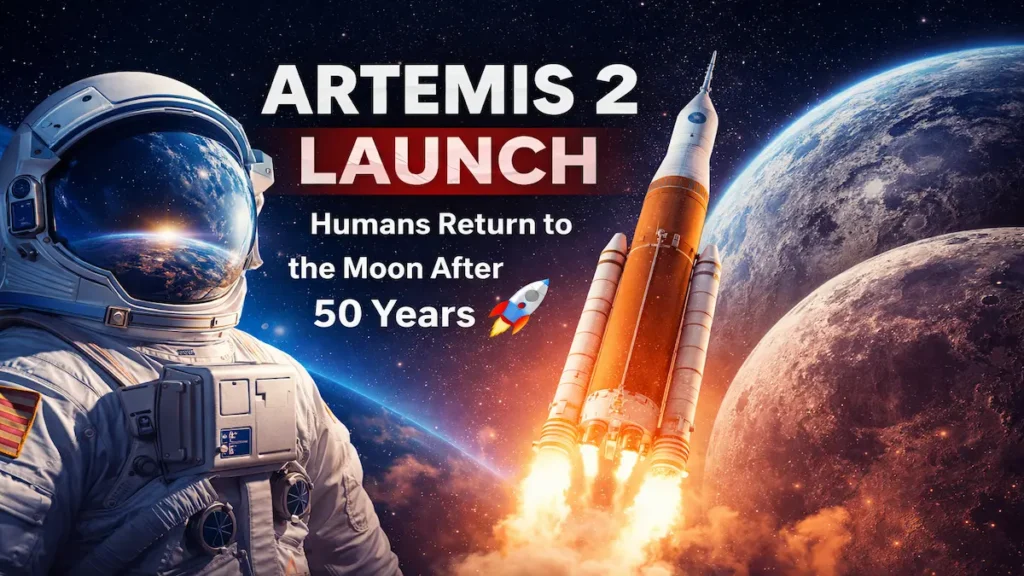
The Artemis 2 launch is one of the most important space missions of this year. After more than 50 years, NASA is finally preparing to send astronauts with Artemis 2 towards the moon again. NASA waited about half a decade to explore the moon again. Artemis 2 launch is not just an ordinary space mission; it is the beginning of a new era for space exploration. This mission is very important for future space missions like Artemis 3, Mars missions, etc.
NASA has already announced many updates related to the Artemis 2 launch. This mission is now in its final stage of preparation to launch. NASA confirms many important updates, like the date of launch, the names of the crew members, all the goals of the mission, and why Artemis 2’s launch is delayed. Now let’s discuss all about this mission deeply below.
Artemis 2 Launch Date
NASA has officially announced the Artemis 2 launch date. It is targeted for April 2026. NASA has planned multiple dates for launch as backup. It is because if anything goes wrong during the launch, like some technical glitches, safety issues, or bad weather conditions, the mission gets delayed. So these dates are like backup dates. NASA’s primary target is April 1, 2026. Other targeting windows for the Artemis 2 launch are:
- April 2, 2026, at 7:22 PM
- April 3, 2026, at 8:00PM
- April 4, 2026, at 8:53 PM
- April 5, 2026, at 9:40PM
- April 6, 2026, at 10:36 PM
The most powerful rocket space launch system (SLS) has already moved to the launch pads. The crew members have already arrived at the Kennedy Space Center in Florida (launch site) to begin their final preparations.
Artemis 2 Crew Members
NASA has officially announced that the Artemis 2 mission takes four astronauts to the moon and then back to earth safely. Three of them are from America, and one is from Canada.
Reid Wiseman
Reid Wiseman is the commander of the Artemis 2 crew and responsible for leading the crew and ensuring the overall success of the mission. He is a former U.S. Navy test pilot. He gained experience working in the International Space Station for about 165 days.
Victor Glover
Victor Glover is the pilot of the Artemis 2 mission. He is playing a major role in navigating and operating the Orion spacecraft. He is also from America and previously flew on the SpaceX Crew-1 mission to the International Space Station.
Christina Koch
Christina Koch is a mission specialist in Artemis 2. She is an electrical engineer. She is from America and holds a record for the longest single spaceflight by a woman. She spent about 328 days in space.
Jeremy Hansen
Jeremy Hansen is also working as a mission specialist in Artemis 2. He is a Canadian astronaut from the Canadian space agency. He is a former fighter pilot, and the Artemis 2 launch will become the first space trip for Jeremy Hansen.
During the Artemis 2 launch, the following records will be established.
- During this mission Christina Koch will become the first woman to travel near the moon.
- Victor Glover will become the first Black astronaut to fly around the moon.
- Jeremy Hansen will become the first non-American astronaut to travel beyond low Earth orbit.
why SpaceX is launching starlink satellites to polar orbit
What Will Happen During Artemis 2 Launch?
Everything was already planned for the launch, and it will follow a carefully planned mission sequence.
- The Artemis 2 mission will launch from the Kennedy Space Center.
- The rocket passes the thick atmosphere, and its speed increases to thousands of km/h.
- After about 2 minutes the solid rocket boosters detach, and then the main rocket continues its journey to the moon.
- After 8 minutes, the main core separates from the spacecraft.
- All crew members go inside the Orion spacecraft. And then the spacecraft enters the trajectory towards the moon.
- Spacecraft will fly around the moon, and after the research it will return back to earth safely.
- NASA estimated that the Artemis 2 mission will last around 10 days.
Why Artemis 2 launch was delayed
The Artemis 2 launch is delayed due to some technical issues. When the scientists were performing the wet dress rehearsal, liquid hydrogen leaked. In this test rocket is completely filled with fuel. But during the test, they detect leakage of liquid hydrogen as fuel. This leakage exceeds safety limits. NASA officially announced this leakage happened during a test. That’s why Artemis 2 is getting delayed. Some additional safety checks and bad weather are also the reason for the delay. NASA delayed this mission to ensure the safety of the astronauts.
Space Launch System (SLS): The Rocket Powering This Mission
The Space Launch System (SLS) is the most powerful rocket ever built by NASA. It is designed to carry astronauts beyond low Earth orbit and bring them back safely to Earth. This rocket is built for deep space missions, including Artemis and future Mars missions.
Comparison of the SLS rocket with the Saturn V rocket. The Saturn V rocket was used in the Apollo mission.
- SLS produces more thrust than the Saturn V rocket.
- The SLS rocket produces around 8.8 million pounds of thrust at liftoff.
- The SLS rocket is capable of carrying heavy payloads, including the Orion spacecraft.
Orion Spacecraft: NASA’s Deep Space Vehicle
The Orion spacecraft is not just an ordinary space capsule. It is the NSA’s next-generation space vehicle that is designed to carry astronauts in deep space. The Orion spacecraft is a highly advanced system that protects astronauts from any harsh situation in deep space. The Orion spacecraft can carry astronauts from Earth to deep space and bring them back to Earth safely. This spacecraft is very useful for long-duration missions in deep space.
Conclusion
The Artemis 2 launch is a very important mission of 2026. Global eyes are on this mission. The launch date was also confirmed. NASA targets April 2026 for the Artemis 2 launch. Now NASA is ready with advanced technology and astronauts to move towards the moon in deep space. The Artemis 2 mission will play an important role in the future landings on the moon. This is the first time they check their system with the astronauts around the moon. Artemis 2 tests the Orion spacecraft’s navigation, communication, and life support system in deep space. The Artemis 2 mission will not land on the moon’s surface. It only flies around the moon and then comes back to earth. It is only a flyby mission that is designed to check the systems and the crew performance. Its closest distance to the moon will be approximately 4600 miles.
Pingback: What happens when Artemis 2 astronauts lose contact with Earth? - Science Scope Hub
Pingback: What Will Artemis 2 Astronauts See In Deep Space? Views Humans Haven’t Seen In 50 Years
Pingback: Unexpected Problems In The Artemis 2 Mission: The Hidden Challenges Of Space Travel - Science Scope Hub
Pingback: What Will Astronauts See Near The Moon? The Shocking Reality Of The Artemis 2 Mission
Pingback: Artemis 2 Splashdown Time Revealed: Exact Return Window, Date & Shocking Re-Entry Details
Pingback: What Happened To Artemis 2 Astronauts After Splashdown? The Shocking Recovery Process