
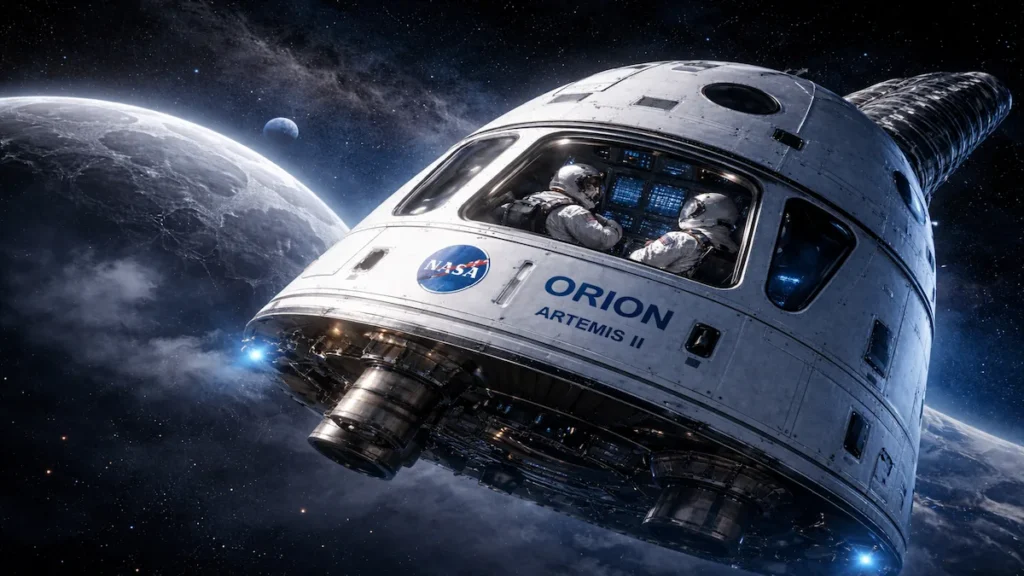
Artemis 2 astronauts experience inside Orion spacecraft is one of the most extraordinary experiences among all the space exploration journeys. After 50 years, this is the first time when NASA is sending astronauts towards the moon in deep space with Artemis 2 mission. During this mission Astronauts will have to face such conditions that very few people have ever felt.
In this article you’ll know, how an astronaut feels when he actually sits inside the Orion spacecraft during the launch. What an astronaut feels while floating in zero gravity and travel into deep space, where earth is just like a distant dot. This mission is not only reaching the moon, it is also like a testing mission that analyze what difficulties does an astronaut go through physically and mentally inside Orion spacecraft built for deep space explorations.
The Moment Of Liftoff: Intense Power And G-Forces

Artemis 2 astronauts experience inside Orion spacecraft begins from the SLS rocket liftoff. As the countdown becomes zero, SLS rocket ignites its engine, the rocket produces upward thrust and it begins to rise from the launch pad. Astronauts inside the Orion spacecraft, suddenly feel strong vibrations and an intense force that push them back into their seats. This is where G-force comes into action. “The acceleration acting on the body is called G-force.” G-force measures the acceleration experienced by a body, it is not a force itself. It only causing a body feels heavier or lighter during high speed turns or rocket launches.
During liftoff astronaut starts feeling a force around 3-4 times of earth’s gravity. It means their body becomes 3-4 times heavier than normal. In this situation even making simple movement is very difficult. Force goes constantly as the rocket goes higher. They feel enormous amount of pressure in their chest, making their breathing heavier. But astronauts are highly trained for such conditions and they also have special suits designed to support their bodies in such critical phase.
What happens when Artemis 2 astronauts lose contact with earth?
Entering Space: The First Feeling of Weightlessness

During whole journey astronauts feel very strong vibrations and intense force but once the rocket entered in space, the engine shuts down then astronauts suddenly feels very light and complete different phase i.e. weightlessness almost a magical shift. In scientific terms, this feeling of weightlessness experienced by astronauts is called microgravity. This happens because the spacecraft and everything present inside it, is continuously in the state of free fall around the earth, which creates microgravity. At this situation every object inside the Orion spacecraft including astronauts begins to float. Their bodies are no longer relying on gravity; even making small movements are completely different. In spacecraft even water floats as droplets and moving requires gentle push. But astronauts start adapting their surroundings very soon. It is another Artemis 2 astronauts experience inside Orion spacecraft.
Life Inside Orion Spacecraft
Artemis 2 astronauts experience inside Orion spacecraft is very difficult than anything we experience in earth. Astronauts live and work in a small highly advanced space capsule while travelling thousands of kilometers in space. There are no large rooms inside the Orion spacecraft; four astronauts share a small cabin. Everything is present within arm’s reach in spacecraft that helps astronauts to operate easily even in microgravity. Astronauts float inside the spacecraft instead of walking. They use packed food so it does not float away and they handle food very carefully while eating to avoid floating particles. Astronauts use Velcro and straps to secure the objects inside the spacecraft.
Sleeping in spacecraft is another obstacle; there are no sleeping beds inside the Orion spacecraft. Astronauts use sleeping bags attached with the wall. These attached bags secure them from drifting away while they rest. Orion spacecraft have highly life support system that maintains oxygen level and remove carbon dioxide from the capsule. It also maintains the pressure and control temperature. Astronauts use digital screen and manual controls to operate the spacecraft during the mission.
Traveling Toward the Moon: A New Perspective
As the Orion spacecraft leaves the earth and begins its journey towards the moon, Artemis 2 astronauts experience inside Orion spacecraft becomes emotional. As the spacecraft travels in deep space, the distance from the earth increase and it becomes smaller from a large blue world floating in deep space. Astronauts will surrounded by complete darkness and moon start appearing larger and more detailed.
The distance between earth and moon is about 384000 kilometers. This journey makes us realize the vastness and emptiness of the space. Seeing earth from such distance is very powerful emotion for many astronauts. This journey often changes how astronauts think about our planet; earth is very small and fragile as compare to the universe.
Deep space silence: A unique experience
Deep space silence is truly rare Artemis 2 astronauts experience inside Orion spacecraft during this journey. It is not like the absence of every day noise, but it’s something else. Space has no environment to carry any sound so there is no familiar background activity.
Unlike the earth, space has no medium like air to transmit the vibrations. There is complete silence outside the spacecraft. Inside the Orion spacecraft, astronauts can still hear some airflow or their own movements but still environment feel very calm and isolated as compare to earth. This environment feels very peaceful but also deeply isolated. This silent environment make astronauts realize that how far they come from home and depend on the spacecraft for their life.
Re-Entry: The Most Dangerous Phase
Re-entry is considered one of the most dangerous Artemis 2 astronauts experience inside Orion spacecraft. After completing the mission spacecraft must return to the earth. While returning the speed of spacecraft is incredibly fast, it involves intense heat, extreme forces and also a little bit error.
When the Orion spacecraft will enter the earth’s atmosphere, it speed is about 40000 km/h. at this speed intense heat produces and temperature can rise around 2700°C (4900°F). This temperature is enough to melt any material but Orion spacecraft have very advance heat shield, it helps to absorb and deflect heat and keep astronauts safe inside the spacecraft.
While returning G-force start acting on the body once again. But this time G-force is much stronger than before during liftoff. Another difficulty is communication blackout. Due to intense heat a layer of super-heated plasma forms around the Orion spacecraft that blocks the radio signal for some time. In the final step, the spacecraft parachute will open and help to reduce the speed and lastly it splash in the ocean. This is what we called a safe journey to space exploration.
Conclusion
The Artemis 2 astronauts experience inside Orion spacecraft in the journey is not compare with any human experience in earth. This journey is full of mysteries, challenges and emotions. These experience starts from liftoff and last till the Orion spacecraft returns to the earth. Every moment of this journey is full of excitement and new experience. This mission is not just about reaching the moon, it is about to test the human technical systems that are developed for deep space and human, how they react, live and work in deep space. This testing is very important for the future deep space missions like Artemis 3 and Mars mission. In future Artemis 2 astronauts experience inside Orion spacecraft will beneficial for future missions.
Pingback: What happens when Artemis 2 astronauts lose contact with Earth? - Science Scope Hub
Pingback: Unexpected Problems In The Artemis 2 Mission: The Hidden Challenges Of Space Travel - Science Scope Hub