
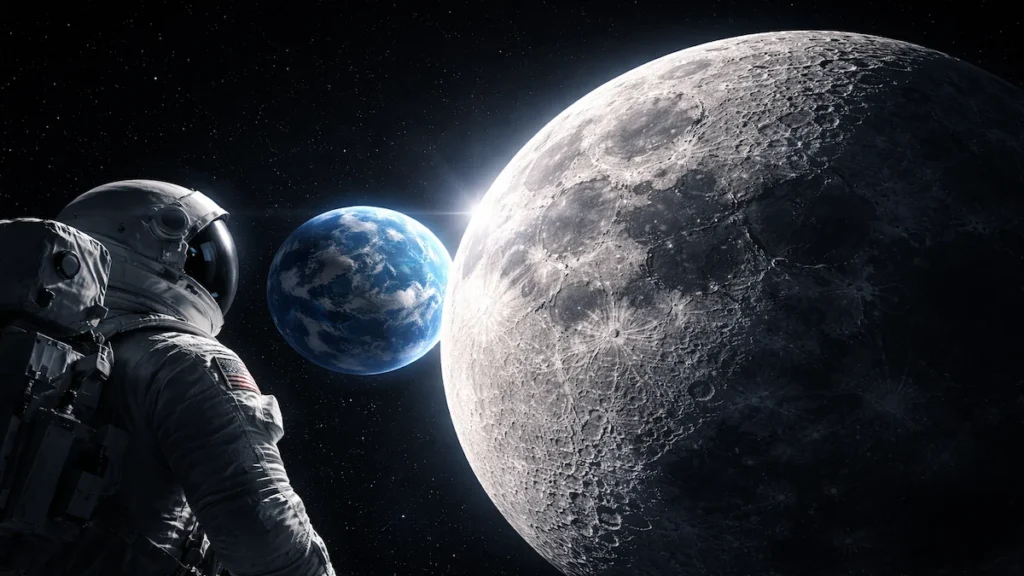
“What will astronauts see near the moon?” is a very interesting topic. During the Artemis 2 moon mission, astronauts witness far beyond beautiful and mysterious views. It feels very exciting to see a completely different and extreme environment of another celestial body in space. As humans were preparing for a long time to travel back to the moon, many people imagined the atmosphere, but reality is too complex. So, during the Artemis 2 moon mission, people are very curious to find, “What will astronauts see near the moon?”
In this article, we’ll discuss all about the hidden dangers, unusual conditions, and the scientific surprises that reveal the mysterious environment of the moon.
The Hidden Side Of The Moon: A Completely Different World
As the Orion spacecraft travels around the moon during the Artemis 2 mission, astronauts will witness the far side of the moon, which is also called the dark side. The far side is never directly seen from the earth. The moon is tidally locked, meaning the same side always faces our planet. This side remained hidden from the direct human view. That’s why it is far more mysterious and important for our research purpose. The far side contains rough and heavily cratered terrains with very few smooth plains. This gives a more rugged and chaotic appearance, just like a new world. This is the most exciting part of the question: “What will astronauts see near the moon?”

The far side of the moon contains a higher number of impact craters compared to the visible side. Scars from billions of years ago, when asteroids impacted, are also clearly visible. It has massive craters and an uneven landscape that tells the violent history of the moon. Another major aspect of the far side is communication blackout. Radio signal blackout is another fascinating part of “What will astronauts see near the moon?”
What happen when Artemis astronauts lose contact with earth?
As the Orion spacecraft travels behind the moon and reaches the far side, communication with Earth is lost temporarily. This creates a natural “radio silence zone.” It happens because the moon blocks all the radio waves coming from the earth, which are responsible for communication. These radio signals are not able to pass through solid objects like the moon. When the Orion spacecraft reaches the far side, the whole moon acts as a large barrier for radio signals. As a result, astronauts lose their connection with Earth. Without any communication, the far side becomes the quietest and dangerous place for the astronauts. Now scientists are interested in setting up a new radio telescope on this far side of the moon. This telescope can detect all the signals coming from the early universe without any interference.
It is a very unique experience for astronauts to explore unfamiliar patterns, unrecognizable shapes, and untouched surfaces that feel distant and mysterious. Scientists believe that the far side of the moon holds very important clues about the moon’s formation and the ancient history of the solar system.
Lunar Dust: A Small Detail With Big Danger

Lunar dust may look harmless from a distance, but it is the most dangerous for the Orion spacecraft, equipment, and astronauts also. Lunar dust, a grey material, can become a serious problem for the mission. This dust is very sharp and abrasive as compared to earth. Because the moon has no atmosphere, its particles are not worn down over time. These particles remained jagged and irregular in shape. Lunar dust can stick to the boots, suits, or equipment of astronauts while they move around the lunar surface.
During the Apollo mission, astronauts reported that lunar dust stuck to their spacesuits, entered the spacecraft, and also caused discomfort while breathing. Lunar dust is also a danger for technology and equipment. It can damage or scratch the surface of the devices and create problems with mechanical systems. Lunar dust is a kind of challenge faced by the astronauts during the Artemis 2 moon mission. This is another fascinating part of “What will astronauts see near the moon?”
Extreme temperature that can shock you
Unlike the earth, space and the moon provide extreme temperatures to the astronauts. Thermal control is one of the biggest challenges in front of scientists during moon missions like Artemis 2. Inside the Orion spacecraft, astronauts are safe, but outside the temperature is beyond tolerance.
In the presence of the sunlight, the moon’s surface temperature can rise up to +120°C, and during the complete darkness, the temperature drops up to -170°C. This is an extreme temperature for humans. Because we never experience this type of temperature on earth. There is almost a 300°C difference in the temperature of day and night on the moon. It happens because the moon has no atmosphere to trap the heat or distribute it evenly. This extreme contrast happens very quickly and creates problems for both astronauts and spacecraft.
To handle this kind of temperature, scientists installed a thermal control system in the Orion spacecraft. These systems help to maintain the temperature inside the Orion spacecraft. It reflects excess heat and distributes warmth where needed. Spacesuits are designed to protect astronauts from the extreme temperature of the moon. These challenges are also the part of “what will astronauts see near the moon?”
Radiation Exposure: A Serious Risk In Deep Space
This is another challenge for astronauts during the Artemis 2 moon mission. It is like an invisible threat, space radiation. Inside the Orion spacecraft, astronauts are partially safe, but deep space is far more dangerous when it comes to radiation. In our earth, the atmosphere and the magnetic field protect us. These layers deflect or block most of the harmful radiations coming from space. But in space or near the moon this protection is absent. This is a major part of “what will astronauts see near the moon?”
Astronauts are exposed to two main types of radiations in space.
1. Solar Radiation
These radiations are emitted by the sun. They include high-energy particles released during solar flares. There is a high chance to increase suddenly during the solar storm.
2. Galactic Cosmic Rays
These radiations are high-energy particles that originated from outside the solar system, like from supernova explosions. These radiations are constantly present in deep space.
These radiations are considered very dangerous because they can pass through the human body and damage their cells. They affect the human body in the following ways: increase the risk of cancer, damage to DNA, effects on the brain and nervous system, and short-term sickness in extreme exposure. That’s why NASA uses multiple methods to protect astronauts from space radiation. These dangers are also considered as the answer to “What will astronauts see near the moon?”
Conclusion
In this article, I describe the most appropriate answer to “What will astronauts see near the moon?” It is far more than just a close-up view of its surface. It includes the hidden dangers, scientific discoveries, and extreme conditions that reveal the true nature of the space. These extreme conditions will help to test the human limits and the technical systems developed by scientists for future deep space missions like Artemis 3 and the Mars mission.
From mysterious sights to the silence of space, from dangerous dust to intense radiation, every detail increases your understanding of the universe. This mission, Artemis 2, is not just a mission to reach the moon; it is just a step of the new era toward finding the hidden secrets of deep space and preparing humanity for what lies ahead.