
Artemis 2 astronauts after splashdown—it sounds like the end of the mission, right? But in reality, it’s where the interesting part begins. Now the question is what happens to Artemis astronauts after the splashdown.
When the Orion spacecraft finally touches the ocean water, many people feel relaxed or celebrate this moment, and that is right. But the strange thing is that the bodies of astronauts are not ready for the earth after the long journey of space exploration. Reid Wiseman, Victor Glover, Christina Koch, and Jeremy Hansen, all four astronauts of Artemis 2, also faced problems in readapting to the earth’s environment. Earth’s gravity hits their bodies differently, and they don’t even balance their bodies properly.
So let’s go step by step to analyze properly what happens to Artemis 2 astronauts after splashdown.
The First Few Minutes: Controlled Chaos on the Ocean
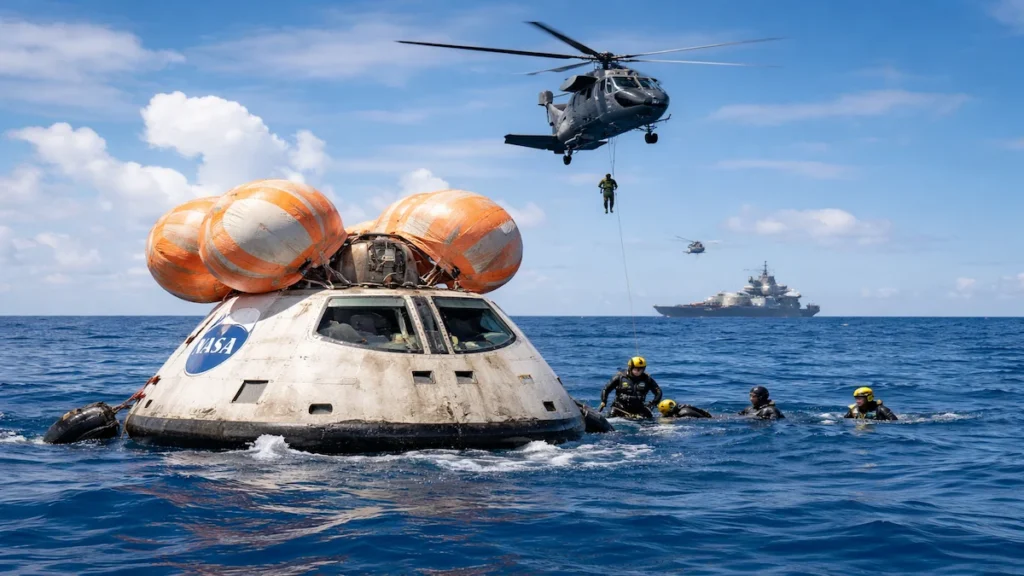
The moment when the Orion spacecraft touches the ocean water, it feels like the end of the mission, but it is also the starting of a phase that feels like controlled chaos. Scientists planned this whole splashdown phase very carefully. As the Orion spacecraft lands on the water, there is a strong but controlled impact. The first spacecraft may bounce, and then it settles down; it maintains its balance and starts floating on the water. Inside the capsule astronauts suddenly feel the transition from high speed to complete stop. After many days in microgravity, astronauts feel heavy in Earth’s gravity. But the crew remains calm and follows the post-landing procedures.
At the same time, the Orion spacecraft’s automatic systems are activated, and it ensures a stable position. It also uses its built-in mechanism to correct its orientation and balance to stay upright in the water if needed. The communication system is also connected fully to confirm a successful landing. Recovery teams reach immediately to the landing zone. Helicopters and ships quickly positioned in the area to move towards the Orion spacecraft. Divers jumped into the ocean to check whether all the systems are working properly or not. They check the stability of the spacecraft and leakage or damage on the spacecraft. Everything happens in a particular manner, but many teams are working at once, so it can look fast and intense. This phase is called “controlled chaos” because everything may appear busy and unpredictable. Every action is pre-planned by the scientists very carefully.
What happen if astronauts lost contact with earth during the mission?
Opening The Capsule: The First Human Contact

For Artemis 2 astronauts after splashdown, this phase is very emotional in the entire process. Because the astronauts finally see Earth up close again after spending several days in space inside the Orion spacecraft.
Before the hatch is opened, the divers and engineers first examine the spacecraft from outside properly. Once everything is confirmed safe, then they move towards the hatch. There is no rush in opening the hatch. Pressure levels inside the Orion spacecraft are checked and made sure the environment is stabilized to ensure no sudden changes that could affect the astronauts inside the Orion spacecraft. After checking all the safety measures, the hatch slowly opened. This moment is the first direct human contact with the Artemis 2 astronauts after the long journey of space exploration. Everyone present outside greets them, and this moment is very emotional for Artemis 2 astronauts after splashdown.
Astronauts do not immediately rush outside the spacecraft after spending several days in space. Their bodies need some time to readjust to the earth’s environment. Medical teams are also present for initial health checkups right at the spacecraft. After some time, astronauts are assisted out one by one when they feel stable and comfortable.
Why Astronauts Don’t Walk Immediately Just After the Mission
As you all know, after the Artemis 2 mission, astronauts do not walk immediately, and this is completely normal. When you see astronauts, they look fine from outside, but their bodies have gone through significant changes during the space journey.
The main reason is microgravity adaptation. In space, there is no gravity; astronauts live in a weightless environment. They don’t use their muscles and bones like in the earth. Over time, muscles used for standing and walking become weaker. After spending several days in space, when astronauts return to Earth’s gravity, their muscles have already gotten weakened, so they are not immediately ready to support their full weight. This is another challenge for Artemis 2 astronauts after splashdown.
The inner ear and balance system is also another major factor. On earth humans’ balance depends on gravity, but space has no gravity. So astronauts’ balance systems adapt to the environment of microgravity during the mission. So when the astronauts come back to the earth, their brains need some time to readjust according to the earth’s gravity. That’s why astronauts feel dizziness and difficulty in standing properly. Artemis 2 astronauts after splashdown have to face these problems in Earth’s environment for some time.
Fluid shift may also be another reason. In space, fluids of the body move towards the upper body or head. But when astronauts return to earth’s gravity, these body fluids shift back down. This causes a temporary effect in blood pressure and also makes astronauts feel lightheaded when they try to stand or walk. These are some major factors why Artemis 2 astronauts don’t walk immediately after the mission.
Immediate Medical Checks: No Time To Wait

The moment astronauts exit the Orion spacecraft; medical teams start their health checkup without any delay. This is a critical phase for Artemis 2 astronauts after splashdown. Astronauts return from the extreme environment in several days; their blood circulation, balance, muscle strength, and heart rate also get affected in microgravity. After the Artemis 2 astronauts’ splashdown, there is no delay, no celebration; health comes first. The medical teams are already on standby in the recovery site, and the doctors are ready to check astronauts after they come out of the spacecraft. Doctors quickly check oxygen level, neurological response, heart rate, and blood pressure. Doctors are not just checking the astronauts’ bodies; they also collect valuable information about how the human body reacts to space travel. Always keep in your mind, “Every mission teaches you something.”
Moving To The Recovery Ships: A Floating Hospital
Artemis 2 astronauts after splashdown take the exit first from the space capsule safely, and then they step into a critical phase of medical checkups. In this phase, recovery teams transport them to the recovery ships, often described as a floating hospital. Astronauts are not able to perform stable movement; their bodies are still adjusting to Earth’s gravity. Astronauts are transported to the large ship operated by the U.S. Navy, which is already positioned in the recovery site. This ship is fully equipped with medical facilities. Here astronauts get proper hydration. They eat their first fresh meal on the ship, and they rest in a controlled environment.
How Long Until They Feel Normal Again?
Artemis 2 astronauts after splashdown don’t feel normal immediately. They need some time to readjust according to the earth’s environment. But here is the question: exactly how much time did they need to restore themselves?
These effects do not go suddenly; some effects disappear in a few hours, others take some days, and full recovery can take weeks. After some days to a week, the body constantly recovers. Muscle power starts to recover, and the inner ear system slowly readjusts to the earth’s gravity. Astronauts can recover faster in short missions like Artemis 2 (10 days) as compared to long-duration space missions.
Astronauts also join some special trainings and recovery programs to rebuild their muscle power and body endurance and to maintain their body balance. Astronauts’ bodies do not readjust instantly; it’s a whole process.
Conclusion
So, did you get what really happens to Artemis 2 astronauts after splashdown?
It’s not as simple as you think. It’s a complex and intense human process. Artemis 2 astronauts after splashdown are struggling to walk, and then slowly they regain some strength and adjust their balance according to the earth’s environment. To reestablish their bodies in earth’s surroundings is a whole process that takes weeks; it’s not that easy to readjust in a few hours. That’s why we can say that “coming back to earth is sometimes harder than leaving it.”