
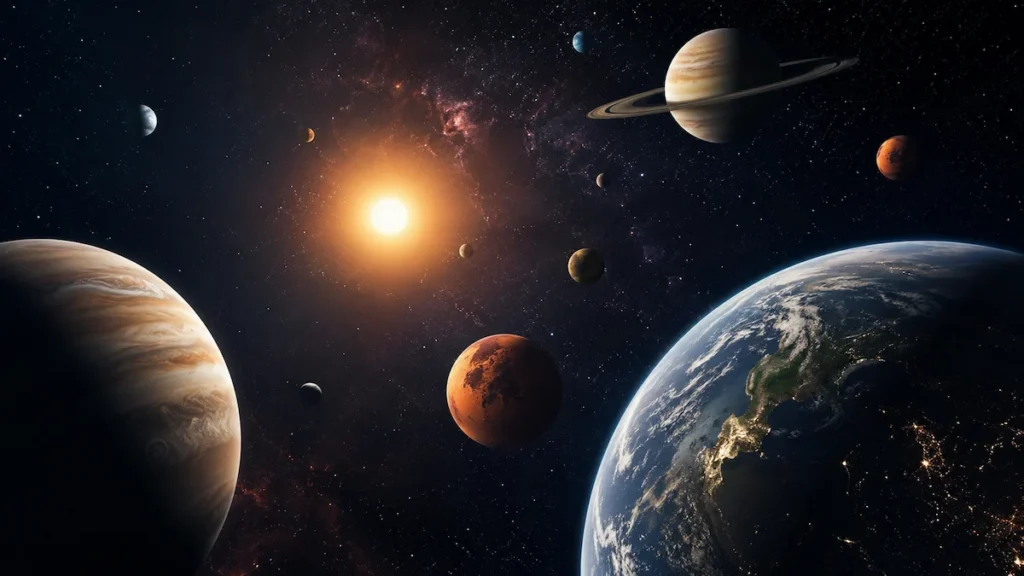
NASA exoplanet discoveries now change the ways we look at our universe. Earlier, when our technology was not enough to look out of our solar system, scientists did not know whether any other planet existed outside. But today, NASA has confirmed the existence of thousands of exoplanets outside of our solar system. Many scientists believe that we only discovered a tiny fraction of what is really out there. Jupiter is the largest planet of our solar system, with a diameter of about 142,984 km at its equator. But scientists have found some of the distant worlds that are even larger than Jupiter, and some planets are rocky planets that may look like Earth. They also found some planets that are revolving around their stars in a region where liquid water exists. Because of these discoveries, some scientists believe that our galaxy, the Milky Way, contains billions of undiscovered hidden worlds with lots of mysteries.
How Did NASA Exoplanet Discoveries Start?
The first major discovery in modern planet hunting happened in the 1990s. Before that, the idea of exoplanets was only theoretical. It was the beginning of a new era in space science when scientists confirmed exoplanets orbiting distant stars outside of our solar system. Since then, NASA exoplanet discoveries have accelerated rapidly. It all happened because of advanced telescopes and modern detection techniques. Scientists found thousands of new hidden worlds across our galaxy with the help of missions like the Kepler Space Telescope and the Transiting Exoplanet Survey Satellite. The Kepler mission alone helps scientists to find out that planets are more common than they think. Planets are not rare; they exist around many stars in our galaxy. After NASA’s confirmation about exoplanets, everyone looked up at the sky and thought for every bright star that it may have its own solar system of hidden worlds, and from here, the idea of aliens increased.
Space tugs could become most important part for future space mission.
The Strange Worlds NASA Has Already Found

NASA exoplanet discoveries contain some of the strangest hidden worlds that seem impossible to exist or like science fiction. Many years of research have led scientists to find planets with hot-burning surfaces, intense-crushing atmospheres, violent storms, and unusual orbital patterns that completely change our imagination towards planetary systems. These discoveries force scientists to think the universe may far more diverse than anyone once imagined.
55 Cancri e – The Hellish Lava World
55 Cancri e is one of the most famous NASA exoplanet discoveries. This world is located around 41 light years away from the earth. This planet’s orbit is very close to its parent star. It only takes 18 hours to complete its one revolution. So a single year on this planet lasts only about 18 hours. It is very close to its parent star, so the surface temperature here may exceed 2000°C (3600°C). Scientists believe that most of the surface of this planet is covered with molten lava. Scientists also observe through the NASA space telescope that its surface may constantly shift due to the volcanic activity and heat. 55 Cancri e remains one of the strangest planets ever found.
HD 189733 b – The Planet with Glass Rain
HD 189733 is another strange hidden world found by scientists. It is a deep blue planet that is located about 64 light-years away from the earth. This planet looks very beautiful, but it is one of the most destructive planets ever found. It has a very intense atmosphere. Scientists believe the speed of wind here is about 5000 miles per hour, and the atmosphere contains silicate particles that could form sideways glass rains during the violent storm. This planet is a perfect combination of beauty and danger.
WASP-12b – A Planet Being Destroyed
WASP-12b is another extreme part of NASA exoplanet discoveries. This giant planet orbits its star very closely. The star’s gravity pulls it very strongly. Scientists believe this planet has stretched and become like an eggshell someday due to intense gravity. Its atmosphere is very strange. Instead of reflecting the light in space, it absorbs most of the visible light, so it becomes extremely dark. Scientists think WASP-12b will be completely absorbed by its star someday.
TOI-700 d – A Possible Earth-Like Planet
Not every NASA exoplanet discoveries are terrifying. Scientists think some of them could possibly support life. TOI-700 is an earth-sized planet that is located in the habitable zone of its parent star. Scientists believe water in liquid form may exist here under the right temperature. Scientists discovered this planet under NASA’s Transiting Exoplanet Survey Satellite mission. Scientists have not yet found any solid evidence that suggests any sign of life here.
Kepler-16b – The Real-Life Tatooine Planet
It is one of the unimaginable NASA exoplanet discoveries. Instead of orbiting one star like our earth does, Kepler-16b orbits two stars, just like a fictional planet, Tatooine, from the Star Wars movie. Two suns would appear at sunrise and sunset in this planet’s sky. Kepler-12b proves that a planet can survive around two stars that scientists thought impossible earlier.
These are some NASA exoplanet discoveries that completely change the thinking of scientists towards planetary systems. These exoplanets help scientists to understand how our universe is vast and unimaginable. Before these discoveries, scientists assumed that our solar system is normal. But today researchers know that some planets could exist with lava oceans, metal clouds, giant storms, two stars, and very intense and crushing atmospheres. Every exoplanet discovery adds some new detail about how planets form and whether life could exist somewhere else in our universe. Scientists still may believe that millions or billions of planets in our galaxy are waiting to be discovered.
How NASA Finds Hidden Worlds With Possibility of Alien Life
Most of the people reading this article thought finding a new planet in space is simple, as seen directly by large telescopes, but the reality is too complex. These planets are too far from the earth. Scientists could not see them directly from the telescope or take their pictures. Most NASA exoplanet discoveries happen indirectly. Scientists study stars instead of a planet. When a planet comes in front of the stars, according to the earth’s view, a tiny drop in its brightness occurs. Then scientists study this small signal very closely. After studying for many years, they reached a conclusion. Studying this drop in brightness, scientists can reveal the planet’s size, its orbital period, and some atmospheric details, and sometimes it may reveal some details of temperature. NASA also uses their computer model and artificial intelligence to analyze a huge amount of data. That’s why NASA exoplanet discoveries are constantly growing every year.
Conclusion
NASA exoplanet discoveries are now revealing more hidden planets with the possibility of alien life. It also reveals a strange planetary system that one cannot even imagine. With our modern technology and advanced telescope, NASA exoplanet discoveries grow day by day and take us closer to finding our answer to all-time humanity’s question, “Are we alone?”
Today we have already discovered thousands of unknown hidden worlds in the darkness. But based on scientists’ confirmation, millions more unknown worlds are still hidden around the stars. To get more space-based articles, stay connected with Space Science Hub.
Pingback: Alien Planet Weather May Include Mornings and Clear Evenings, Webb Telescope Finds
Pingback: Earth Rotation Speed Is Slowing Down – And Humans Are the Reason, New Study Reveals