
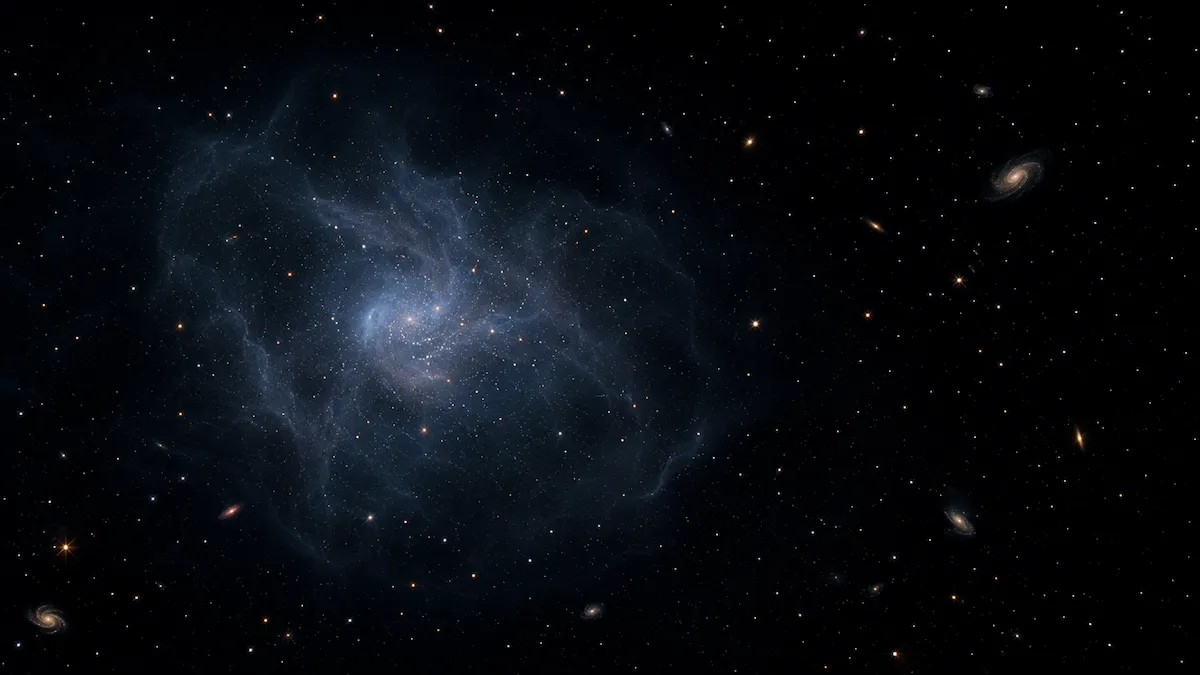
What are dark galaxies? It sounds like unreal story. A galaxy that you can’t see. But the dark galaxies are real. Recently NASA’s Hubble telescope has provided some more evidence that these mysterious galaxies exist. The discovery of dark galaxy is very important because it challenges some of scientist’s ideas about how galaxies are form and evolve.
Earlier scientists thought that most galaxies have millions of stars. But dark galaxies suggest that some of them do not form many stars and left dark and invisible. In 2026, scientists have found more of them ever before. Let’s dive into what they are, why they exist and why they are very important for space science. By reading this whole article you’ll got a clear answer to what are dark galaxies.
Are black holes actually holes in space?
What Are Dark Galaxies – The Simple Explanation?
When people listen the word “galaxy” most of them imagine a place containing millions of star, glowing gases and colorful nebulae. But dark galaxies are different. They are totally opposite of your imagination.
What are dark galaxies? In simple terms they are galaxies that failed to create stars. They contain very little or no stars. They have the basic structure of a galaxy – a large halo of dark matter holding everything together. But they never form enough stars to light up, so they become invisible to us. That’s why dark galaxies are very difficult to detect with ordinary telescope. Scientists believe that dark matter hold these galaxies. Dark matter is invisible matter that makes up most of the matter in the universe. Even though we can’t see dark matter directly, its gravity can hold a galaxy together. For many years, astronomers believe that some small galaxies in the early universe would fail to form stars. According to their observations, these galaxies should still exist today, hidden in space and almost impossible to see.
Now, researchers are finally finding evidence that these mysterious objects may be real.
What Are Dark Galaxies Made Of?

To understand what are dark galaxies made of, first you have to understand what is dark matter because most dark galaxies are made of dark matter.
Dark matter is one of the biggest mysteries in science. Scientists believe that dark matter forms most of universe. There is about five times more dark matter than regular matter in the universe. The strange thing is that no one has ever seen dark matter directly. It doesn’t produce light, reflect light, or block light, which means it is completely invisible to telescopes. The only way scientists know it exists is through its gravitational effects on things we can see. In simple galaxies like ours the Milky Way, stars, gas, and dust are surrounded by a huge, invisible cloud of dark matter. This dark matter acts like a gravitational framework that helps to hold the entire galaxy.
In a dark galaxy, that invisible dark matter structure still forms normally. But in dark galaxies stars are very few or sometimes no stars present inside it. Scientists are still trying to understand, that why inside these galaxies never formed large numbers of stars. Even though dark galaxies are difficult to see, they are not completely impossible to detect. Some of them contain small amounts of hydrogen gas, by which radio telescope can detect them.
Why Do Dark Galaxies Exist? What Stopped the Stars From Forming?
It is one of the biggest questions, if they are galaxies then why they don’t have stars. After studying for years, scientists think there might two possible reasons behind it.
Ultraviolet background radiation: this idea goes back to the early universe. After some time when first stars and galaxies were formed, space was filled with powerful ultraviolet radiation. This intense radiation heated the gas inside many small galaxies. When gas becomes too hot, it cannot easily collapse to form new stars. Some small galaxies may have lost their gas completely. By this, they lost important material which needed to create stars.
Galaxy collisions and stripping: In this possibility, galaxies interact with each other especially in crowded region. During this powerful collision smaller galaxy may lose much of its gas due to strong gravitational force. After losing gas, galaxies are unable to form stars and become dark galaxies.
How Scientists Found Dark Galaxies

If dark galaxies don’t emit any light and they are invisible, then how can astronomers detect them? It goes back to the core question what are dark galaxies and how they get detected. This is where modern astronomy gets genuinely clever.
Method 1 — Neutral Hydrogen Radio Signals
Even without stars, some dark galaxy candidates contain clouds of neutral hydrogen gas. It produces weak radio signal at a frequency of 21 centimeter, called the “21cm line”. This radio signal produces when electron inside the hydrogen atom flip its spin. Scientists detect these signals by using powerful radio telescopes. In April 2026, a team of researchers led by Marco Monaci of Swinburne University of Technology discover 70 new dark galaxy candidates by using this technique. Some of them may turn out to be true dark galaxies, while others could be extremely faint galaxies that contain only a small number of stars.
Method 2 — Globular Cluster Hunting
Scientists also develop another method to find dark galaxies in space. In this method scientists focus on globular clusters. Many galaxies contain globular clusters—large, tightly packed groups of ancient stars that orbit around a galaxy. Even if a galaxy is too faint to observe, its cluster may be visible.
In February 2026, researchers led by Dayi Li at the University of Toronto used the Hubble Space Telescope, Europe’s Euclid telescope, and Japan’s Subaru telescope to search for unusual concentrations of globular clusters in the Perseus Cluster. This cluster is a dense group of thousands of galaxies located about 240 million light years away from the earth. They discovered an object called CDG-2, which contains few globular clusters connected to it. Scientists believe that CDG-2 is made of about 99.9% of dark matter. It is the strongest dark galaxy candidate ever found.
The Ghost Galaxy — 99.9% Dark Matter
In February, 2026 scientists found an extremely faint galaxy that was so difficult to see by using NASA’s Hubble telescope. They give it a nickname “Ghost Galaxy”. Its actual name is CDG-2. It appears to be made entirely of dark matter. Scientists estimated that more than 99.9% of its mass is dark matter. And the remaining 0.1% is normal matter like stars, gas and dust.
Scientists believe that our galaxy Milky Way contains about 85% of dark matter, and still it contains billions of stars. If we talk about CDG-2, it is very different. It contains very less visible matter that makes it nearly invisible to us. This object tells us, some galaxies without many stars also exist in our universe. And CDG-2 could be the best example. If future observations proves that the discovery is true, then it would confirms that dark matter can hold a galaxy for billions of years, even when the galaxy does not contains many stars. It proves that an invisible galaxy may exist because of powerful gravitational effect of dark matter.
Conclusion
What are dark galaxies? Dark galaxies are like invisible galaxies in space. These galaxies are mostly made of dark matter — a mysterious substance that scientists cannot see directly.Normal galaxies, like the Milky Way, contain billions of stars, glowing gas, and dust. They are visible to us because they emit light. But dark galaxies don’t contain any star, so they don’t shine and become very difficult to find.
Scientists believe dark galaxies exist because of dark matter. Dark matter does not give off light, but it has gravity. Its gravity can pull and hold normal matter together, and help in forming the galaxies. Today, scientists use powerful tools like space telescopes and radio telescopes to search for these hidden galaxies in space. They search for hydrogen gas signals or the way gravity affects nearby objects. Finding dark galaxies is important because they can help scientists understand how galaxies are born, how dark matter shapes the universe, and why the universe looks the way it does.
I hope that now you understood “what are dark galaxies?” If you love to read about strangest mysteries of universe, then stay connected with Science Scope Hub.
Pingback: Pink Planet: Scientists Discovered It 13 Years Ago – But Its Biggest Secret Just Came Out
Pingback: What Is a Dyson Sphere? The Most Ambitious Idea in the Universe — And Why Scientists Are Searching for Real Ones Right Now