
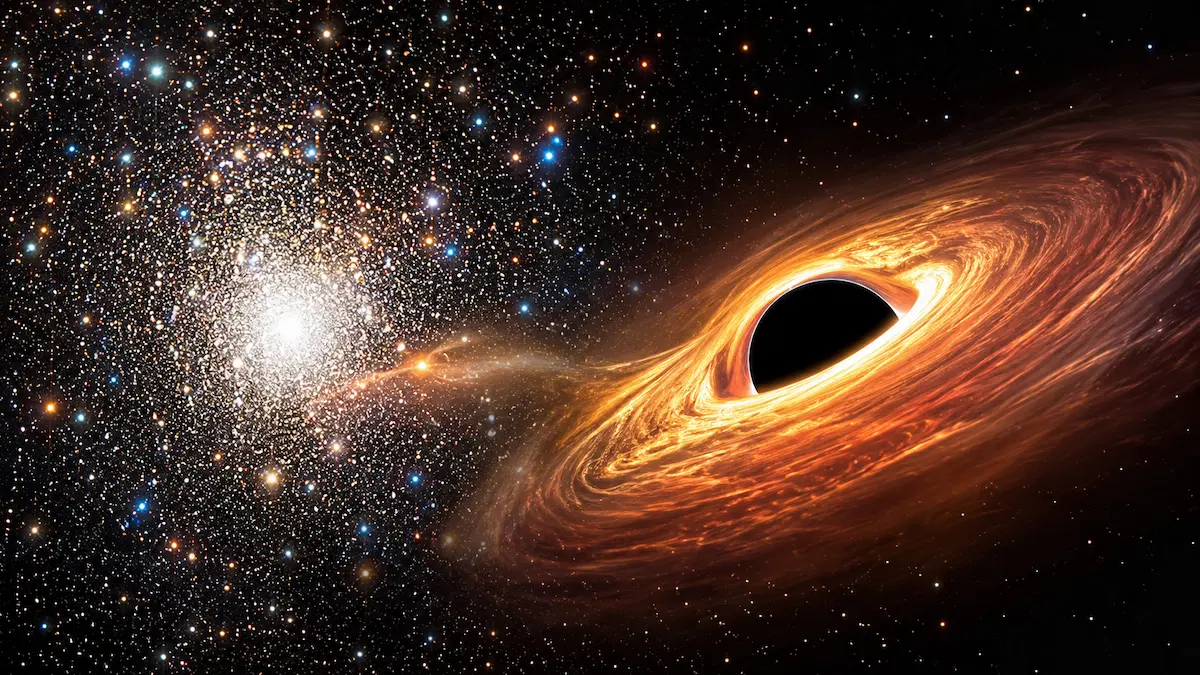
The Omega Centauri black hole has become one of the biggest space discoveries of the year. For many years, astronomers believed that Omega Centauri should contain many black holes, but they could not find any solid evidence. Now, Hubble Space Telescope and the James Webb Space Telescope (JWST) changed everything. Scientists have found the first confirmed stellar-mass black hole inside Omega Centauri by using these powerful observatories. The newly discovered black hole has been named oMEGACat BH-2.
On July 13, 2026, NASA announced that astronomers had discovered the first confirmed stellar-mass black hole in Omega Centauri. The discovery was made using over 20 years of Hubble observations, supported by data from the James Webb Space Telescope.
SpaceX Starship Flight 13 will launch with 20 starlink satellites soon.
This discovery is important because Omega Centauri is not an ordinary star cluster. It is the largest and brightest globular cluster in the Milky Way. It contains millions of stars packed into a relatively small region of space. Scientists have studied this cluster for decades because they believe it may hold important clues about how black holes form and survive in crowded environments. The discovery of Omega Centauri black hole also proves that some black holes can remain hidden inside dense star clusters for billions of years without being directly seen. Scientists cannot see it directly. They detect it by observing its effect on nearby stars.
What Is Omega Centauri and Why Have Scientists Studied It for So Long?

To understand why the Omega Centauri black hole is making headlines everywhere, it is important to understand what Omega Centauri actually is.
Omega Centauri is a giant globular cluster. It is located in the constellation Centaurus, about 15,000 to 17,000 light-years away from Earth and it contains nearly 10 million stars bound with gravity. Most globular clusters contain only one generation of stars, but Omega Centauri is different because it contains stars of different ages and they have different chemical composition. Due to these unusual features scientists believe that Omega Centauri may not have started as a globular cluster at all. Scientists believe that it might be the remaining core of some galaxy that was pulled by our galaxy, Milky Way billions of years ago. Scientists study it for many years because it contains millions of stars and it is very common to produce a black hole when a massive star dies. After many years scientists could not find any of them, but recently they discover Omega Centauri black hole by using most powerful telescopes.
NASA Swift Telescope Rescue Mission
How Did Hubble and James Webb Find the Omega Centauri Black Hole?
Scientists cannot see it directly, because black holes do not produce any visible light like stars. This makes them very difficult to detect. So scientists use an indirect method to detect them. They start observing how black hole affects its nearby objects. For Omega Centauri black hole discovery, scientists combined years of observations from the Hubble Space Telescope with powerful infrared data collected from the James Webb Space Telescope. This information becomes very useful in this discovery. With this data scientists detect a small star moving in a strange way. The star appeared to be orbiting an invisible object with a mass several times greater than our Sun. After studying its motion carefully and other possibilities, scientists concluded that the invisible object is a stellar-mass black hole. Scientists officially called it, oMEGACat BH-2. They estimated that its mass is several times the mass of the Sun. It remained almost impossible to detect until both Hubble and James Webb telescope revealed its presence.
How Omega Centauri Black Hole Discovery Changes Earlier Thoughts of Scientists
Omega Centauri black holediscovery is much more important than finding a black hole in space. Because it solved some unanswered questions for many years. From many years scientists believed that globular clusters like Omega Centauri should contain many black holes because millions of massive stars have lived and died there over billions of years. Many computer models also suggested that most of those black holes would leave the cluster. Over millions of years, close encounters with other stars could slowly push them out into space. This created a major mystery. If black holes formed there, where did they go?
The discovery of oMEGACat BH-2 make scientists believe, at least some black holes live inside the cluster. That finding helps scientists improve their computer models of how globular clusters evolve over time. After this finding scientists thinks there are many more hidden black holes may still exist inside Omega Centauri and other globular clusters across the Milky Way. With the help of modern technology, now scientists can also find almost invisible black hole.
oMEGACat BH-2
Scientists called this newly discovered Omega Centauri black hole as “oMEGACat BH-2”. It is classified as a stellar-mass black hole, meaning it formed when a massive star died and collapse under own gravity. Stellar-mass black holes are much smaller than the supermassive black holes found at the centers of galaxies. Scientists believe oMEGACat BH-2 belongs to this category. It is a quiet black hole, so that it remained hidden for so long. Many other black holes are easy to detect because they pull nearby star gases and produces bright X-rays. But oMEGACat BH-2 does not consuming large amount of material. So it is very difficult to detect. Scientists adopt an indirect method to detect it. They observe the motion of its nearby star. As the star moves very strangely around an invisible object. It revealed the presence of Omega Centauri black hole. This method opens a new window to discover other hidden black holes across our galaxy, Milky Way.
More Black Holes Like oMEGACat BH-2
First Omega Centauri black hole discovery quickly raises a question about other black holes present in Omega Centauri.
Many astronomers believe, there could be many more black holes like oMEGACat BH-2 Omega Centauri contains millions of stars packed closely together bund with gravity. Over billions of years, many massive stars would have died and left behind black holes. If one hidden black hole has already been discovered, it is possible that many others still remain invisible because they are not actively pulling everything surround them like massive black holes present at the center of the galaxy.
Scientists study constantly and they give strange information about Omega Centauri. Some researchers believe the cluster may contain an intermediate-mass black hole at its center. This is different from oMEGACat BH-2, which is a stellar-mass black hole. But the evidence for center intermediate-mass black hole is not certain yet, scientists continue their further investigations about other hidden black holes in Omega Centauri. As our technology grows, future observations may reveal other invisible objects in this cluster.
Conclusion
The discovery of the Omega Centauri black hole is an important milestone in modern astronomy. By combining observations from the Hubble Space Telescope and the James Webb Space Telescope, scientists confirmed the first known stellar-mass black hole inside the Milky Way’s largest and brightest globular cluster called Omega Centauri. The newly discovered oMEGACat BH-2 not only solves part of a long-standing mystery but also suggests that many more hidden black holes could still exist inside Omega Centauri. It gives astronomers a powerful new method for finding quiet black holes that cannot be detected using traditional techniques.
As Hubble, James Webb, and future observatories continue exploring the universe. The Omega Centauri black hole may be remembered as the first clue that led to many more hidden black holes waiting to be discovered.
Stay connected with Science Scope Hub for more interesting space stories, mysteries and recent space missions.
Pingback: Hidden Planet Discovered: James Webb Finds a Mysterious World Hiding in a Famous Star System