
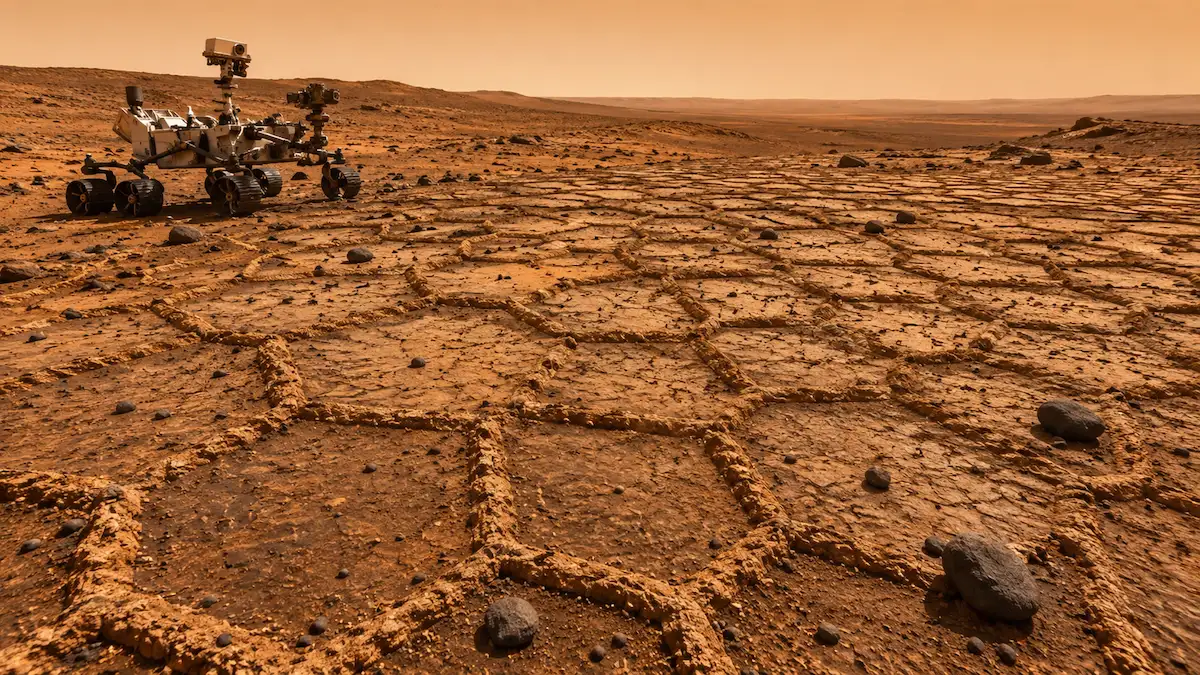
Mars honeycomb structures were found by NASA’s Curiosity rover. It has been exploring Mars for almost 14 years. During this time, it sends much valuable information to us. It climbed the lower slopes of Mount Sharp, travelled across ancient riverbeds and also collected some strong evidences that prove liquid water once flowed here billions of years ago.
But on June 21, 2026, the rover tells something that surprised even experienced scientists.
It found some unusual Mars honeycomb structures, that contains connected polygon shaped pattern and look like a giant honeycomb. The raised rocky ridges formed almost identical shapes and spread across the ground for 20 to 30 meters (65 to 100 feet). Nearby, rover also found several dark and rounded pebbles that scientists have not fully understand yet. Scientists have some possible clue about the formation of these strange patterns, but they don’t have a final answer. Let’s dive deeper and understand more about Mars honeycomb structures. What curiosity rover found, why these patterns seems so unusual and what could we found about the history of Mars?
Why SpaceX Starship Flight 13 is important for future Mars mission?
What Are the Mars Honeycomb Structures?
The Mars honeycomb structures were first noticed by the Mars Reconnaissance Orbiter (MRO), a NASA spacecraft that has been orbiting Mars for years. From the space, that area looked smooth and light in color. Nothing looked strange from the distance. But everything changed when NASA’s Curiosity rover reached the location. Scientists were surprised to find a large area covered with connected polygon-shaped patterns that looked like a giant honeycomb. William Farrand, a Senior Research Scientist at the Space Science Institute, described the landscape as looking like the top of a giant Martian honeycomb.
The rover found many well preserved polygon shaped cracks with raised rocky ridges about 1 centimeter (0.4 inches) high. These ridges formed a connected pattern across the ground, making the surface look like a giant honeycomb or even a waffle. If we simply look at Mars honeycomb structures, they seem beautiful but along with beauty they also consist a scientific mystery. The most surprising part is the structures appeared to be extremely well preserved and how they survived for so long without being worn away by Mars harsh environment. Scientists keep studying to unsolved this mystery.
James And Hubble Telescope Find A New Black Hole.
Where Exactly Did Curiosity Rover Find the Mars Honeycomb Structures?
NASA’s Curiosity Rover found Mars honeycomb structures inside Gale Crater. It is a huge impact crater that is about 96 miles (154 kilometers) wide. Curiosity rover makes this crater its home, since it landed on Mars in August 2012. More specifically, these unusual structures were found on the lower slopes of Mount Sharp, a mountain that rises about 3 miles (5 kilometers) above the center of Gale Crater. Curiosity has been slowly climbing this mountain for years because its different rock layers preserve the history of ancient Mars.
While moving toward a small crater, Curiosity rover used its Mastcam camera to take an image of extraordinary landscape. In the image ground was covered with thousands of raised polygon-shaped patterns that stretched across the surface for many meters. From above, the rocky texture looked so unusual that some scientists compared it to the skin of a reptile. Dr. Abigail Fraeman, the deputy project scientist for the Curiosity mission at NASA’s Jet Propulsion Laboratory (JPL), said the team had seen polygon shaped rocks before. But they had never observed them covering such a large area. The Mars honeycomb structures stretched across the landscape much farther than expected. This makes it one of the most remarkable geological discoveries made by Curiosity rove in recent years.
What Caused the Mars Honeycomb Structures?

Scientists still don’t have any idea how Mars honeycomb structures formed. At the moment, there is no single answer. Instead, researchers are studying several possible explanations, and more than one of them could be correct.
Theory 1: Ancient Wet and Dry Cycles
Most of the scientists believe in this theory. It suggested that the Mars honeycomb structures were formed when Mars had flowing liquid water billion of years ago. On Earth, similar polygon-shaped cracks often appear in dry lake beds and wetlands. They form when the ground repeatedly becomes wet, dries out, and then becomes wet again. As the soil expands and shrinks over many years, cracks slowly develop into connected polygon patterns.
Scientists believe something similar may have happened inside Gale Crater in Mars. Over countless wet and dry cycles make the ground expanded and contracted many times. Scientists believe this process make Mars honeycomb structures. The raised ridges are another important reason. Researchers think that mineral-rich water may have flowed through these cracks, leaving behind harder minerals. Over billions of years, wind and erosion wore away the softer surrounding rock, while the harder mineral-filled cracks and remained standing as raised ridges.
Theory 2: Extreme Temperature Changes
According to this theory Mars honeycomb structures were not formed due to liquid water. It states that Mars experiences huge temperature changes between day and night. Rocks heat up during the day and cool down during the night. As this process repeats over millions of years, the rocks slowly expand and shrink. Eventually, the stress becomes too great, that it create polygon shaped cracks into the surface. Scientists call these formations thermal contraction polygons, and they look very similar to the Mars honeycomb structures found by Curiosity Rover.
Theory 3: Stress Deep Below the Surface
Some scientists believe underground forces are responsible for Mars honeycomb structures. Pressure inside the Marian crust built up slowly over billions of years. When rock layers move, they produce stress and this stress may created a network of connected cracks. Later, minerals were filled in these cracks, leaving behind a strange polygon shaped pattern that Curiosity rover sees today and scientists call it Mars honeycomb structures.
To find the correct answer, the Curiosity team is now studying the rocks in detail using its APXS and ChemCam instruments. Scientists are comparing the chemical composition of the raised ridges with the flat areas inside each polygon. These measurements may reveal which theory best explains the mysterious Mars honeycomb structures.
The Dark Pebbles: Another Mystery on Mars
The Mars honeycomb structures were not the only surprising discovery at this location. While studying the unusual polygon-shaped patterns, NASA’s Curiosity rover also found several small, dark colored pebbles scattered across the ground. These rocks have become another mystery for scientists because they look different from the surrounding terrain. Researchers are still trying to find where they came from.
Scientists describe one possibility, these pebbles are the pieces of older Martian rock that broke away from higher layers on MountSharp and slowly rolled down the slope over time. Some scientists also think these dark pebbles could actually be meteorites that came from space and landed on Mars long ago. Curiosity rover detects nickel in these dark pebbles. And this is an important clue because nickel is found in many meteorites. But scientists do not make any final conclusion yet. Because only the presence of nickel is not sufficient to prove that the pebbles are pieces of meteorite. Curiosity team is constantly studying its chemical composition to determine whether they are meteorites or Martian rocks. Until more data is collected, the origin of these dark pebbles remains another mystery alongside the Mars honeycomb structures.
Conclusion
The discovery of the Mars honeycomb structures is another reminder that Mars still holds many secrets. Even after nearly 14 years of exploration, NASA’s Curiosity rover continues to find unusual landscapes that scientists don’t know. From the space, this area looked like an ordinary and bright color ground. But when Curiosity reached there, it revealed a strange network of raised polygon shaped ridges stretching across the surface. Along with the mysterious dark pebbles found nearby. Scientists currently have several possible explanations for how the Mars honeycomb structures formed, including ancient wet-and-dry cycles, extreme temperature changes, and underground geological stress. However, none of these ideas has been confirmed yet. Curiosity is still collecting valuable data, and future studies may finally reveal the true origin of these strange formations.
Stay connected with Science Scope Hub for more space mysteries and missions.
Pingback: Astronomers Found 4 Hidden White Dwarf Stars Shockingly Close to Earth