
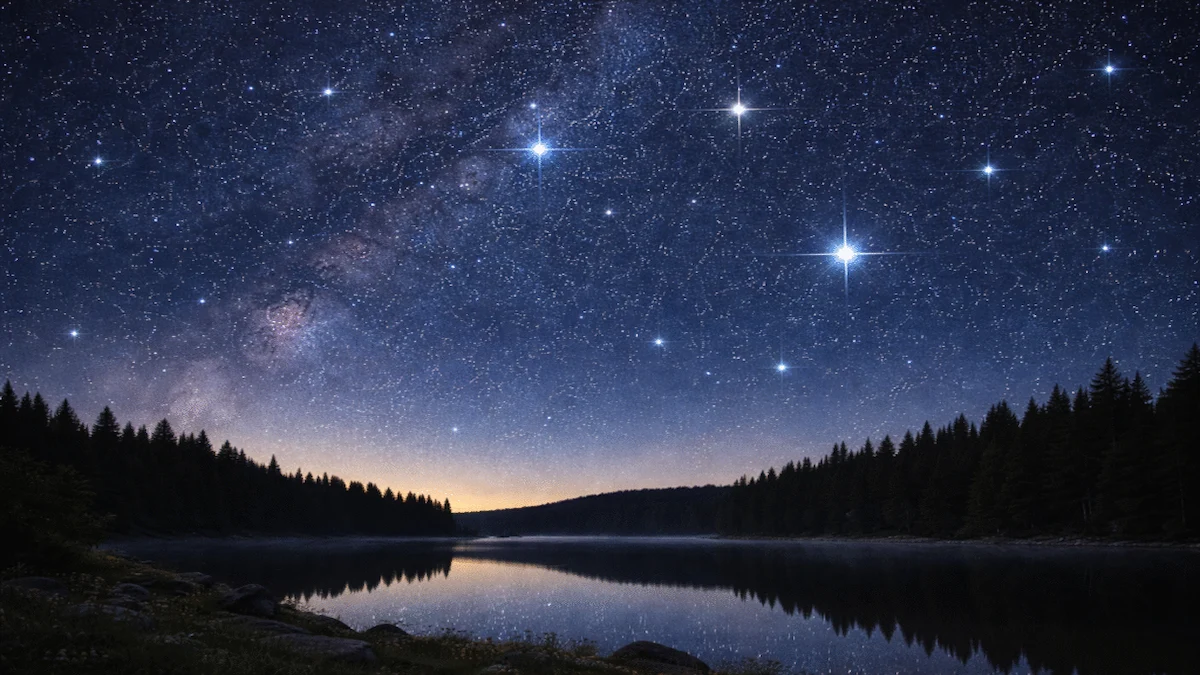
As you know that our universe is so mysterious. Some of its events are difficult to understand. Twinkling of stars is one of these strange things. When you look up in the sky at night, you’ve probably noticed something interesting i.e. twinkling of stars in the sky. These stars shine, fade and then shine again. They are like tiny light as someone is turning on and off them. By observing this strange activity of stars then a question raised in our mind i.e. why do stars twinkle? The reason behind this stars twinkle is simple natural physics. In this article I’ll explain the reason behind this question “why do stars twinkle?” in detail and everything in depth about this concept of stars twinkling.
What Does Twinkling Really Means?
When you look up in the sky, you saw stars doing a very interesting activity. Stars are shining then they fade and after it shines again. This effect of the stars is called twinkling. In simple words twinkling is the effect of the stars that make them flickering, shaking and changing their brightness. Stars are like small light that someone is turning on and off them. The truth is stars do not actually twinkle itself. Light emerges from the star is constant. But twinkling of stars happens actually. The reason behind this is refraction of light. Light is coming from extremely far away stars and when it enters in our earth’s atmosphere some physics laws act on it and it comes under the atmospheric refraction that causes twinkling.
Scientific Reason behind ‘Why Do Stars Twinkle?’

To understand why do stars twinkle? You must know about the long journey of the light that coming from the stars and about some concepts on which light depends. First you should know that when light passes through a denser to rarer or rarer to denser medium it changes its path, this is called diffraction of light. Light from the star covers millions of kilometers. After covering this long journey it did not reaches us directly. First it has to passes through our earth’s atmosphere. Our earth’s atmosphere has many layers. And they are not sill or stable. Some part of our atmosphere is warm, some are cooler and some parts are moving extremely fast. The motion of these layers is unpredictable and they have different temperature and densities. As the concept of refraction of light, when star light passes from one atmospheric layer to another with different temperature and density, it bends in different direction, so instead of reaching to your eyes in straight line it starts wobble and dances. Because of this bending of light when we see stars they starts appearing flickering, shaking or changing their brightness. That’s why scientists observe stars from the high mountains. This is the reason behind one of the most popular question “why do stars twinkle?”
If you want to know more about latest space discoveries 2025 then, click here
Why Do Stars Twinkle More Near The Horizon?

If you look the stars that are near the horizon, you can notice that they are twinkling more than the stars which appear directly over head. This also helps to explain why do stars twinkle? As we all know that light do not reaches us directly. First, it has to passes through earth’s atmosphere by which it is refracted and bends in many direction which causes twinkling of stars. The stars which appear near the horizon, they twinkle more than ones are directly over head. Near the horizon the earth’s atmosphere is thicker and denser. Starlight passes through much more atmosphere before it reaches your eyes. So, it bends more than the star light that comes from directly over head. As result the stars near the horizon twinkles more than the stars that appears directly overhead. “In simple words, the stars near the horizon twinkle more because their light has to passes through more layers of unsteady air, by which it bends more and increases the flickering effect.”
Would Stars Twinkle in Space?
To understand this question, first of all you have to know about “why do stars twinkle?” I explained you all about twinkling of stars before. Stars twinkle because of the earth’s atmosphere, light passes through it and bends in many direction so stars appear us with flickering effect. This is called twinkling of stars. But in space there is no atmosphere so light travels in straight line. It does not get deflected from its direction so stars would shine at a constant brightness without flickering, shaking or changing colour. Stars don’t twinkle by themselves. They only appear to twinkle because of earth’s atmosphere. If we remove the atmosphere then the twinkling gets disappeared.
Why Planets Don’t Twinkle Like Stars?

While learning about why do stars twinkle? A new question is appeared in your mind about the twinkling of planets. You notice that planets usually shines steadily and don’t flickers as much. Planets appear larger and more spread in the sky. Planets are far away but they are still close enough that we can see them as small ball or disc, not tiny point of light like stars. Planets are much closer to us than stars, so the bending of light (atmospheric disturbance) doesn’t affect as much. Stars are located much far away so this atmospheric disturbance affects them more and star appears us twinkling. In simple word planets are nearer than star so bending of light doesn’t affect them more so planets don’t twinkle like stars. By this we can also identify stars and planets quickly; usually twinkling means star. Understanding this topic also help reinforce the main concept behind why do stars twinkle?
Final Thought
In this article I’ll explain all about why do stars twinkle? The simple reason is that because of the earth’s atmosphere. The light coming from the star has to passes through the many layer of air so it bends in many directions and then it reaches to our eyes. It makes light appears flicker and create a beautiful twinkling effect that we see at night. Next time when you look up at night, remember that stars aren’t blinking at you. You’re actually watching invisible motion of air above you. This is very small but crucial detail that connects everyday stargazing with real science. By understanding “why do stars twinkle?” takes you little closer to this mysterious cosmos.