
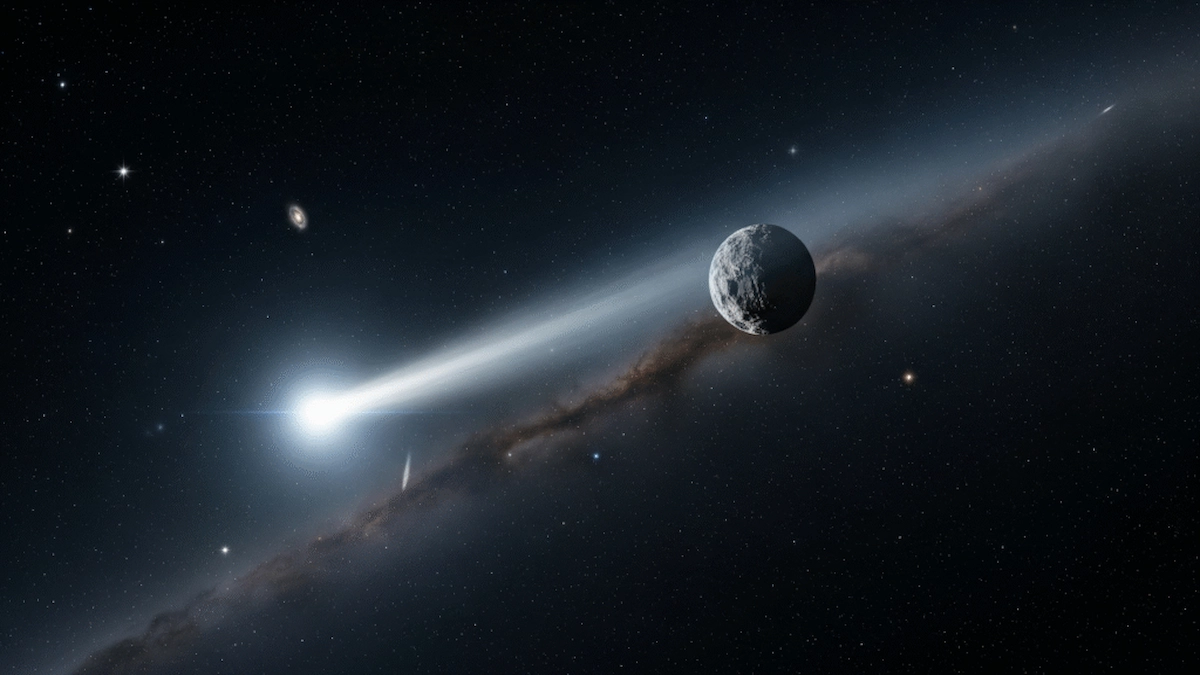
Nowadays all the scientists closely keep an eye on a strange space object known as 3I Atlas. This strange object is a comet, which comes from a distant star. Recently it became one of the most talked about space topics. This 3I Atlas update is attracting global attention because it is an interstellar comet. This interstellar comet is valuable for the scientists because it is extremely rare to see one, and it provides a lot of information about distant stars, like the composition around them, the environment around them, the temperature, the radiation, etc. In December 2025, scientists are going to reveal some 3I Atlas updates that are helping them to understand about the nature or the true origin of this interstellar comet. In this article we are going to cover all the latest 3I Atlas updates, so stay connected with us.
Latest 3I Atlas Update From Scientists
The latest 3I Atlas updates are based on the new observations collected by the scientists. Some of the major 3I atlas updates are:
1. NASA Confirms 3I Atlas Is an Interstellar Comet:
An important 3I Atlas update made by NASA. Scientists study its speed and its path; they find that it moves incredibly fast and it does not move in an oval path like our solar system’s comets do. It moves in a hyperbolic trajectory. This comet is also not bound to the sun’s gravity. It enters our solar system at high speed, and then it passes near the sun, and the sun’s gravity is not strong enough to catch it, and then it takes exit and never returns again. After all this study, NASA confirms that 3I Atlas is not from our solar system; it came from a distant star. This 3I atlas update is important for scientists because they get a rare chance to study other distant stars of the cosmos without leaving our own.
2. 3I Atlas comes closest to the Earth:

One of the latest 3I Atlas updates is that on December 19, 2025, it made its closest approach to the Earth. Even though it flies closest to the earth, its distance is still very far from our planet (about 170 million miles or 270 million kilometers). This distance is very long so that there is no danger to Earth from 3I Atlas. This closest approach is very beneficial for scientists. Because of this, they get much clearer data from the most advanced telescopes. This 3I Atlas update helps scientists to study the brightness, shape, gas cloud, and so many other details deeply. Interstellar comets are very rare, so this is like a once-in-a-lifetime opportunity to study them and know more about distant stars.
3. NASA Spacecraft and Telescope Directly Observed 3I Atlas:

In this 3I Atlas update NASA claims that many spacecraft and telescopes have directly observed the 3I Atlas comet. These observations were made by advanced instruments that are designed to catch very far and fast-moving objects. Missions like the Parker Solar Probe, along with advanced telescopes like Hubble and James Webb, made this observation when the comet passed through the inner solar system. With the help of this 3I Atlas update, scientists can check how this 3I Atlas releases gas and dust when it is nearby the sun. After getting this information, they compare it with our solar system’s comets’ data and get more unknown lectures from the mysterious cosmos.
4. James Webb Telescope Reveals an Unusual Gas Composition:

This is one of the most important 3I Atlas updates. This 3I Atlas update comes from NASA’s James Webb Space Telescope (JWST). It studies the gas composition of the comet 3I Atlas and found large amounts of carbon dioxide (CO₂), water vapor, and carbon monoxide. When scientists compared this data with our solar system comets, they found a very unusual thing: the concentration of CO₂ is very high in 3I Atlas as compared to comets found in our solar system. By this unusual gas composition, scientists realize that the environment around the parent star of 3I Atlas is very different from ours. This important 3I Atlas update makes scientists more curious about this other star object. After this, more questions are rising in minds, like the temperature, radiation level, chemical composition, gases, the environment around another star, etc.
5. Scientists Detect X-Ray Emissions from Interstellar Comet 3I ATLAS:

From the recent 3I Atlas update, scientists found emission of X-rays by 3I Atlas. When the gas cloud and dust of a comet interact with the solar wind, which means the charged particles emitted by the sun, it causes the emission of X-rays. This is an important 3I Atlas update because these X-ray patterns are different from our solar system comets. It means that their surface compositions are different. By this we understand that the surrounding area where it formed is different from our solar system so that its surface composition is not similar to our solar system’s comets.
Want to know more about Interstellar Comet 3I ATLAS, then click here
How NASA and Other Agencies Are Tracking the Latest 3I Atlas Updates
Interstellar comet 3I Atlas is moving very fast, so monitoring its current updates is not a simple task. Scientists only have a limited time to study this interstellar comet. By the latest 3I Atlas update, NASA and other international space agencies are working together by combining their space-based instruments and ground-based telescopes and also sharing their data networks to monitor more 3I Atlas updates, like its motion, behavior, speed, etc. NASA is playing the main role in the investigation. NASA is using its most advanced instruments that are designed to track fast-moving objects to know 3I Atlas updates. Agencies used space-based telescopes to track 3i Atlas because they give clearer data without any of Earth’s atmospheric interference. It gives more accurate 3i atlas updates.
Final Thought on the 3I Atlas Update
These 3I Atlas updates are showing that scientists are constantly monitoring this mysterious interstellar object. They are still busy discovering new 3i atlas updates. Still, we don’t know a lot of things about this mysterious interstellar visitor. Scientists don’t have much time because comets are still moving very fast. After some time it goes away from our solar system and then never returns. We lost this golden opportunity to learn more about other stars and how this cosmos works. So they have only limited time. As scientists give more 3I Atlas updates as expected, this article will update you as soon as possible.
