
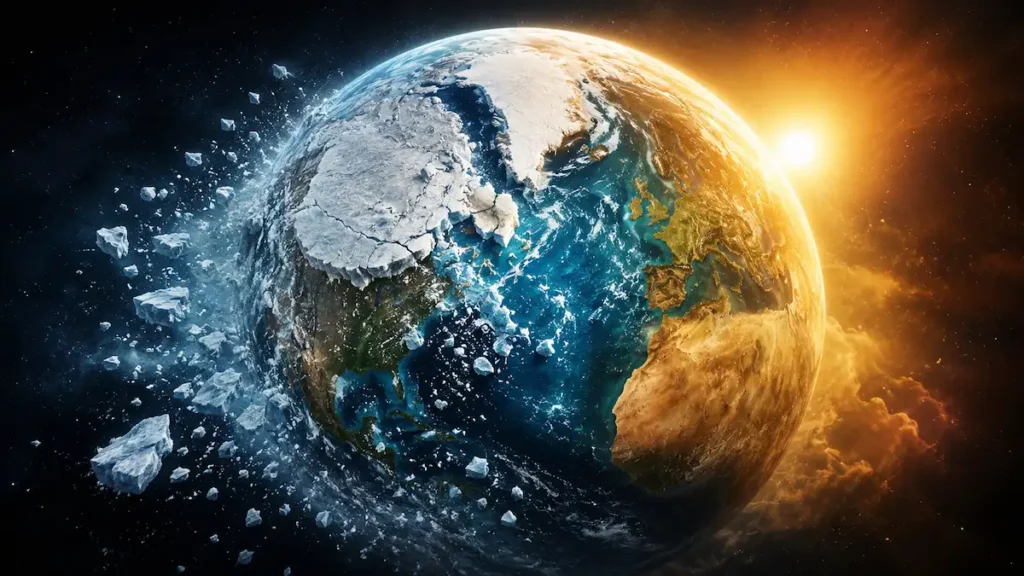
Recently scientists have discovered earth rotation speed is slowly changing and climate change is now one of the reasons why. Something very surprising is happening to our planets. This time the moon or volcanic eruptions are not the main reasons.
In March, 2026 a major study was publish by researchers at the University of Vienna and ETH Zurich found that the melting glaciers and ice sheets are the main reasons for slowing down earth rotation speed. As the global temperature rises, enormous amount of ice melts in Antarctica and Greenland and flow into the oceans. This changes the earth’s mass and affecting earth’s rotation speed. The days getting longer but this change is too small that you can’t even notice. However, modern scientific instruments can measure these changes with incredible accuracy.
First – What Is Earth Rotation Speed?
Before knowing about the recent changes, let’s quickly cover this topic.
Earth’s rotation speed is very fast. At the equator, its rotation speed is about 1670 kilometers (1037 miles) per hour. It is faster than any passenger airplanes. Even though we don’t even feel it, but earth is constantly spinning. Earth takes 23 hours 56 minutes and 4 seconds to complete one rotation. Due to the rotation process, we experience the cycle of day and night on earth. This constantly spins also help to shape the weather patterns.
Earlier, scientists think that earth rotation speed was only influence by natural forces like the moon. Moon’s gravity pulls the earth’ ocean, this creates tides and it slowing down the earth rotation speed over millions of years. Earth’s rotation is stable and humans do not feel anything because these changes happened so slowly. But new scientific researches have now changed this assumption. Now scientists have found human driven climate change also affects earth rotation speed. From here a new chapter starts.
NASA hidden exoplanets discoveries.
What Has Actually Changed In Earth Rotation Speed?

Scientists noticed an unusual change in earth’s rotation between 2000 and 2020. The earth’s rotation slowed down more than expected during this period. Earth’s rotation speed was slowing down at the rate of 1.33 milliseconds per century and scientists found climate change is one of the main reasons.
“The reason behind it: when mass moves farther away from the center of earth, is spinning speed slow down.”
You can understand it better with an example. When a skater keeps her arm close to the body, she spins faster. But when she raise her arm outwards, her spin slows down. She hasn’t done anything expect she adjust her mass outward. And that’s why her spin speed slows down.
Same thing happens with the earth. When huge amount of ice melts from the glaciers and it flows to the oceans. This huge water adds some mass and spread across the planets. As the planet’s mass moves farther from the axis, earth rotation speed decreases. Scientist Mostafa Kiani Shahvandi of the University of Vienna described this phenomenon. “He compares earth’s changing spinning speed to a figure skater. He said never before earth “raised it arms” so quickly as it did between 2000 and 2020.”
This effect is so tiny that human can’t even notice but large enough to measure by modern scientific instruments.
Why Is Earth Rotation Sped Slowing Down?
At first, this idea sounds very strange. How melting ice can affect the speed of a planet. But this complete theory depends how mass distribute across the planets. Here’s the whole process how it works.
Step 1: Temperature Rise Globally
On earth human activities releases gases in the atmosphere. These gases trap heat and causes high temperature globally.
Step 2: Polar Ice Melts
As the temperature rises, large ice sheets along with mountain glaciers start melting in Greenland and Antarctica.
Step 3: Water Flows Toward The Equator
The melted water from the glaciers flow into the oceans and spread across the world. It naturally spread toward the equator where earth’s surface is wider.
Step 4: Mass Moves Away From Earth’s Rotational Axis
When water moves toward the equator. It means mass is moving farther from the earth’s poles. And poles are the rotational axis of the earth.
Step 5: Earth’s rotational speed drops
According to a physics law, earth rotation speed slows down to conserve the angular momentum. As a result earth’s spin becomes a little slower.
This Is Unprecedented – Here’s What 3.6 Million Years of Data Shows

To understand this unusual change in earth’s spinning, scientists don’t just analyze recent data. Instead they also examined about 3.6 million years of earth’s geological history. To do this, scientists studied a tiny marine organism called benthic foraminifera. Their shells have clues about ancient ocean temperature and sea levels. During their research, scientists discovered something very surprising.
Over those millions of years, natural ice ages cycle because the earth’s spinning speed increase and decrease many times. But these changes were completely normal and happened over thousands or millions of years. But none of those earlier changes match with the rate of slowdown recorded between 2000 and 2020. It happened much faster than almost any natural earth rotation speed slowdown in the past 3.6 million years. According to scientists, they only analyze one period roughly two million years ago, that came close to today’s rate. Even then, the slowdown was smaller than what we experience today. This slowdown is not just strange or unusual, it’s historically extraordinary.
How Does It Affect Real Life?
Most of the people think the change of 1.33 milliseconds per century is too small. And they are right normal people cannot notice in their daily life. But in the precision technology, even a fraction of millisecond matters. For example
GPS need to know the speed of earth’s rotation to calculate accurate locations. Even a tiny change in earth’s spin can affect these calculations. Without the accurate calculations, you phone’s map could show you incorrect location. So scientists have to update regularly and correct the systems error to keep GPS accurate.
Global timekeeping also depends on the earth’s rotation. The world’s official time system called UTC is designed to synchronize with the planet’s actual spin. Since 1972, international timekeepers occasionally make tiny adjustments called ‘leap seconds’ to keep the clock sync with the earth’s rotation. Before, scientists thought that earth was spinning fast so, a “negative leap second” might be needed around 2026. But the recent slowdown by human driven climate changes those predictions. Now scientists expect this adjustment is delay for about 3 years.
For space navigation, knowing exact earth rotation speed is also very important. Spacecraft navigation requires the exact knowledge of earth’s rotation. Even a tiny error can make a massive trouble, when we guiding a spacecraft from millions of kilometers away.
What About Three Gorges Dam?
Climate change is not the only way, how humans have disrupted the earth rotation speed. NASA Scientists have found some other humans large projects that can influence earths spinning speed. One example is china’s three Gorges dam. It is the world’s largest hydroelectric dam. Scientists got some clues that it can influence our planets spin, when its massive reservoirs began to fill with water. According to scientists this dam slowed down the earth rotation speed a little bit. This dam hold back roughly 40 cubic kilometers of water, raised 175 meters above the sea level. This enormous mass (roughly 39 trillion kilograms) slows the rotation by 0.06 milliseconds and it shifts the earth’s axis by approximately 2 centimeters.
This delay is too small as compare to climate change slowdown. But it is also a reason for slowing down the speed of earth’s rotation. It’s sufficient to prove that human built structures can influence the earth’s spinning speed.
Conclusion
Our earth has been rotating for about 4.5 billion years. Throughout its history many natural forces such as moon’s pull, volcanic eruption and movement deep inside earth’s core, interrupted the earth’s rotation. But today we know something very surprising, human driven climate change and some human made infrastructures also influence earth rotation speed. According to the scientists, the earth’s spinning speed is slowing down faster than almost any similar changes observed by scientists in last 3.6 million years. And it is because of human driven climatic change. The days are getting longer but normal person cannot notice it. But these changes matter to scientists who manage the world’s time keeping system. In places like Paris experts constantly compare earth rotation speed with high accurate atomic clocks. When the change is large enough, they adjust the clocks to sync with earth’s actual rotation speed.