
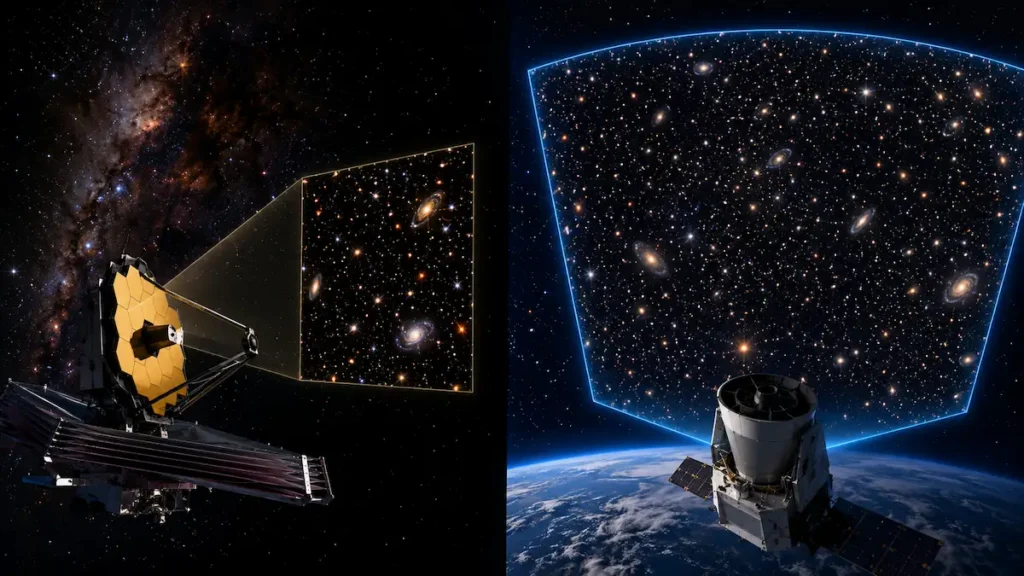
Nancy Grace Roman Space Telescope vs James Webb – Surely you have seen both names popping up everywhere, and most people want to know about their differences. Most of the people think NASA developed a new telescope to replace the older one. But this is not the truth. The two telescopes have totally different functions, and they are designed to perform completely different functions.
In this article, we’ll explain how each one functions and why we need both telescopes. Both telescopes help us to study the universe in a better way.
Nancy Grace Roman Space Telescope Vs James Webb – The Simple Version First
To understand about them, imagine you have two cameras.
Think of the James Webb Space Telescope (JWST) as a super-powerful zoom camera or microscope. It locks onto one small part of the sky and studies it in incredible detail. It can capture the light coming from the billion of light years away galaxy that formed just after the universe began. It can analyse the atmospheres of distant planets and reveal very small details that any previous telescopes could not see. It is very useful, but it can cover only a small area. It cannot analyse a huge area in space quickly.
Now think of the Nancy Grace Roman Space Telescope as a wide-angle camera. Instead of covering a particular region in the sky, Roman telescope covers a huge area in the sky at once. This quality helps it to make enormous universe maps and discover billions of hidden galaxies in the universe.
The basic difference between them is James Webb covers a particular region in the sky with much detail, but Roman telescope covers a huge region in the sky. So both telescopes help to study the universe, but their jobs are different. “James Webb helps to find extraordinary details, and Roman Telescope helps to find an extraordinary number of things in space.”
What is the Nancy Grace Roman Space Telescope?

Before understanding the Nancy Grace Roman Space Telescope vs James Webb comparison, you need to know about what Roman actually is. Because lots of people heard this name for the first time.
The Nancy Grace Roman Space Telescope is NASA’s next major space observatory. It is planned to launch in October 2026 on a SpaceX Falcon Heavy rocket from the Kennedy Space Center. This telescope is named after NASA’s first chief astronomer. And her name was Nancy Grace Roman. She played an important role in creating the Hubble Space Telescope, so she is also called “Mother of Hubble”.
The main tool in this telescope is a 300-megapixel infrared camera. This camera has 18 advance detectors that help to take enormous images of space. An image captured by Roman telescope is 100 times wider than the Hubble or James image. And its speed is incredibly fast. It can survey the sky 1000 times faster than the Hubble telescope.
The Core Difference – Wide Vs Deep

This is the heart of the Nancy Grace Roman Space Telescope vs James Webb story. James Webb contains a 6.5-meter-wide mirror. It is the largest mirror ever launched into space. This large mirror collects more light from incredibly faint and distant objects. It allows the Webb telescope to collect fine details of distant objects like some of the ancient galaxies that formed just after the Big Bang. JSWT focuses on a small patch at once in the sky, just like watching through a keyhole. It can see fine detail, but it cannot quickly scan the large area in the sky.
While the Nancy Grace Roman Space Telescope has a smaller mirror (2.4 meters wide). This size is the same as Hubble’s mirror. Because of the smaller mirror, it cannot observe fine details like the JWST. But Roman telescope has one advantage: it can scan a large area in the sky. Its camera has an enormous field of view. When Roman looks at the sky, it can observe a wide panorama, like opening a wide window instead of peering through a keyhole. “NASA tells us clearly; the Webb telescope tells us about the early universe in detail and Roman will help us to understand how the early universe evolved and changed over billions of years.”
Human driven climate slow down the earth’s rotation speed.
What Can Roman Do That Webb Can’t?
Here’s where Roman becomes genuinely exciting – and why the Nancy Grace Roman Space Telescope vs James Webb question misses the bigger picture.
The Roman telescope is capable of doing something that Webb can’t do. Roman can repeatedly scan huge regions of the sky and study billions of objects at a time. In a single image Roman can cover an area of the sky about the size of the full moon. It can do this in just 146 seconds. To analyze this same area, the Webb telescope takes months because it only focuses on a smaller region at a time. A Roman telescope can help scientists in making maps of large portions of the universe, where billions of galaxies are located. Roman can find approximately 100,000 exoplanets during its mission. This number is much larger for all previous missions combined. Roman can also help to solve one of the biggest mysteries of astronomy, i.e., dark energy. “Dark energy is the unknown force that helps in expanding the universe faster.” Scientists only know about it because of its effect in the universe, but they can’t fully understand it. By creating enormous maps containing billions of galaxies, Roman will provide data to scientists that they need to finally understand what dark energy actually is. James Webb cannot do this survey. Its short field of view makes it the wrong tool for the job.
Conclusion
The Nancy Grace Roman Space Telescope vs James Webb is not an actual competition. It’s more like a partnership in exploring our universe. Through this article, we all understand that Roman focuses on a wider area and Webb focuses on an individual part with incredible details. NASA has a clear plan for both Roman and Webb telescopes. They designed them to work together. Without Roman telescopes, scientists would spend many years searching for most of the interesting objects. And without Webb, scientists would not be able to find tiny details of distant objects. So, they are going to capture a large picture of the universe with more fine information.
I hope now you can understand that when Roman launches in October 2026, it will not make Webb obsolete. This is all about the Nancy Grace Roman Space Telescope vs James Webb.
Pingback: Artemis 3 Crew Revealed: Meet The 4 Astronauts NASA Just Chose Humanity’s Return To The Moon
Pingback: NASA Roman Telescope Launch Update: Fueling Complete as Historic August 2026 Launch Nears