
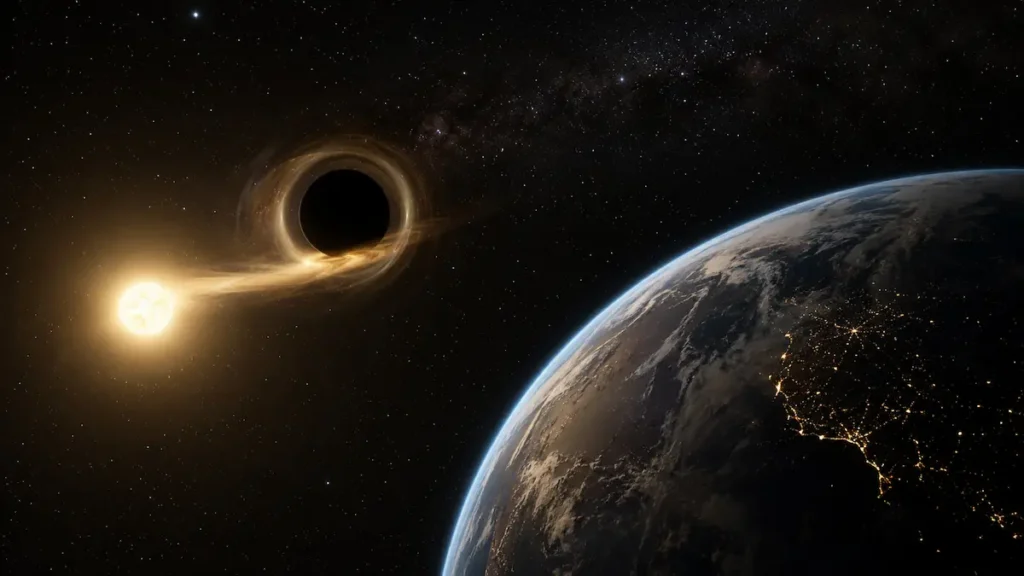
What is the closest black hole to earth?
Now days, this question is asked by most people everywhere. So the answer is Gaia BH1. It is the closest one to earth. It is located about 1600 light years from earth. In cosmic terms, it’s very close to earth. But in reality, it is very far away that even our fastest spacecraft would take roughly 40 billion years to reach there. This duration is longer than the universe itself has existed. Let’s break all the detailed information that we have about the closest black hole to earth.
What Is The Closest Black Hole To Earth Called?
Humans called the closest black hole to earth, Gaia BH1. A team of astronauts lead by Kareem El-Badry discovered it in 2022. Kareem El-Badry is working with the Harvard-Smithsonian Center for Astrophysics. Before Gaia BH1 was found, scientists believe the closest black hole to earth to an object named, A06200-00. It is located in the constellation Monoceros. It is believe that recent discovered black hole Gaia BH1 is about three times closer than it to earth. This closeness made it an instant headline when it announced. The name of closest black hole is inspired by European Space Agency (ESA’s) Gaia spacecraft which help scientists to find it. Gaia spacecraft spent years to make a detailed map of billions of stars of our galaxy. This massive information help us a lot to make this discovery possible.
You May Like
How Far Is The Closest Black Hole To Earth?
If you are wondering what is the closest black hole to earth in terms of distance then here’s the number. Scientists estimated Gaia BH1 is approximately located 1600 light years away from the earth. It is present in the direction of constellation Ophiuchus (also called Serpent Bearer).
A light year is the distance that light covers in one year. And light moves around 300,000 kilometers per second. Light takes around 1600 years to travel the distance between earth and Gaia BH1. This means when astronomers see Gaia BH1 today, they actually seeing it as it was 1600 years ago. It was the time when the Roman Empire was beginning to decline. If we talk in cosmic terms, 1600 light years is vey less distance. Our galaxy is about 100,000 light years across, so Gaia BH1 is located in our local region of the galaxy. But when we think it as reality it is very far from us. Astronomers consider this black hole as one of our neighbors in universe.
How Was The Closest Black Hole To Earth Discovered?

From here the story begins more interesting. If you want to understand what is the closest black hole to earth, first you need to know that no one actually saw this black hole. According to scientific definition, black holes do not emit light, so we cannot see them. Astronomers found it by noticing behavior of surrounding objects. Objects around the black hole tell about its presence.
When scientists are studying the Gaia’s data they found something very unusual. A star similar to our sun appeared to be wobbling back and forth as it moved through space. Through this wobble, scientists get a clue that something invisible is pulling this star with its stronger gravitational force. By studying carefully the star’s wobble scientists calculated the mass of the unseen object. They believe that unseen object’s mass is about 10 times greater than our sun’s mass. In our universe, there are only few things that have mass this much and are completely invisible. It could only be one thing: a massive invisible black hole. Gaia observes hundreds of thousands of stars, but scientists stood out only this particular star because of its strange motion. And it turned to be the answer to what is the closest black hole to earth. Scientists also observe it by using the Magellan Baade Telescope in Chile and the Gemini North Telescope in Hawaii to make sure this discovery was real. And they confirmed that Gaia BH1 had been found.
Is The Closest Black Hole To Earth Dangerous?

When you all know what is the closest black hole to earth and how it is far from earth, now you wants to know is it dangerous to earth or not. So the simple answer is no, not even a little bit. In cosmic terms, even the Gaia BH1 is the closest black hole to earth. But actually it is very far from us.
To understand how far it is, think of the nearest star system to earth, Alpha Centauri. It is only about 4 light years away from us. It means the black hole Gaia BH1 is around 400 times farther away as compared to it. Because of this great distance Gaia BH1 posses absolutely no threat to earth.
There is another important reason for not to worry. Gaia BH1 is a dormant black hole. That means it is not actively pulling gas or materials in, from its surrounding space. Active black holes produces powerful burst of X-rays but Gaia BH1 is not doing that. Instead it is sitting very quietly at the center and its companion star orbits like our earth orbits the sun.
A Second Black Hole Was Found Nearby Too
Astronauts found another exciting discovery, while studying the data from Gaia spacecraft. Scientists discovered a second dormant black hole called Gaia BH2. It is located about 3800 light years away from the earth in the direction of Constellation Centaurus. It has around 8.94 times more mass than our sun’s mass. It is also not actively consume materials from its surrounding space. Gaia BH1 and Gaia BH2 represent the first clear example of dormant stellar black holes found in our galaxy. These two black holes suggested that, there are many quiet black holes hide in our galaxy Milky Way, waiting to be discovered.
Conclusion
So, what is the closest black hole to earth? It is Gaia BH1. It is a quiet, dormant and huge black hole located around 1600 light years away from the earth. Scientists do not discover it by seeing directly. Instead they found it by noticing the subtle wobble of its nearby star. This closest black hole to earth reminds us that how wonderful our universe is. Next time when anyone asks you what is the closest black hole to earth, you know what to tell them and you’ll have a great story to go with it. The best part is that it poses no threat to earth. It’s like a giant monster sitting quietly in the sky.
If you want to keep exploring the unusual objects of the universe, then stay connected with the Science Scope Hub.
Pingback: Are Black Holes Actually Holes In Space? The Surprising Truth About Space’s Strangest Objects