
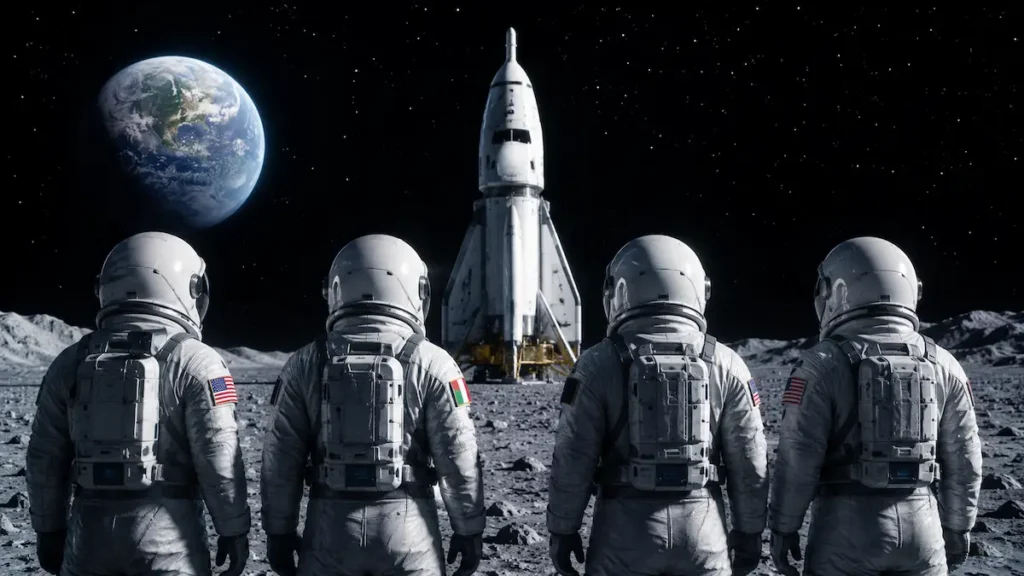
On 9 June, NASA officially announced the Artemis 3 crew. Honestly, this news stops you scrolling. In this mission, humans are expected to return to the moon for the first time after 50 years. This mission takes humanity one step closer to walking on the moon. NASA makes this announcement at the Johnson Space Center in Houston, Texas. They reveal all four astronauts in front of the cameras. Three of them are American, and one is from Italy. This is the first time an Italian astronaut is chosen for the Artemis mission. The Artemis 3 crew announcement makes many people very excited because the last astronauts landed on the moon in 1972; after that, this is the first time when astronauts are going to land on the lunar surface.
In this article we’ll know everything about the crew members, who they are, and why this announcement matters so much for space science.
Who Is on the Artemis 3 Crew?
The Artemis 3 crew contains four astronauts, and each one has a different role and experience.
Randy Bresnik will be the commander of the mission. He is a veteran NASA astronaut and former test pilot. He already flew in space before, and now he will lead the crew as the commander during one of NASA’s most important space missions.
Luca Parmitano will be the pilot in Artemis 3. Parmitano is an Italian astronaut of the European Space Agency. He is the first ESA (Italian) astronaut ever selected for any Artemis mission. He was a military pilot and has experience with more than 20 types of aircraft. In 2007 he landed a damaged military plane after striking a bird. For this work, he was awarded Italy’s Silver Medal of Aeronautic Valor. He was visibly emotional during the announcement.
Frank Rubio will play the role of mission specialist. He is already a well-known astronaut in the space industry. He holds the record for spending the longest continuous time in space. After spending much time in space, now he is planning to join the journey to the moon.
Andre Douglas is the second mission specialist of Artemis 3. This trip to space will be the first flight for him. He served as a backup astronaut in the Artemis 2 mission. But now he becomes a part of the Artemis 3 crew. This is going to be his first journey to the space.
NASA has also prepared with a backup astronaut. Bob Hines is selected for backup in the Artemis 3 crew. He will train with the main team and be ready to enter if anything happens or changes before the launch.
NASA’s will launch its new most powerful telescope in August 2026.
What Will Artemis 3 Crew Actually Do?

It is where many people get confused after the announcement. The Artemis 3 crew is not landing on the moon’s surface during the mission. NASA announced that this mission is just like a critical rehearsal. The main objective of the astronauts during this mission is to test how the Orion spacecraft works with the new lunar landing system being developed by SpaceX and Blue Origin.
You can take this mission as a dress rehearsal before the real show begins. Before any astronaut steps onto the lunar surface, NASA must prove that Orion can successfully rendezvous and dock with those new landers in space. It means that Orion has to connect with another spacecraft in space safely. Docking two different spacecrafts that are built by different companies, with a human crew on board, for the first time, is a great challenge. That’s why NASA called this a complex mission.
So, while Artemis 3 crew members may not walk on the lunar surface during this mission, they will be doing one of the most important tests in the entire Artemis project.
When Is Artemis 3 Launching?
The Artemis 3 is expected to launch as early as 2027. The Artemis 3 crew will travel with NASA’s Orion spacecraft, which will be launched by the powerful Space Launch System (SLS) rocket from Kennedy Space Center in Florida. NASA is very careful in giving the exact liftoff dates. NASA administrator Jared Isaacman mentioned “2027” is the target for the mission. But later he clarified that “late 2027” is not any committed date from NASA. In a simpler way, 2027 is just an expected year, but still this schedule could be changed as the mission develops. Yet NASA has not officially confirmed any specific launch schedule.
Even the dates are unscheduled, but the main object of NASA with this mission is very clear. Taking humans back to the lunar surface by 2028. If successful, then it becomes history as a mark of the first return to the moon’s surface since the Apollo program in 1972 (more than 50 years).
Why the Artemis 3 Crew Announcement Matters So Much
It’s easy to read a NASA headline and scroll it, but wait here for a moment. It is very important for space science.
This is the first time when an Italian astronaut is selected for the Artemis mission. Luca Parmitano will represent both the European Space Agency (ESA) and Italy. Now Italy has a direct seat at the table for one of the most significant missions of the modern era. It shows how modern space exploration is becoming an international effort. Multiple countries work together to explore the moon.
There is also another big global context. NASA is trying to become the first to reach the moon’s surface in the modern era. While other countries like china is also making its effort for future lunar landings. So it is kind of a space race between powerful countries. As a result, the Artemis 3 moon mission is now becoming one of the most important missions of this decade.
Another reason makes it special is no one has walked on the moon’s surface for more than 50 years. Now four humans have been chosen for humanity’s return to the moon. Their names are officially connected to one of the most ambitious space programs since the Apollo mission. For many years, people waited for the beginning of humanity’s journey back to the moon.
Conclusion
The Artemis 3 crew announcement is not a regular NASA update. All four astronauts, Randy Bresnik, Luca Parmitano, Frank Rubio, and Andre Douglas, standing together in Houston, represent not just their countries or careers but a promise—that humans are returning to the moon, and this time America is not alone. Now the Artemis 3 crew will carry this responsibility forward. This mission does not allow the astronauts to land on the lunar surface. They only test critical technologies and important procedures that help in future lunar landings. In future missions, when astronauts once again walk on the moon’s surface. They will remember the Artemis 3 crew effort in making their dream come true.
If you want to keep yourself updated about humanity’s journey back to the moon. Browse more articles on Space Science Hub.
Pingback: What Is The Closest Black Hole To Earth? The Surprising Answer (And How Far It Really Is)
Pingback: NASA Moon and Mars Simulation Mission: NASA Is Paying 4 Volunteers to Live in Space for a Year — Here's Everything You Need to Know