
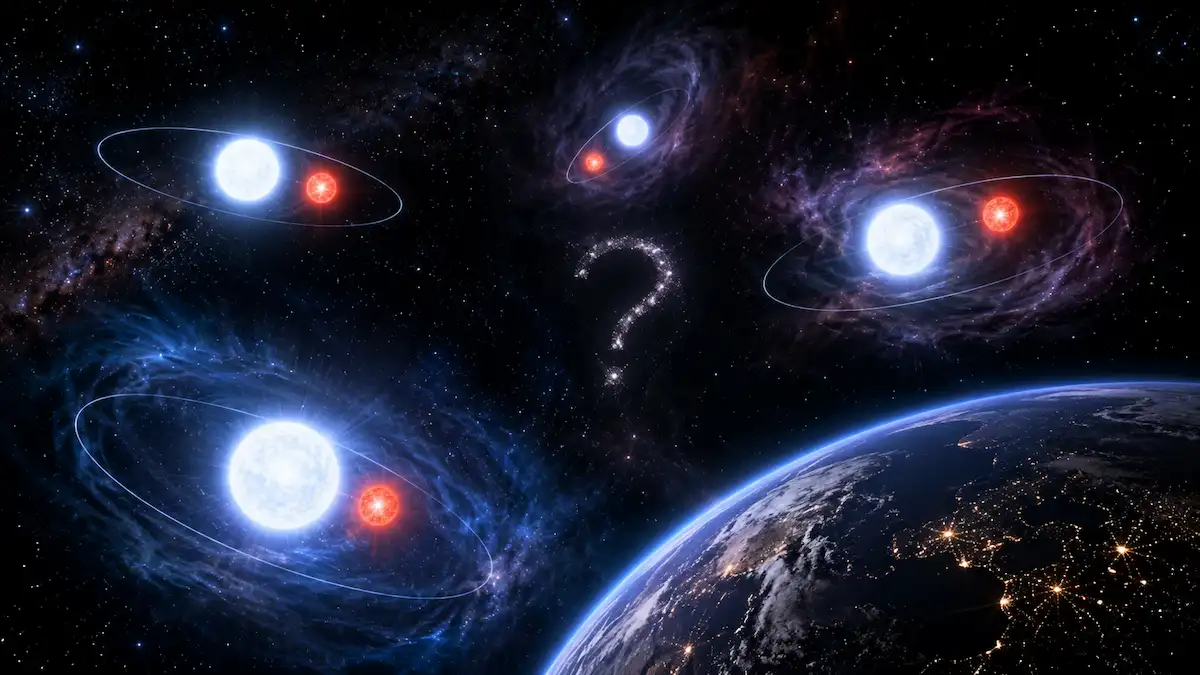
Scientists just discovered four hidden white dwarf stars almost in our cosmic backyard. It may sound impossible because scientists have been studying the stars near Earth for many years. These white dwarfs are located within about 65 light-years of Earth. This discovery make us realize that even our nearest stellar neighborhood still holds surprising secrets. One of these newly confirmed white dwarfs is only 25 light-years away from the earth. It is one of the ten closest known white dwarfs to our solar system. The discovery surprised astronomers because these stars were not actually invisible. Instead, they were hidden behind much brighter red dwarf stars, whose light completely overwhelmed the faint glow of the white dwarfs. NASA’s Hubble Space Telescope helps scientists to detect them. The discovery of these Hidden White Dwarf Stars reminds us that space still has many secrets waiting to be found. Scientists believe that we don’t know about our solar system yet completely. Even the space regions which scientists fully understand reveal completely new objects when they use modern technology and new observation techniques.
NASA just found some strange patterns on Mars surface.
What Are Hidden White Dwarf Stars?
When you first listened about the discovery of Hidden White Dwarf Stars, quickly a question appears in your mind what is white dwarf star.
When a Sun like star runs out of fuel, it left behind a small and extremely dense core, which is called white dwarf. Instead of exploding as a supernova, stars like our Sun slowly lose their outer layers and leave behind a stellar core. That remaining core is not able to produce energy by nuclear fusion, so it slowly cools over billions of years while becoming fainter and fainter. The newly discovered Hidden White Dwarf Stars were especially difficult to detect because each one is part of a binary star system. In every system, the white dwarf has a much brighter red dwarf companion. When astronomers looked through ordinary visible-light telescopes, the red dwarf completely outshined the faint white dwarf, making it appear as though only a single star existed. This explains why these Hidden White Dwarf Stars remained undiscovered for so many years. They were hiding in plain sight, but their brighter companion stars acted like powerful flashlights that covered their faint light.
How Did Astronomers Finally Find These Hidden White Dwarf Stars?

The discovery of these Hidden White Dwarf Stars did not happen by accident. It began when astronomers noticed something unusual about several nearby red dwarf stars. The stars appeared to move with tiny “wobbles.” These small changes suggested that an unseen object was pulling on them through gravity. Although scientists suspected a hidden companion, they could not see it directly using normal observations. To solve the mystery, researchers used NASA’s Hubble Space Telescope to observe the systems in ultraviolet light. White dwarfs are much easier to detect in ultraviolet wavelengths because they remain much hotter than their red dwarf companions. Hubble’s sensitive instruments separated the faint ultraviolet glow of the white dwarfs from the brighter visible light of the red dwarfs, confirming that four hidden stellar remnants were actually there. One system, called G 203-47, had been suspected of hiding a white dwarf for 27 years. Hubble finally confirmed that suspicion, making the hidden object one of the closest known white dwarfs to Earth.
Why This Discovery Is a Big Deal for Astronomy
Finding Hidden White Dwarf Stars is exciting because scientists believed they had already identified most of the stars close to our solar system. The latest discovery proves that our local neighborhood is still not completely mapped. One of the biggest surprises is that one of the newly confirmed white dwarfs is only about 25 light-years from Earth. That makes it one of the 10 closest known white dwarfs to our planet. Discovering such a nearby object after decades of observations shows that astronomers still have more to learn about the stars around us.
The discovery also improves our understanding of how binary star systems evolve. When a Sun-like star becomes a white dwarf, its gravity and temperature continue to affect its companion star. By studying these systems, astronomers can learn how stars lose mass, cool over billions of years, and change after their nuclear fuel is gone. Every new Hidden White Dwarf Star gives scientists another opportunity to test their models of stellar evolution and better understand the life cycle of stars like our own Sun.
Could More Hidden White Dwarf Stars are waiting to be found?
The discovery of four Hidden White Dwarf Stars immediately raises another important question: How many more are still hiding nearby?
Researchers believe these four stars are probably not the only hidden white dwarfs close to Earth. Many nearby red dwarf stars have never been observed in enough detail using ultraviolet light. If more of them have faint white dwarf companions, they could remain invisible in ordinary observations. Astronomers now plan to study other nearby binary systems using the same technique that led to this discovery. By combining precise measurements of a star’s motion with ultraviolet observations from space telescopes, they hope to uncover many more hidden stellar remnants.
This means our map of the solar neighborhood may still be incomplete. Every newly discovered Hidden White Dwarf Star helps scientists to build a more accurate picture of the stars surrounding our Sun. It also improves estimates of how many white dwarfs exist in the Milky Way.
Conclusion
The discovery of Hidden White Dwarf Stars reminds us that the universe can still surprise us, even close to home. Astronomers confirmed four previously hidden white dwarf stars within about 65 light-years of Earth, including one only 25 light-years away. These stars remained unnoticed because their faint light was hidden by brighter red dwarf companions.
Using the Hubble Space Telescope’s ultraviolet observations, researchers finally revealed these long-hidden stellar remnants and it showed scientists could not fully understand about our cosmic neighborhood yet. More importantly, this discovery suggests that other Hidden White Dwarf Stars may still be waiting to be found. As astronomers continue studying nearby binary systems with advanced telescopes, they may uncover many more hidden objects that have escaped detection for decades.
Every new discovery helps us understand how stars are born, evolve, and eventually die. The four newly confirmed Hidden White Dwarf Stars are another reminder that space exploration is far from over. Even the stars closest to Earth can still hold remarkable secrets, and future observations may reveal many more hidden wonders in our own corner of the Milky Way.
If you are a space lover then stay connected with Science Scope Hub for more space mysteries.