
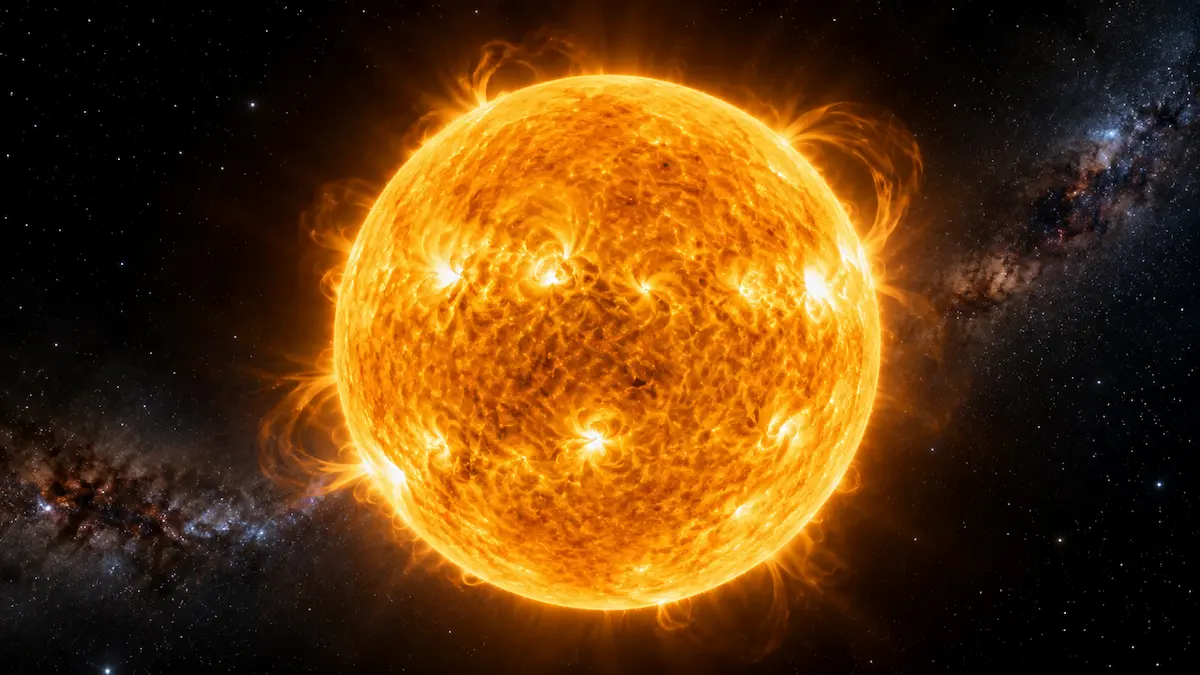
Is our Sun a dwarf star? It is one of the most asked and confusing questions.
Our Sun is so huge that about 1.3 million Earths could fit inside it. It is around 100 times wider than Earth and has 333,000 times more mass than our planet. So, calling something this large a “dwarf” seems hard to believe. But surprisingly, the answer is “yes”. Our sun is a yellow dwarf star. NASA officially describes it as a yellow dwarf, and astronomers give it the scientific classification G2V. In this name, the Roman numeral V means dwarf. Most of the people don’t know the real meaning of the word “dwarf”. In astronomy, it has a completely different meaning. Once you understand why scientists use this label, Sun will become more amazing for you.
Is Our Sun a Dwarf Star — What Does That Actually Mean?
When most people first ask is our sun a dwarf star, they imagine a tiny and faint object that can only be seen through a powerful telescope. But this is only an assumption. In astronomy, the word “dwarf” does not describe a star’s physical size. The Sun is brighter than about 85% of the stars in the Milky Way. It is also more massive than about 95% of the stars within 23 light-years of Earth. In every aspect our sun is enormous. So why is it called a dwarf?
The answer goes back to a Danish astronomer named Ejnar Hertzsprung. In 1906, when he was studying some of the reddest stars in the sky, he noticed something very interesting. He saw these stars could be divided into categories. Some were extremely bright and others were much dimmer. To distinguish them, he called bright star “giants” and dim stars “dwarfs”.
This classification was not based on the physical size of the star. Instead, it was based on the luminosity, which means the amount of light a star produces. Stars brighter than the sun, called giants and stars dimmer than the sun called dwarfs. Now the sun is less luminous as compare to the true giants of the universe so that it was classified as a dwarf. That’s exactly why is our sun a dwarf star remains one of astronomy’s most searched questions. After many years still the answer of “is our sun a dwarf star” surprised most of the people.
What Type of Dwarf Star Is the Sun?

Is our Sun a dwarf star of just one type, or does it belongs to a specific category? It falls into a very specific one. Our Sun is classified as a G-type main-sequence star, formally named as G2V. Each part of its name has a unique meaning.
G-type means the Sun has a surface temperature between 5,300 and 6,000 Kelvin (about 9,000 to 10,000°F). The Sun’s visible surface is about 9,980°F (5,525°C), placing it near the hotter end of this range.
Main-sequence means the Sun is in the longest and most stable stage of its life. During this phase, it produces energy by fusing hydrogen into helium in its core. The Sun has been in this stage for about 4.6 billion years.
The V (Roman numeral 5) is the luminosity class, and it means dwarf. Every main-sequence star has this label. In fact, most stars in the Milky Way are dwarf stars. Red dwarfs make up about 70–75% of all stars in our galaxy, while yellow dwarfs like the Sun make up only about 7%, making them much less common.
What Stage of Life Is Our Sun In?
Is our sun a dwarf star that’s aging? The answer is, “Yes”. Our Sun is roughly halfway through its main-sequence lifetime. It means sun is middle aged. Stars like our Sun stay on the main sequence for about 10 billion years total. Our Sun formed approximately 4.6 billion years ago. That means it has roughly another 5 billion years left before it begins the next stage of its evolution.
Right now, sun continues to producing energy by fusing around 600 billion kilograms of hydrogen into helium every single second in its core. The energy released by this reaction is very crucial for life to survive on earth. Every ray of sunlight, every warm day, and every photosynthetic reaction in every plant on the earth depends on this process. This process takes place about 93 million miles away from the earth. The Sun is also getting slightly larger and brighter as it ages. It has already grown about 10% since it was born. This growth will continue for billions of years.
FAQ
Q: Is our Sun a dwarf star?
Yes. The answer is yes. The Sun is officially classified as a yellow dwarf and is scientifically known as a G-type main-sequence star (G2V). In this classification, the “V“ means dwarf. However, in astronomy, the word “dwarf” describes a star’s luminosity class and stage of life, not its physical size.
Q: What stage of life is our Sun in?
The Sun is currently in the middle of its main-sequence phase. This is the longest and most stable stage of a star’s life. It was formed about 4.6 billion years ago and is expected to remain in this stage for another 5 billion years before becoming a red giant.
Q: What is the real shape of the Sun?
The Sun is almost perfectly spherical, but it is not a perfect sphere. Because it rotates faster at the equator than at the poles, its equatorial diameter is about 43 kilometers wider than its polar diameter. Although many people think the Sun is yellow, but it actually appears white in space. The yellow color we see from Earth is caused by our atmosphere.
Q: Could our Sun become a white dwarf?
Yes. After using up its hydrogen fuel in about 5 billion years, the Sun will expand into a red giant. It will then shed its outer layers, creating a planetary nebula, and the remaining core will become a white dwarf. This small, dense remnant will slowly cool over trillions of years.
Q: Why is the Sun called a dwarf if it’s so large?
This is one of the main reasons people ask “is our Sun a dwarf star”. The term “dwarf” was introduced by Danish astronomer Ejnar Hertzsprung in 1906 to distinguish stars that were less luminous than giant stars. The Sun is called a dwarf not because it is small, but because it is much less luminous than the true giant stars in the universe.
Conclusion
So, is our Sun a dwarf star? The answer is yes. The name may sound confusing, but it is the correct scientific classification. Our Sun is a yellow dwarf, also known as a G-type main-sequence star. It is currently in the most stable stage of its life, where it produces energy by fusing hydrogen into helium. By human standards, the Sun is incredibly large. It is also larger and brighter than about 85% of the stars in the Milky Way. But if we compare sun with the giant stars of the universe, sun is much smaller and dimmer. That’s why scientists put it in the category of the dwarf star. The sun’s long term stability makes life possible on earth. If we have a bigger and more unstable star, then it made our planets inhabitable. But we get a dwarf star “Sun” that provide light and heat for 4.6 billion years, with another 5 billion to go.
Stay connected with Science Scope Hub for more mysterious space stories.
Pingback: What Is a Dyson Sphere? The Most Ambitious Idea in the Universe — And Why Scientists Are Searching for Real Ones Right Now