
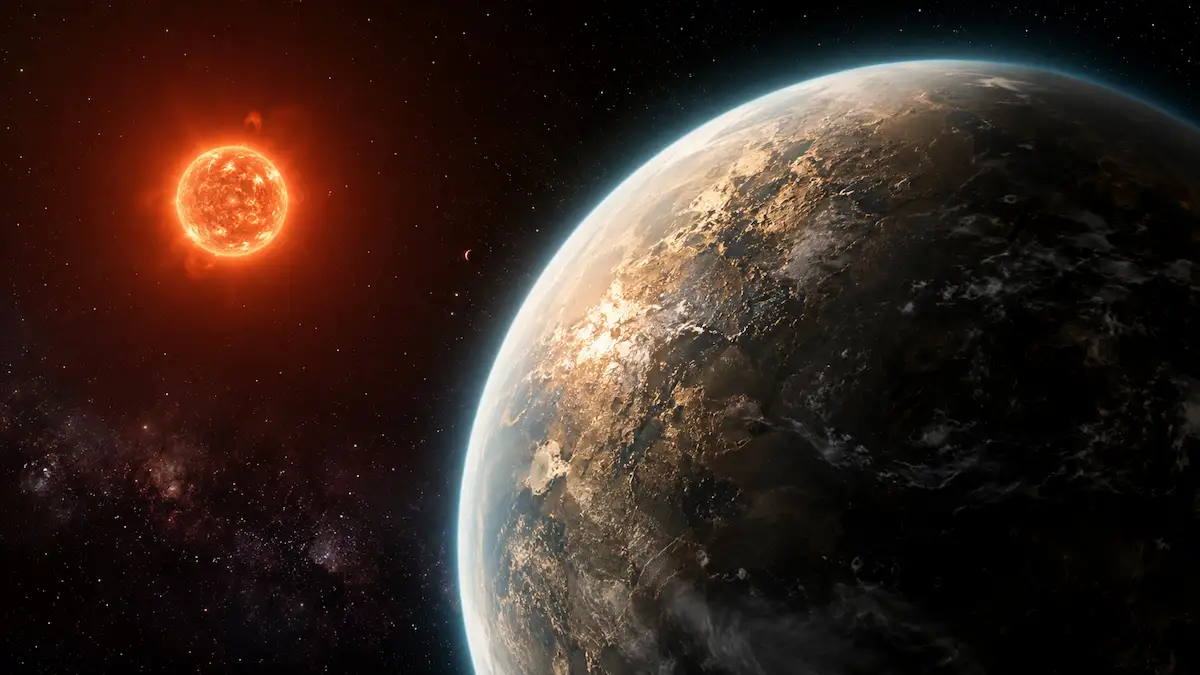
Earth-like planet with atmosphere has become one of the most exciting topics in modern astronomy after scientists found strong evidence that exoplanet, LHS 1140b may have earth like atmosphere. It is located about 48 light-years away from Earth in the constellation Cetus. It may still have a thick atmosphere despite orbiting one of the most active types of stars in our galaxy. LHS 1140b orbits a small red dwarf star, which is cooler than our Sun but often produces powerful stellar flares. These flares release intense ultraviolet and X-ray radiation that can slowly remove atmospheric gases from nearby planets. Because of this harsh environment, astronomers have long believed that rocky planets around red dwarfs would struggle to keep their atmosphere stable.
Recent observations from the James Webb Space Telescope are now challenging that assumption. The data suggest that LHS 1140b may have a stable atmosphere despite it’s surrounded by harsh environment. If future observations confirm these observations, this Earth-like planet with atmosphere could change astronomer’s earlier thoughts about the atmosphere of world that orbits the red dwarf star. The discovery is encouraging researchers to look at these planetary systems with fresh optimism instead of dismissing them as hostile environments. Scientists may need to rethink how they search for habitable planets around red dwarf stars.
NASA found strange patterns on Mars.
Why LHS 1140b Is Different From Most Other Rocky Exoplanets

Scientists have discovered more than 5000 exoplanets beyond our solar system. But only few of them are rocky worlds like earth. Among these rocky worlds, even fewer orbit inside the habitable zone where temperatures might allow water to exist in liquid form. LHS 1140b belongs to this rare category, but its physical properties make it even more interesting than many previously discovered rocky planets. Its diameter is about 1.7 times of earth’s diameter and it contains nearly 5.6 times of Earth’s mass that makes it much denser and gas rich planet like Neptune. These measurements suggest that its interior is dominated by rock and metal, much like Earth. One important advantage of its greater mass is stronger gravity. A stronger gravitational pull do not let its atmospheric gases to escape into space, especially when the planet is constantly exposed to radiation from its active parent star. This makes the possibility of an Earth-like planet with atmosphere much more realistic than scientists once believed.
Scientists also believe LHS 1140b is tidally locked, meaning one side always faces its star while the opposite side remains in permanent darkness. This may sound like an extreme environment but modern climate simulations show that a thick atmosphere could move heat from the bright side to the dark side. This natural circulation could prevent huge temperature differences and create a much more balanced climate across the planet.
James Webb Didn’t Take a Picture — It Read Invisible Clues
James Webb Space Telescope did not able to capture a detailed image of exoplanet LHS 1140b by using its ordinary cameras. So that it studied extremely far object through their light. This approach allows scientists to study space objects that are not seen directly.
Whenever LHS 1140b passes directly in front of its parent star, a tiny amount of starlight travels through the thin layer of gas surrounding the planet before reaching Webb’s sensitive infrared instruments. During that short journey, molecules inside the atmosphere absorb very specific wavelengths of light. Every gas has its own unique spectral fingerprint. James Webb carries instruments capable of measuring incredibly tiny changes in infrared light. By comparing the star’s spectrum before, during, and after the transit, scientists can identify the gases that may exist around the planet.
This technique is known as transmission spectroscopy. It allows scientists to investigate the worlds that are impossible to capture or see directly. Now scientists can study the composition of an extremely far planet’s atmosphere and learn how it has evolved over time. The recent observations give evidence that suggest LHS 1140b is an Earth-like planet with atmosphere.
Could This Planet Hide a Global Ocean Beneath Its Sky?

One of the biggest questions scientists are now asking is whether LHS 1140b could have liquid water. Finding an atmosphere is exciting, but an atmosphere alone does not make a planet habitable. The surface temperature, air pressure, and the amount of heat received from its star all work together to determine whether water can stay in liquid form.
Recent climate models suggest that LHS 1140b may receive enough energy from its red dwarf star to avoid becoming a completely frozen world. At the same time, it is not close enough to become extremely hot like Mercury or Venus. This balance has made researchers consider the possibility that some parts of the planet could support stable liquid water if a thick atmosphere is present.
Because the planet is likely tidally locked, scientists think the region between its permanent day side and night side may offer the most suitable conditions. This area, often called the “terminator zone,” and it could experience moderate temperatures where liquid water has the best chance of surviving. If future observations confirm this idea, the Earth-like planet with atmosphere could become one of the strongest candidates for studying environments that may resemble those needed for life beyond our Solar System.
Can Life Survive Around a Violent Red Dwarf Star?
Red dwarf stars are the most common stars in the Milky Way, but they are also among the most unpredictable. Young red dwarfs regularly produce powerful flares that release energetic particles capable of damaging planetary atmospheres. Because of this, scientists once believed that planets orbiting these stars had very little chance of remaining habitable for long periods. However, LHS 1140b is encouraging astronomers to reconsider that assumption. Its strong gravity may help hold atmospheric gases more effectively than Earth does, reducing the amount of gas lost during stellar activity. Some researchers also believe the planet could have a magnetic field generated by its molten interior. If such a magnetic field exists, it would act like Earth’s magnetosphere, deflecting many charged particles before they reach the atmosphere.
Another important factor is the age of the star. As red dwarfs grow older, they generally become less active than they were during their youth. If LHS 1140b managed to survive the most violent stage of its star’s evolution, it may now exist in a much calmer environment. That possibility makes the Earth-like planet with atmosphere even more valuable because it shows that some rocky planets around red dwarfs may remain stable for billions of years instead of losing their atmospheres early in their history.
Conclusion
The discovery of a possible Earth-like planet with atmosphere around LHS 1140b is an exciting reminder of how quickly space science is advancing. Just a few years ago, astronomers could only confirm whether a distant planet existed. Today, they can begin exploring its atmosphere, climate, and even estimate whether it might contain liquid water.
While many questions remain unanswered, this discovery highlights the incredible power of the James Webb Space Telescope and the future of exoplanet research. As scientists continue collecting more data, LHS 1140b may become one of the most important worlds in the ongoing search for habitable planets beyond our Solar System.
Stay Connected with Science Scope Hub for latest space discoveries and mysteries.
FAQ
What is LHS 1140b?
LHS 1140b is a rocky exoplanet located about 48 light-years away from Earth. It orbits a red dwarf star and lies inside the habitable zone, where temperatures may allow liquid water under the right conditions.
Why is this discovery important?
Scientists have found strong evidence that LHS 1140b could be an Earth-like planet with atmosphere. If confirmed, it would help researchers understand how rocky planets survive around active red dwarf stars and improve the search for potentially habitable worlds.
Did James Webb discover life on LHS 1140b?
No. The James Webb Space Telescope has not detected life. It has only provided evidence suggesting that the planet may have an atmosphere. More observations are needed before scientists can determine its exact composition.
Can humans live on LHS 1140b?
There is currently no evidence that humans could live on LHS 1140b. Scientists are still studying its atmosphere, climate, and surface conditions to understand whether it could support any form of life.
Pingback: 7 Recent James Webb Discoveries 2026 That Will Change How You See the Universe