
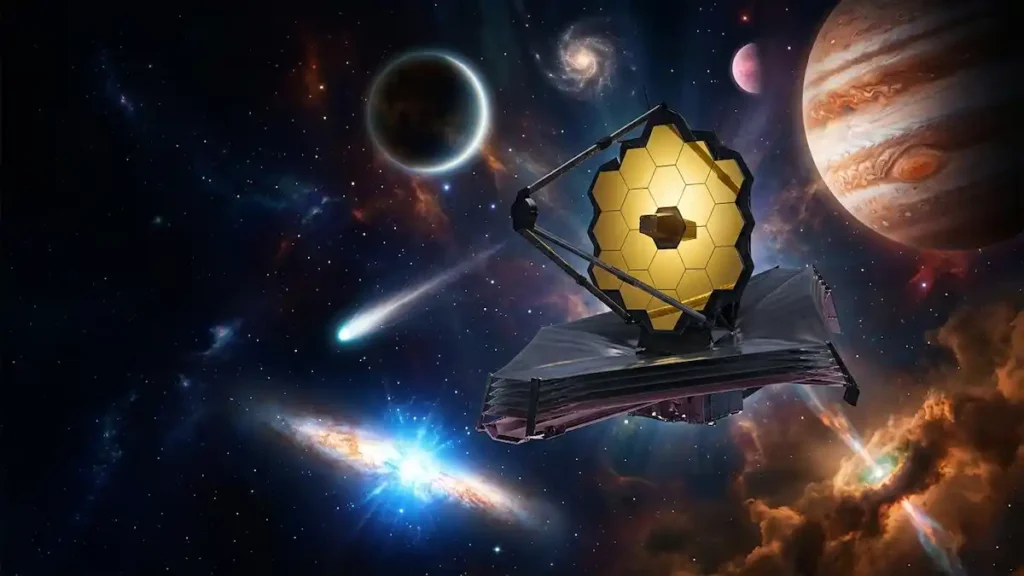
The recent James Webb discoveries 2026 have been nothing short of spectacular.
Every few weeks or so, the James Webb Space Telescope, some 1.5 million miles away from Earth, provides us with new information that lets us reveal the veil of our universe. In 2026, in particular, the James Webb discovered new planets, strange weather on those planets, signs of ancient civilizations from outside of our solar system, and even whole galaxies that were challenging to our understanding of the beginnings of our universe.
If you are not yet familiar with these recent James Webb discoveries 2026, here is a brief synopsis of some of them that I find the most interesting and why they could be significant to us.
Recent James Webb Discoveries 2026 – At a Glance
Before diving into the thrilling details, here are the 7 recent James Webb discoveries 2026 that you will learn about in this article:
- Beta Pictoris d – A hidden planet found orbiting one of the most intensively studied planetary systems.
- WASP-121b – A chaotic world where conditions on the morning and evening sides are dramatically different.
- WD 1856 b – The Planet That Survived the Death of Its Star
- Pink Planet GJ 504b – A gas giant with unusual atmospheric activity resulting in pink clouds.
- Comet 3I/ATLAS – An ancient visitor from our solar system’s history.
- Cigar Galaxy – Webb Reveals 16.5 Million Stars Hidden Behind Cosmic Dust
- Protostar L1527 – A young star surrounded by a dusty cocoon where scientists have observed crystals forming.
Now, let’s take a closer look at these recent James Webb discoveries 2026 and see what other exciting news scientists have to share.
Beta Pictoris d — The Planet Nobody Was Looking For
Among the recent James Webb discoveries 2026, Beta Pictoris d has turned out to be one of the most surprising ones. While analyzing the spectrum of a young star called Beta Pictoris that is located about 63 light-years away from earth, by using Webb’s NIRSpec instrument astronomers have spotted a planet that appeared due to the absorption line of carbon monoxide. Unlike typical telescopic observations, which usually show a bright point, the Webb Space Telescope’s NIRSpec was able to see the planet’s atmosphere. Astronauts clearly found that Beta Pictoris d orbits a young star, named Beta Pictoris. The discovered planet is about 2.4 times more massive than Jupiter. By this way, Beta Pictoris has become the second planetary system in our galaxy, with at least three directly imaged planets. According to the European Southern Observatory’s Very Large Telescope archival data, Beta Pictoris d was confirmed.
WASP-121b — Where Dawn and Dusk Are Two Different Worlds
Amongst the recent James Webb discoveries 2026, the researchers observed that WASP-121b is one of the hottest planets ever observed. It is a typical ultra-hot Jupiter and tidally locked to its sun. It takes about 1.3 days to complete one revolution around its sun. Due to this, one side always faces the star while the other one remains cold and dark. Observations made by Webb show that the hottest planet has significant chemical variations between its dayside and nightside. Indeed, one side is extremely hot, allowing water molecules to split, while the other one stays cool enough for metals and silicates to form clouds. Apart from that, previous James Webb Space Telescope discoveries showed silicon monoxide and water molecules split by the planet’s heat. All the earlier data allow researchers to understand how starlight, convection, and heat define the chemistry of ultra-hot gas planets.
WD 1856 b — The Planet That Survived the Death of Its Star

Among the recent James Webb discoveries 2026, the planet WD 1856 b is most fascinating one because it survived the dramatic death of its host star. In this planetary system, this Jupiter-like plane orbits around a white dwarf and it complete its one revolution in about 34 hours. This white dwarf is located about 80 million light years away from us. James Webb observed that this world is warmer than they expected, at 126 degrees Celsius. The planet’s orbit is only 50 times larger than the distance between the Earth and the sun. The latest James Webb data also show methane and some clouds in the atmosphere of this planet. Scientists have found that it has a mass 4 to 11 times that of Jupiter, and they believe that this planet gives a useful insight into what could happen to our solar system.
Pink Planet GJ 504b — Salt Clouds in an Alien Sky
Amongst other recent James Webb discoveries 2026, GJ 504b is considered one of the most successful cases since it was possible for JWST to get a spectrum of such a faint planetary-mass object for the first time. Indeed, previous measurements taken from the ground were not precise enough to capture GJ 504b’s spectral features because it is extremely faint. With JWST NIRSpec observations, it became possible to detect water, methane, carbon dioxide, ammonia, and other molecules. Apart from that, researchers found evidence of salt cloud and unusual chemistry, which may indicate metallicity enhancement. The results are helping scientists understand the atmospheres of cold planetary-mass objects that were previously too faint to study in detail. However, there is still a question remain unanswered whether GJ 504b should be considered a planet or a brown dwarf since the mass of this object is estimated to be around 25 Jupiter masses.
Comet 3I/ATLAS — An Ancient Visitor From Another Star System

The recent James Webb discoveries 2026 contributed to gaining new insights on the fascinating interstellar comet 3I/ATLAS. Indeed, it is considered the third observed interstellar visitor that passed the Solar System. The researchers utilizing data from both Webb and ALMA have found that water in the comet has contain 10 times more deutrium content compared to the water comets found in our Solar System. Its unusual carbon isotope ratios also suggest that it formed in an extremely cold environment, below about 30 K. According to the scientists, the interstellar comet 3I/ATLAS could originate from an external planetary system, unlike our own solar system, with average formation temperatures several times lower than those in our system. Astronomers believe that this interstellar comet may form around 10–12 billion years ago. This object existed long before the appearance of the Sun and it potentially one of the oldest objects ever studied by humans.
Cigar Galaxy — Webb Reveals 16.5 Million Stars Hidden Behind Cosmic Dust

Amongst the recent James Webb discoveries 2026, most impressive one comes from a cosmic spectacle known as Messier 82. Also known as the Cigar Galaxy, this starburst galaxy located about 12 million light-years away from us. It has been captured by Webb’s NIRCAM in extraordinary detail. The major finding is that there are at least 16.5 million stars in Messier 82.Astronomers are certain that this number only represents a small fraction of the actual stars in the galaxy, as many are too dim for Webb to see. By looking at the Cigar Galaxy in near-infrared light, astronomers were able to peer through the dense clouds of dust and see the galaxy’s irregular disk for the first time.
This latest finding helps astronomers to better understand how stars form within starburst galaxies and what role these violent explosions play in shaping galaxy evolution.
Protostar L1527 — Webb Reveals a Star Still Being Born
Among the James Webb discoveries 2026, the latest findings on L1527 provide a closer insight into the life cycle of a young star. This protostar, which is 460 light years away in the famous Taurus star-forming region, is estimated to be 100,000 years old, and classified as a class 0 protostar. The James Webb Space Telescope allowed to explore this object’s formation process in detail, as its NIRSpec and MIRI instruments targeted the gas and dust filaments around the young star, tracing emission from hydrogen, water, OH, and various ions. With these observations, astronomers revealed that L1527 continues to accrete gas and dust at a rate of about one millionth the mass of our Sun per year, thereby shedding light on the physical mechanism which drives the growth of a young stellar object.
Conclusion
The recent James Webb discoveries 2026 provided valuable information about the most distant and mysterious astrophysical objects in our universe. From unexpected and extreme exoplanet atmospheres to analyzing ancient material from outside our solar system, Webb’s observations are furthering our understanding of the universe and are answering many questions that were previously impossible to figure out. But the work of the telescope has just begun.
It is still exploring the stars, planets, galaxies, and other objects in our universe and continues providing valuable information about chemicals that inhabit these regions, as well as their effects on distant planetary systems.
What makes the recent James Webb discoveries 2026 so remarkable is that they highlight the telescope’s ability to uncover findings that scientists did not expect to find. Therefore, as time goes on and Webb explores more, it is expected that even more surprising facts will be discovered. The next discovery could change our understanding of the universe once again.
Stay connected with Science Scope Hub for more space mysteries and new discoveries.
Pingback: James Webb Investigated 2 Possible Dyson Spheres — The Shocking Truth Revealed