
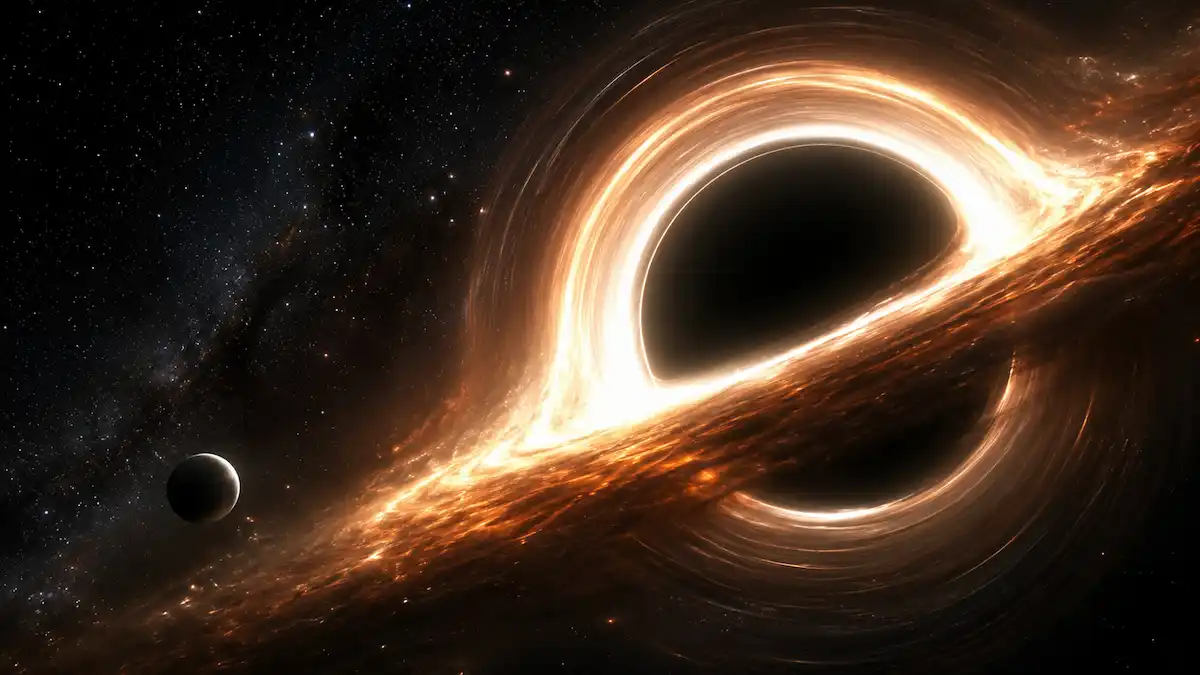
Gargantua black hole is one of the most famous scientific concepts from Interstellar. But is it actually real? The simple answer is “no”. Gargantua is not a real black hole discovered by astronomers. It is a fictional supermassive black hole created for a science fiction movies named Interstellar which is directed by Christopher Nolan. However, the science behind it is surprisingly real. Its design was inspired by Einstein’s theory of general relativity, gravitational lensing, and extreme time dilation.
That’s what makes the Gargantua black hole so fascinating. Although it only appears in a movie, it was made as realistic as possible. The creator of the movie worked with a Nobel Prize winning physicist Kip Thorne to make it as accurate as possible. They even made computer simulations to show how light will act when hitting a fast spinning black hole. The end result was an incredible scientifically accurate black hole that is one of the most realistic Hollywood has ever created.
In this article, you’ll learn whether the Gargantua black hole could really exist, how big it can be, why time moves differently near it, and how it different or similar to the real exising black holes such as Sagittarius A* and TON 618.
What Is Gargantua Supposed to Be?
In the movie Interstellar , Gargantua is an extremely supermassive black hole with a bright accretion disk. The movie’s story involves the planets orbiting around this black hole, including Miller’s planet, Mann’s planet, and Edmunds’ planet. According to the movie’s physics, Gargantua is a rotating black hole with a mass of about 100 million times of the sun. The scientific justification for this design choice involves the fact that only such a supermassive black hole could provide the centripetal acceleration required for planetary orbits without experiencing the same extreme tidal forces expected near a much smaller black hole. This is also why Gargantua is different from the black holes we can imagine. It is not a big black hole of stellar mass. The supermassive black hole can absorb millions or even billions of solar masses and have a much bigger event horizon.
How Big Is the Gargantua Black Hole?
The actual size of the Gargantua black hole has yet to be determined, and it is also depends on which part of the black hole you are talking about.
Firstly, it is important to know that the black hole’s surface is purely theoretical because the matter cannot exist in a solid state at such temperatures. Therefore, the most accurate way to measure the black hole’s size is to consider its event horizon, also known as the point of no return. It is not possible to locate the Gargantua black hole because its size is too big. However, the black hole’s mass is approximately 100 million solar masses, which is significantly more than the stellar black hole’s mass. Therefore, the Gargantua’s event horizon is exponentially bigger than the event horizon of a stellar black hole.
On the other hand, the accretion disk around the black hole is highly visible and easy to locate. However, one should know that the glowing ring around the black hole seen in the movie is not the black hole itself but the shadow of it. Therefore, when determining the size of a black hole, the glowing ring should not be used as a reference because this ring is the depiction of the accretion disk (the glowing ring of gas and dust around the black hole).
How Far Is Gargantua Black Hole From Earth?
The distance between Earth and Gargantua black hole is non-existent because Gargantua is fiction. In the movie Interstellar, it is shown that people reach Gargantua’s system through a wormhole near Saturn. So, you can only see the fake black hole in movie.
Therefore, if you try to search in the web something like “Gargantua black hole distance from Earth” you will find no results. However, if you want to find a real-life supermassive black hole, you need to know about Sagittarius A* that is located in the Milky Way center about 26,000 light-years away from us.
The Mind-Blowing Time Dilation Near Gargantua

One of the most famous ideas connected to the Gargantua black hole is time dilation.
In Interstellar movie, astronauts visiting Miller’s planet discover that approximately one hour on the planet corresponds to seven years for people farther away from the black hole. This sounds impossible, but the basic concept comes from Einstein’s theory of general relativity.According to general relativity, gravity affects the passage of time. The stronger the gravitational field, the more slowly time passes relative to an observer in a weaker gravitational field. The effect becomes extreme near a black hole.
For the movie’s scenario to work, Miller’s planet would have to orbit Gargantua black hole at an extremely closely distance but at the same time be able to sustain life. However, the science fiction becomes science fact when it comes to the theory of spacetime. The researchers that created the film’s scientific foundation started with the assumption that Gargantua is a “spinning” black hole (a rapidly rotating supermassive black hole). Moreover, it has been theorized that such a black hole could create an extreme time dilation for the planet that would be orbiting very closely to it.
So while the exact movie scenario is highly extreme, gravitational time dilation itself is absolutely real physics.
Gargantua Black Hole vs TON 618: Which Is Bigger?
A comparison between the Gargantua black hole vs TON 618 is very interesting because one is fictional and the other is real.
In the movie Interstellar, Gargantua was designed as a supermassive black hole with a mass of roughly 100 million times that of the Sun. On the other hand, TON 618 is a quasar, located several billion light-years away from us and containing the heaviest black hole discovered, which has a mass of tens of billions of solar masses. Thus, it is clear that the TON 618 black hole is much bigger than the fictional Gargantua black hole. However, it is also necessary to consider that the mass of the quasars’ black holes is often difficult to be estimated accurately enough. The biggest difference is that TON 618 is a real astronomical object, while Gargantua exists only in the fictional world of Interstellar. Gargantua was designed to demonstrate the nature of a fast rotating supermassive black hole, while the scientists are studying TON 618’s characteristics through observations of its quasar activity.
Therefore, there is no doubt if we compare Gargantua black hole vs TON 618, then the TON 618 wins in terms of mass. However, the Gargantua is still a great fictional achievement that was unique for the field of astronomy.
Gargantua Black Hole vs Sagittarius A*
Now we compare Gargantua black hole with Sagittarius A*, the real supermassive black hole present at the center of the Milky Way.
First of all, there is a much difference in their masses. The mass of the Sagittarius A* is about 4 million solar masses, while the mass of Gargantua black hole was about 100 million solar masses. So, the black hole from Interstellar movie is around 25 times bigger than the black hole present at the center of our galaxy. Secondly, Sagittarius A* is a real object which astronomers are studying right now, while the Gargantua was only created for the movie, Interstellar. However, this comparison is still useful because these two giants are supermassive black holes. The comparison shows that they are really huge and it is hard to imagine such sizes, especially when we talk about our own black hole at the center of the galaxy. However, even this giant is much smaller than the Gargantua black hole.
Final Answer: Is the Gargantua Black Hole Possible?
The Gargantua black hole is not a real black hole discovered somewhere in the universe. It is a fictional supermassive black hole created for the movie, Interstellar. But the science behind is far more interesting than simply calling it fictional. Its strange appearance is based on real gravitational lensing. Its extreme time dilation comes from real predictions of Einstein’s theory of general relativity. It designed as a rapidly spinning supermassive black hole that was chosen to make the movie’s extraordinary planetary orbits and time effects more scientifically plausible. So, could a real black hole behave exactly like Gargantua? We don’t know. The precise combination of conditions shown in Interstellar is extraordinarily extreme and has not been observed in nature. But the fascinating part is that the movie didn’t need to invent completely new laws of physics to create its monster.
Gargantua is fictional but the physics that inspired it is real.
And that’s exactly why this fictional black hole remains one of the most fascinating examples of science and science fiction meeting on the big screen.