
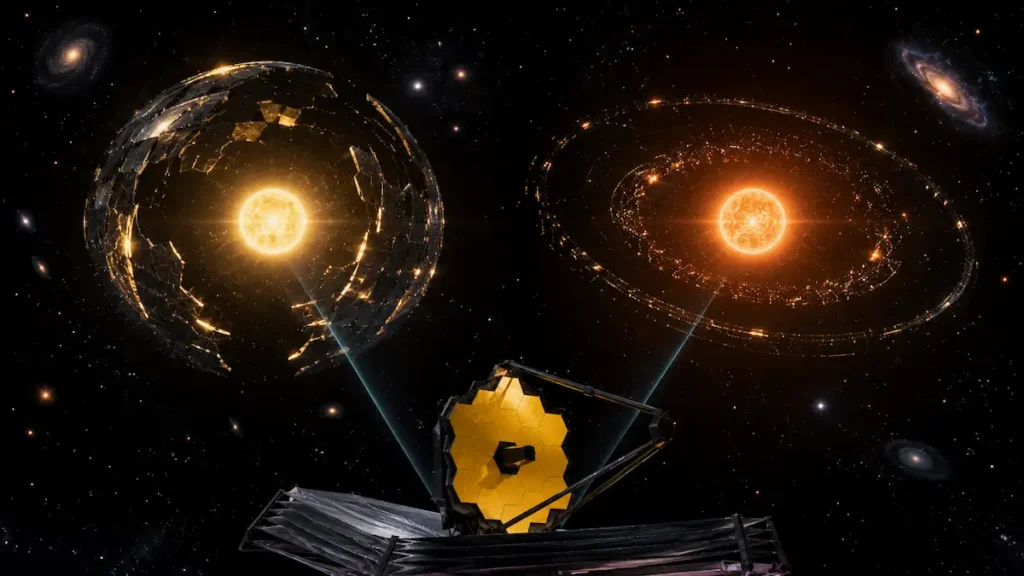
The search for Dyson spheres has taken another fascinating turn. Astronomers have been trying to find signs of alien life for decades. One of the possible ways to do this is to try and find a huge amount of energy coming from some unusual structures built by aliens near a star. Scientists think that, if such a structure exists, it would emit infrared light that would be visible to us from the Earth.
Two stars recently attracted scientists’ attention as the candidates for a Dyson sphere, identified by project Hephaistos, a research project which is designed to find possible signs for alien life. Their unusual and suspicious signals have caught the eye of researchers. But when JWST looked at these stars, it saw something that, perhaps, was not meant to be seen.
No alien megastructures turned out to be hidden behind the mysterious appearance of these stars. Instead, JWST found a more common reason for the appearance of unusual infrared signals. It appeared because these distant galaxies are almost perfectly lined up behind the stars from our point of view. As a result, their light was imprinted on them, creating the illusion of infrared signals coming from strange structures. Although the search for alien life has not reached its goal, this result clearly shows how difficult the search for Dyson Spheres really is. A mission of this level is needed for the work because only such powerful telescopes will allow us to see evidence of intelligent life beyond the Earth.
Recent James Webb Space Telescope Discoveries 2026
James Webb Investigated Two Possible Dyson Sphere Candidates
Project Hephaistos has been searching for potential signs of various forms of alien life, including signals for Dyson Spheres. Two of the candidates for containing a Dyson Sphere had shown an intriguing amount of mid-infrared radiation, which could be a sign of interest to astronomers searching for artificial structures in space. However, the origin of this radiation had not been confirmed, as telescopes before the James Webb Space Telescope had not been able to distinguish between the infrared light coming from the stars themselves and the galaxies behind them, which had a significant amount of light coming from them as well.
This is where the James Webb Space Telescope came into play.
With the superior capabilities of the JWST, astronomers were able to confirm the source of mid-infrared light coming from the two candidates, D and E; unfortunately, this light was not coming from any structures built by aliens. Rather, the source of the light was proven to be two very bright, dusty galaxies, which happened to be behind both of the stars. Both candidates had been proven to just be normal galaxies, containing an abnormal amount of dust and energy, but nothing outside of that.
The galaxy behind candidate D, a Hot DOG, or Hot Dust-Obscured Galaxy, is an example of a class of galaxies that possess an extreme amount of hot dust, while the galaxy behind candidate E is a dusty starburst galaxy, which has a very high star formation rate.
While there is still a possibility of Dyson Spheres remaining undiscovered by the project, the JWST has proven that the candidates D and E are nothing more than normal galaxies, whose high dust content allowed their light to shine through, which astronomers at first mistook for artificial signs of life.
Does This Change the Search for Dyson Spheres?

Not really, In fact the latest evidence could be used to make the search more accurate. Every false approach gives scientists valuable information. In this case, background galaxies can sometimes mimic the signs of a Dyson sphere, being bright red sources when observed from Earth. This data can now be used to help future research on Dyson spheres. It’s important to note that the search for Dyson Spheres is still in its early stages. Scientists are improving their search methods for years.
The James Webb Space Telescope is already helping astronomers become more skilled at this task. The search for Dyson spheres is limited only by time and technology. With more telescopes, researchers can look at more stars, and analyze more data, possibly finding more evidence of some civilization, or a natural phenomenon that can be mistaken for one.
For now though, the latest evidence has proven that the two objects targeted by the James Webb Space telescope were not dyson spheres but rather distant galaxies hidden by stars.
Why Are Scientists Searching for Dyson Spheres?
The idea of a Dyson Sphere was originally posed by the physicist Freeman Dyson, who discussed the possibility of a civilization far beyond our own, would need to harvest the energy of their entire star. The most obvious way to use entire energy of a star is to construct some kind of megastructure around the star itself to collect the energy. Scientists assume that it would likely take the form of a loosely arranged “swarm” of assorted solar panels, satellites, and other structures. Together, these objects could collect a large amount of the star’s energy.
The question is, how could we observe a Dyson sphere from the earth?
The answer lies in the infrared spectrum. Any object that absorbs significant amounts of radiation will emit waste heat in the form of infrared light. Because heat can produce infrared radiation, a large artificial structure around a star could potentially create an unusual infrared signature. This is why astronomers are so interested in discovering “infrared-dim” stars.
But there is a major problem. The Universe is full of natural sources of infrared light. These include things like dusty galaxies, regions of space where stars are being born, and the areas around black holes. So, just because you see some infrared light doesn’t necessarily mean that it was created by alien megastructures. Before jumping to conclusions like Dyson spheres, astronomers have to exhaust all other possibilities first. That is exactly what happened with the latest candidates.
Conclusion
The newest search for Dyson spheres ended up without finding any trace of alien civilizations, but the mystery seems to continue. After James Webb’s team analyzed the anomalous infrared light, it turned out that the reason for it was most likely not alien megastructures but distant galaxies. This discovery shows how challenging it can be to find traces of advanced civilizations in the infinite cosmos. However, the search for Dyson Spheres has not finished yet, and scientists have become even more prepared for the next search. More sensitive telescopes will be able to find potential candidates for being consumed by a star in the future. Thus, the chances of getting a positive result in the search for alien megastructures will be much higher. Nevertheless, so far, scientists have not found any signs of alien life in these two stars. However, the fact that such civilizations could exist in our Universe makes you wonder if they are out there searching for other civilizations too.
Stay connected with Science Scope Hub for latest space news and space mysteries.