
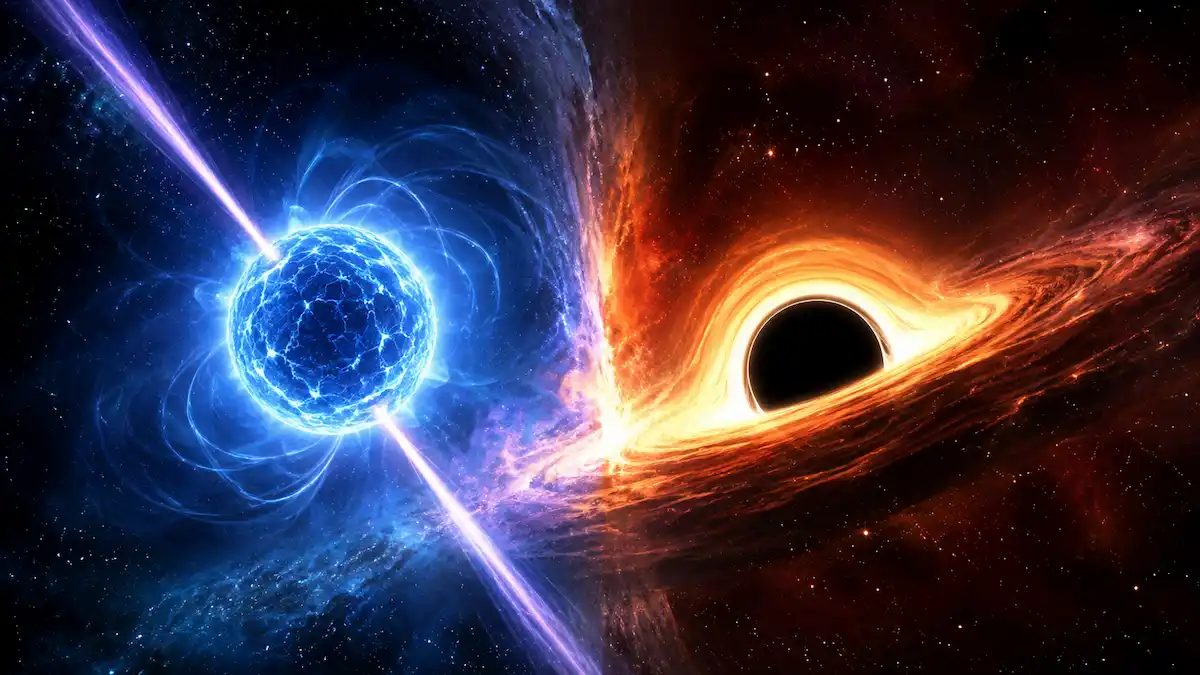
Every black hole and neutron star originate from the same supernova explosion of gigantic stars. However, there is a vast difference in how the core of a dead star behaves. The science behind black hole vs neutron star is depend on the force in play within a core, the mass of a collapsing star, and the degeneracy pressure of neutron matter. Hence, the topic of black hole vs neutron star is one of the most intriguing subjects in stellar evolution.
Not every dying star becomes a black hole. Some of them are turned into neutron stars for physical reasons. A star stops being a star when its core collapses under its gravity. The only reason why the process can stop is that the immanent attractive force cannot penetrate through the quantum barrier known as neutron degeneracy pressure. If the gravity wins the race, the result is a black hole, if not – there is a neutron star.
While one has a rigid surface composed almost entirely of neutrons, the other literally consumes everything around it, compressing matter beyond the point where not even light can escape. The study of black hole vs neutron star is important to understand the life-cycles of massive stars, but also to explain how galaxies form, how heavy elements are produced in the universe and test the limits of Einstein’s theory of gravity.
Are black holes actually holes in space?
The Life of a Massive Star Determines Its Final Fate
Every star spends its life balancing two powerful forces. Gravity pulls in all the matter in a star which leads to its collapse, while the fusion process that occurs in the core produces energy that pushes outward. These two forces are remained balance for the majority of a star’s lifetime. A massive star will fuse hydrogen into helium and heavier elements like carbon, oxygen, neon, and silicon until it begins forming iron.
Once a star reaches this stage the production of energy stops since further fusion of iron does not give off any energy; instead, it consumes energy. At the same time, the core of the star lost outward supporting pressure which allows gravity to overcome it. The core collapses within less than a second. This leads to a core-collapse supernova which is one of the most violent explosions observed in the universe.
However, this explosion is not what ultimately determines the outcome in black hole vs neutron star. Instead, everything depends on the core that remains after this explosion. It determines the leftover will either becomes a neutron star or continue collapsing into a black hole.
Why Some Stars Become Neutron Stars

A neutron star is one of the densest objects known to science. If the core that remains from a star’s collapse remains below the stability limit supported by neutron degeneracy pressure, gravity is finally stopped before a black hole can form. The remaining object is only about 20 kilometers (12 miles) wide but it can contain more mass than our sun holds. We can’t even imagine how dense it is. Only a single teaspoon matter of neutron star weighs billions of tons on earth. There are no normal atoms present inside a neutron star. Electrons and protons merged together and leaving neutrons packed together tightly. Many neutron stars are able to rotate hundreds of times each second. Some produce beams of radio waves which sweep across deep space like a lighthouse. When the beams pass by our line of sight on Earth, we see them as pulsars.
Using X-ray telescopes, NASA’s new NICER mission has been able to measure neutron stars in unprecedented detail. It help to improve scientists’ understanding about densest material in the universe and answers about black hole vs neutron star.
Why Some Stars Become Black Holes Instead

While neutron degeneracy pressure can halt the collapse of many stellar cores, but it is not enough to completely resist gravity. If the remaining core is particularly massive, it will continue to collapse under its own weight, until it reaches the stage of a black hole.
The division between these two outcomes is called the Tolman-Oppenheimer-Volkoff (TOV) limit. While the exact limit is still debated among scientists, most agree that a neutron star is only stable within the range of 2-3 solar masses. Once the core collapses past this point, neutron degeneracy pressure is overcome, and the core begins collapsing until it reaches a point where not even light can escape its gravity; the event horizon.
Unlike neutron stars, the collapsed mass of a black hole has no surface, as whatever matter crosses the event horizon is lost to gravity forever. This has been predicted by Einstein’s General Theory of Relativity and backed up by observation. LIGO and Virgo’s observations of stellar-mass black holes confirm that such objects exist in the universe, and providing direct observational evidence for the final stage of black hole vs neutron star evolution.
Black Hole vs Neutron Star: The Key Differences Explained
While both objects originate from the remnants of giant stars, but the black hole vs neutron star is very different in its nature.
A neutron star is a stellar remnant dense enough to have a surface of neutrons, which make it possible to see. Light can escape from it and also pulsar’s beams of radiation from its poles can be observed on Earth. Unlike the neutron star, a black hole has no surface, only an infinitely dense point called a singularity. Black hole is surrounded by an invisible boundary which is called event horizon or point of no return. Nothing can escapes from it after crossing event horizon, even a ray of light.
Density and size are another major difference in black hole vs neutron star. A neutron star is about 20 km in diameter on average, but the black hole’s event horizon’s diameter totally depends on its mass. However, the singularity in the middle of the black hole can be anything from a few centimeters to tens of kilometers. Both neutron stars and black holes contain enormous amounts of matter and have extremely powerful gravity.
The reason why scientists are so fascinated by black hole vs neutron star is that they help to observe how gravity affects matter in the most extreme conditions possible and test the foundations of physics.
Can a Neutron Star Eventually Become a Black Hole?
Yes—but only if it gains some additional mass.
A neutron star can exist for billions of years but in a binary star system, it can pull gas from its companion star. This added mass increases the size and density of the neutron star. If the neutron star gains enough mass beyond the TOV limit, then the neutron degeneracy pressure will no longer be able to withstand the gravity. And then neutron star collapse under its own gravity and turn into a black hole. This theory is now significant in the black hole vs neutron star debate since it shows how one can turn into the other under specific conditions.
Another theory involves the collision of two neutron stars. GW170817 detected by the LIGO-Virgo collaboration in 2017, is the first event observed that revealed the merger of two neutron stars that occurred a long time ago. In addition to an enormous amount of energy, such a collision leads to the creation of heavy elements like gold or platinum, and a very massive object at the center, which over time will most likely turn into a black hole. This type of observation helps scientists to explain black hole vs neutron star.
Final Thoughts
The answer to black hole vs neutron star is ultimately determined during the final moments of a massive star’s life.
If the core that is collapsing under its own gravity does not reach the critical density (supported by the neutron degeneracy pressure), it will form a stable neutron star. However, if the implosion proceeds further and neutrons are no longer able to resist the gravity, an unstoppable collapse occurs until the point of no possible escape: a black hole form.
Although modern astronomy has answered many questions surrounding black hole vs neutron star, but important mysteries still remain. Researchers continue investigating the critical mass and other variables, including rotation, magnetism, and binary interactions, that may describe the end of a massive star.
Future observations from next-generation telescopes and gravitational-wave observatories will able to further improve our understanding towards black hole vs neutron star.
FAQ
Que: What is the biggest difference in black hole vs neutron star?
Ans: The biggest difference in black hole vs neutron star is that a neutron star has a physical surface supported by neutron degeneracy pressure, while a black hole is surrounded by an event horizon from which nothing can escape, not even light.
Que: What determines black hole vs neutron star formation?
Ans: The final outcome of black hole vs neutron star depends mainly on the mass of the collapsing stellar core after a core-collapse supernova. Smaller cores become neutron stars, while more massive cores collapse into black holes.
Que: Can a neutron star become a black hole?
Ans: Yes. If a neutron star gains enough mass from a companion star or merges with another neutron star, it can exceed the stability limit and collapse into a black hole.
Que: Que: Will the Sun ever become a black hole?
Ans: No. The Sun is not massive enough. It will eventually become a white dwarf rather than becoming a black hole.
Que: Which is denser, a black hole or a neutron star?
Ans: Both are extraordinarily dense, but black holes represent a more extreme gravitational collapse. In the context of black hole vs neutron star, black holes compress matter beyond the point where neutron degeneracy pressure can resist gravity.
YOU MAY LIKE
- New Tesla Roadster Takes Flight — But Elon Musk’s Original Car Is Still in Space
 This week, Tesla Roadster comes twice in the news for two very different reasons. On October 15, 2026, Tesla showed off a new Roadster prototype in Texas that appeared to lift off the ground using thruster technology inspired by SpaceX. While the new Roadster was making headlines on Earth, the original red Tesla Roadster that… Read more: New Tesla Roadster Takes Flight — But Elon Musk’s Original Car Is Still in Space
 - Astronomers Find the First Green Star – Could Our Sun Also Glows Green After it Dies?
 Astronomers just found the first green star and the reason of its unusual color is surprising. Astronomers at the University of Warwick have detected a dead star that actually looks green to the human eye, something that never confirmed before research. Scientists believe that the star has gained this green color because it consumes some… Read more: Astronomers Find the First Green Star – Could Our Sun Also Glows Green After it Dies?
 - Microblazar Discovered In Our Galaxy, After 30 Years of Searching And Its Jet Is Pointed Straight At Earth
 Recently a microblazar has been confirmed in our own galaxy, Milky Way. Scientists have been investing this cosmic mystery for nearly 30 years. The study reveals that the object named IRAS 18293-0941 sits about 1200 light years away from Earth and one of its powerful jets points straight towards the Earth. It sounds danger but… Read more: Microblazar Discovered In Our Galaxy, After 30 Years of Searching And Its Jet Is Pointed Straight At Earth
 - Orionid Meteor Shower: The Ancient Shooting Stars That Left By Halley’s Comet Centuries Before You Were Born
 The Orionid Meteor Shower returns this month, and brings beautiful streaks of lights and fill the dark sky with colours. Each meteor burning up in the sky is a tiny piece of dust that left behind by the Halley’s Comet hundreds of years ago. Now centuries past, and when Earth passes through this old trail… Read more: Orionid Meteor Shower: The Ancient Shooting Stars That Left By Halley’s Comet Centuries Before You Were Born
 - Northern Lights Alert: Aurora May Be Visible in 22 US States Tonight
 Northern Lights Alert is going out across parts of the United States tonight, and if you live in the right state, you might get a rare chance to see the aurora borealis without booking a flight to Alaska or Iceland. NOAA’s Space Weather Prediction Center has issued a geomagnetic storm watch for the night of… Read more: Northern Lights Alert: Aurora May Be Visible in 22 US States Tonight