
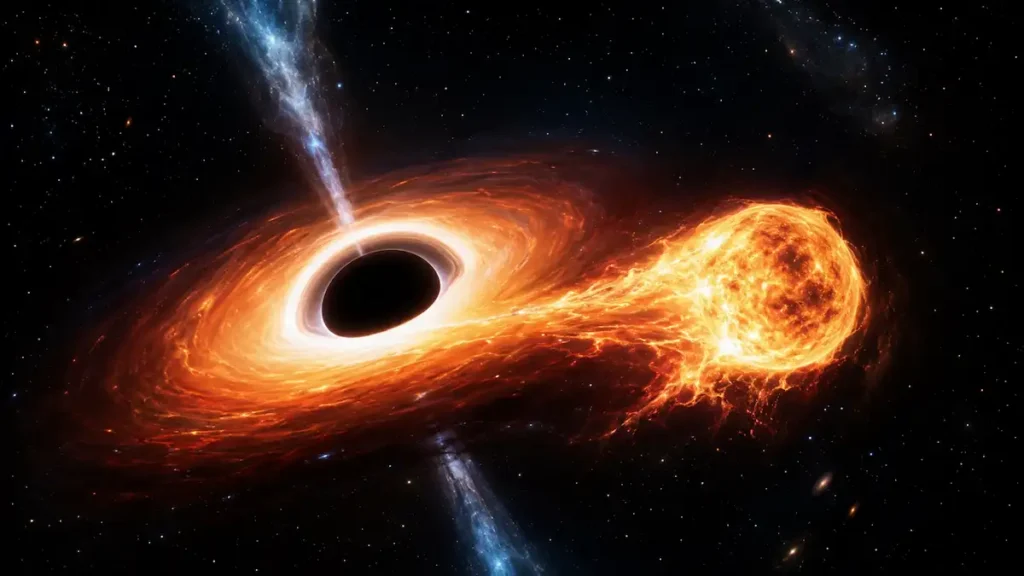
A black hole eating a star sounds like imaginations, but it’s true. Astronomers actually observed it.
The latest news from NASA has uncovered one of the weirdest supermassive black holes yet. As we know that most of the suprmassive black holes are present at the center of the galaxies. But this black hole was unique; it was drifting thousands of light-years away from the core, this type of black holes are called wandering or rogue black holes. And the most interesting part is, astronomers found it was devouring a star. After this observation, events like “black hole eating a star” has now increased. These events are also called tidal disruption events (TDEs). These explosions allow scientists to better understand how black holes work and how galaxies form, and they even ask some important questions like “What causes some supermassive black holes to wander through space?” so every single bit of these discoveries are precious to us.
NASA finalized Roman telescope launch date.
So, what actually happens when a black hole eating a star event begins? Can any black hole swallow a star? And could something similar ever happen to our own Sun? Here’s what the latest science tells us.
How a Black Hole Eating a Star?
A black hole eating a star would not be a gentle or gradual process. The type of scenario in which one pictures of a huge, hungry black hole consuming everything around it is incorrect. This process starts when the star passes inside a critical distance known as the tidal radius. If the star is far enough away, it can orbit the black hole, safely, for billions of years. However, if the star gets too close, or goes beyond a certain point of no return, the black hole will begin to pull the star towards him.
The black hole pulls much stronger on the closest part of the star, creating a larger gravitational force on one side and a smaller one of the opposite. This difference in forces can tear a star apart, stretching it out until it reaches a point where it can no longer hold itself together. This process of being stretched out is called spaghettification.
Once the star is torn apart, not all of its material falls into the black hole immediately. Some of the material spread into the space, while the rest material forms a rapid spinning accretion disk around the black hole. Due to the intense friction created by the accretion disk, the gas is heated to millions of degrees, radiating intense amounts of light, X-rays, and ultraviolet light. Because of this glowing disk scientists easily detect when a black hole eating a star.
NASA’s Latest Discovery Reveals a Wandering Black Hole

The latest black hole eating a star event is unusual because the black hole was not located where scientists were expecting to find it. Most of the supermassive black holes stay at the centers of galaxies, where they grow by sucking gas, dust, and occasionally stars. But from the recent observations NASA scientists found this black hole 30,000 light years away from the center of its host galaxy.
NASA scientists studied the record-breaking tidal disruption event which is called AT2024tvd, where a black hole ripped apart a passing star. This explosion is bright enough to be seen from Earth. The astronomers used NASA’s Neil Gehrels Swift Observatory, Hubble Space Telescope and the Chandra X-ray Observatory to study the explosion in different wavelengths of light. The discovery was surprising because it is very rare to find such a massive black hole far away from its galaxy’s center. From the researcher’s point of view, this black hole may have been ejected long ago when its galaxy was collided with another galaxy, or another theory states that it may be the remains of a smaller galaxy that was merge with any other galaxy. To find a wondering black hole is much difficult than finding those present at the center of the galaxy. Scientists say when they see a black hole eating a star, it looks like a lighthouse.
Can a Black Hole Eat the Sun or Even Earth?
After knowing about a black hole eating a star, many people ask the same question: could our own Sun be next? The answer is extremely unlikely.
The nearest black holes from earth are thousands of light years away, and are not approaching us. If a black hole with the mass of our sun was to appear in the place of the sun, we would continue to orbit as normal, seeing as black holes have gravity, and gravity is based on mass, not type of star. A problem would arise however, because the sun is our source of heat, light, and energy. Without a sun we lost sunlight, heat and energy completely. We would most likely freeze and making life on Earth becomes impossible.
The Sun itself is safe. It isn’t dense enough to be able to collapse into a black hole upon death. Astronomers think it’ll instead turn into a red giant and then shrink into a white dwarf wrapped in a planetary nebula. A black hole eating a star only possible if it gets too close to one, which given the immeasurable size of space, isn’t likely to happen given how many stars there are.
Why Don’t Black Holes Swallow Everything Around Them?
One of the biggest myths about black hole is that it constantly pulls in everything nearby. Many Hollywood movies also show black hole like a cosmic vacuum cleaner but it does not behave like that.
The gravity of a black hole does not become strong enough to suck in all material until one gets very close to it; objects that orbit far away can do so for an extremely long time. This is evident with our galaxy, the Milky Way, whose center contains an enormous black hole, Sagittarius A*, which weighs 4 million times more than our sun. However, there are still billions of stars that orbit safely around it without getting sucked in. A black hole eating a star only occurs if its orbit would decay and close in on the black hole until it reaches the tidal radius, beyond which light cannot escape the gravity of the black hole. Most stars will not decay close enough to be tidally disrupted, which is why these disruptions are rare events.
Final Thought
A black hole eating a star is one of the most violent processes imaginable, but it’s also one of the most valuable to scientists. Because the black hole in these rare events is less massive than a supermassive black hole, it allows scientists to study these space monsters in a new way. A black hole in the form of a supermassive object at the heart of a galaxy is an object that does not appear to be in danger of dying out soon. A recent finding by NASA suggests that a large percentage of supermassive black holes are “wandering” through space, having lost their galactic home.
Even though that is surprising, this finding will not affect us here on Earth. Tearing stars apart is not something that is going to happen anywhere near our solar system anytime soon. It is good for us that the events are so far away because scientists are able to study the gravity from afar In the future, as new telescopes gaze into the cosmos, it will lead to many more studies about black holes and their effects on the stars around them. With the findings from the black hole eating a star, astronomers will hopefully be a little closer to figuring out the role they play in the formation of the universe.
YOU MAY LIKE
- Milky Way’s Black Hole Is Slowly Destroying Itself to Power Cosmic Rays”
 Milky Way’s black hole may be doing something scientists never expected. It is sacrificing a piece of itself to power some of the most energetic particles in our galaxy. A theoretical study suggests that Sagittarius A*, the supermassive black hole present at the center of the Milky Way, could be using its own spinning energy… Read more: Milky Way’s Black Hole Is Slowly Destroying Itself to Power Cosmic Rays”
 - New Tesla Roadster Takes Flight — But Elon Musk’s Original Car Is Still in Space
 This week, Tesla Roadster comes twice in the news for two very different reasons. On October 15, 2026, Tesla showed off a new Roadster prototype in Texas that appeared to lift off the ground using thruster technology inspired by SpaceX. While the new Roadster was making headlines on Earth, the original red Tesla Roadster that… Read more: New Tesla Roadster Takes Flight — But Elon Musk’s Original Car Is Still in Space
 - Astronomers Find the First Green Star – Could Our Sun Also Glows Green After it Dies?
 Astronomers just found the first green star and the reason of its unusual color is surprising. Astronomers at the University of Warwick have detected a dead star that actually looks green to the human eye, something that never confirmed before research. Scientists believe that the star has gained this green color because it consumes some… Read more: Astronomers Find the First Green Star – Could Our Sun Also Glows Green After it Dies?
 - Microblazar Discovered In Our Galaxy, After 30 Years of Searching And Its Jet Is Pointed Straight At Earth
 Recently a microblazar has been confirmed in our own galaxy, Milky Way. Scientists have been investing this cosmic mystery for nearly 30 years. The study reveals that the object named IRAS 18293-0941 sits about 1200 light years away from Earth and one of its powerful jets points straight towards the Earth. It sounds danger but… Read more: Microblazar Discovered In Our Galaxy, After 30 Years of Searching And Its Jet Is Pointed Straight At Earth
 - Orionid Meteor Shower: The Ancient Shooting Stars That Left By Halley’s Comet Centuries Before You Were Born
 The Orionid Meteor Shower returns this month, and brings beautiful streaks of lights and fill the dark sky with colours. Each meteor burning up in the sky is a tiny piece of dust that left behind by the Halley’s Comet hundreds of years ago. Now centuries past, and when Earth passes through this old trail… Read more: Orionid Meteor Shower: The Ancient Shooting Stars That Left By Halley’s Comet Centuries Before You Were Born