
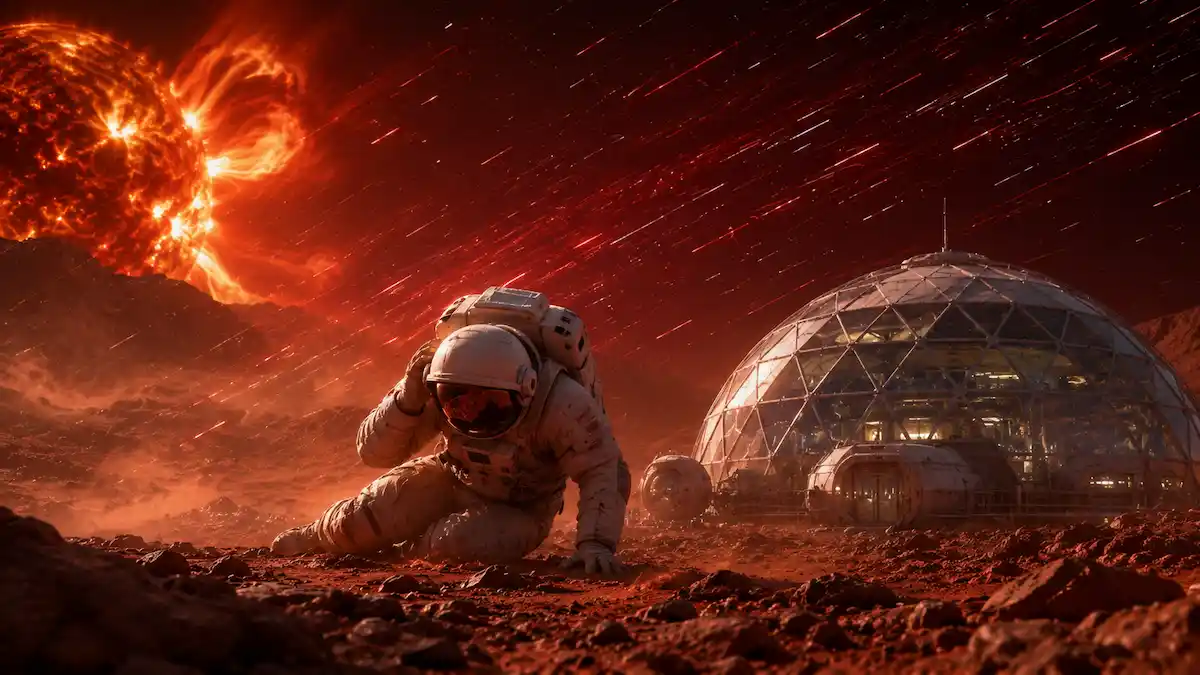
Mars radiation could potentially be one of the greatest challenges for humans to survive on the red planet. During the human’s journey to space, mars is most likely the next stop, after the moon. Scientists have found that, Mars has reserves of water ice, valuable minerals, and other resources that could be used to make the trip much easier for humans, considering that a day on Mars only lasts for 24.6 hours. But Mars has a major issue, which is radiation, and it could be even bigger issue than the cold, and occasional dust storms.
Growing Food on Mars: The Impossible Challenge Scientists Are Trying to Solve
Our Earth has atmosphere that acts as a blankets to our planet and magnetic field that protects us from radiation and other space junk, but Mars has a very, very thin atmosphere and no magnetic field so it provides very less protection from the harmful mars radiation. For short travel times, radiation may not be an issue, but for long period mars missions, radiation could could significantly increase health risks. So that Mars radiation be a much worse threat than the isolation, and cold temperatures of the planet itself.
Mars Radiation Comes From Two Very Different Sources

The mars radiation is not only produced by a single phenomenon. Galactic cosmic rays (GCRs) and solar energetic particles are the two main sources of mars radiation.
Galactic cosmic rays originate from outside of our solar system. These are high-energy particles from unknown sources, possibly produced by astrophysical phenomena or other high energy processes. Individual GCRs can penetrate spacecraft shielding and human tissues. Thus, they proved a challenge to our current shielding technologies.
Solar energetic particles, have a different source mechanism. These are charged particles accelerated from the sun, most often by solar flares or coronal mass ejections. Unlike galactic cosmic rays, solar particles are sporadic events. They can produce much higher radiation in a very short period of time.
Both sources have a contribution on mars radiation environment and both can produce different scale and type of radiation risk. While galactic cosmic rays are a slowly varying hazard, solar events can produce a much greater radiation hazard over a short period of time. The atmosphere of Mars is not sufficient to protect against either form of radiation. The atmosphere of Mars provides less protection against radiation than Earth. So during a mission on mars, radiation risk increases as compare to the earth missions. Exposure to mars radiation for long time can increases the risk of cancer and other health problems because high energy particles can interact with the cell and DNA. NASA has declared mars radiation as one of the key challenges to future long-duration mars missions.
YOU MAY LIKE
- NASA Investigates a Hidden Moon Cave That Could Become NASA’s Next Lunar Base Site
 NASA has approved a mission to search for a hidden Moon cave that could one day provide shelter for astronauts in future. The mission, called GIMLI, will explore a mysterious pit on the lunar surface to find out whether it leads to a huge underground lava tube. If scientists confirm that the hidden cave exists,… Read more: NASA Investigates a Hidden Moon Cave That Could Become NASA’s Next Lunar Base Site
 - Milky Way’s Black Hole Is Slowly Destroying Itself to Power Cosmic Rays”
 Milky Way’s black hole may be doing something scientists never expected. It is sacrificing a piece of itself to power some of the most energetic particles in our galaxy. A theoretical study suggests that Sagittarius A*, the supermassive black hole present at the center of the Milky Way, could be using its own spinning energy… Read more: Milky Way’s Black Hole Is Slowly Destroying Itself to Power Cosmic Rays”
 - New Tesla Roadster Takes Flight — But Elon Musk’s Original Car Is Still in Space
 This week, Tesla Roadster comes twice in the news for two very different reasons. On October 15, 2026, Tesla showed off a new Roadster prototype in Texas that appeared to lift off the ground using thruster technology inspired by SpaceX. While the new Roadster was making headlines on Earth, the original red Tesla Roadster that… Read more: New Tesla Roadster Takes Flight — But Elon Musk’s Original Car Is Still in Space
 - Astronomers Find the First Green Star – Could Our Sun Also Glows Green After it Dies?
 Astronomers just found the first green star and the reason of its unusual color is surprising. Astronomers at the University of Warwick have detected a dead star that actually looks green to the human eye, something that never confirmed before research. Scientists believe that the star has gained this green color because it consumes some… Read more: Astronomers Find the First Green Star – Could Our Sun Also Glows Green After it Dies?
 - Microblazar Discovered In Our Galaxy, After 30 Years of Searching And Its Jet Is Pointed Straight At Earth
 Recently a microblazar has been confirmed in our own galaxy, Milky Way. Scientists have been investing this cosmic mystery for nearly 30 years. The study reveals that the object named IRAS 18293-0941 sits about 1200 light years away from Earth and one of its powerful jets points straight towards the Earth. It sounds danger but… Read more: Microblazar Discovered In Our Galaxy, After 30 Years of Searching And Its Jet Is Pointed Straight At Earth
NASA Has Already Measured the Mars Radiation Environment.
The good news is that scientists don’t have to guess about all the dangers what astronauts will face on the mars. NASA’s Curiosity rover is carrying a lot of equipment, including the Radiation Assessment Detector or RAD. The RAD was specially designed to measure the radiation environment during the flight and on the planet after landing. The readings have given us the most useful information that help us to plan the future mars missions.
During the early stages of Curiosity’s mission on the Martian surface, the galactic cosmic rays were delivering about 210 micrograys per day, but it varies over time. NASA observed that Mars has thin atmosphere so it can block some mars radiation but the amount of protection changes depending on the weather and the season. This number is even more important because Curiosity is a machine, not a person. An astronaut cannot just wear a spacesuit and get the same protection as the rover. For human missions to space, we would need to build special spacecraft, houses, and vehicles. We would also need strict safety steps to protect astronauts from radiation as much as possible. Plus, the danger from radiation doesn’t start when astronauts land. It begins the moment they start the trip.
The Journey to Mars May Be One of the Hardest Parts

A future crew sent to Mars would face another unique challenge: a long journey in deep space. While they are circling the planet, astronauts are going to be outside from the protections of Earth’s atmosphere as well as the planet’s magnetic field. This result, exposing them to cosmic rays and solar energetic particles. Curiosity’s RAD measured an average of 1.8 millisieverts of galactic cosmic radiation per day inside the space craft, while on its way to Mars.
NASA later used the curiosity’s readings to calculate an estimate of radiation exposure for a reference mission to Mars. The reference mission would consist 180-day journey to Mars, 500-day stay and then 180-day to return back. The total exposure calculated by the models would be about 1 sievert during the entire mission. This radiation is divided into three equal parts, one third from the journey to Mars, one third from the stay on mars and one third from the return trip. Of course, those are just estimates, since it depends on the spaceship, the time when mission is launched, the amount of shielding, and other factors. So it is a very challenging engineering problem.
One obvious way to reduce mars radiation exposure for astronauts is to build spacecrafts with better shielding. The solution is to create more shielding, but shielding adds mass, and it can be expensive to transport additional material into space. As a result, engineers cannot simply create massively thick spacecraft walls in order to solve the problem.
There is one more issue: extremely energetic cosmic rays can collide with atoms of shielding material and creates secondary radiation. Thus, a material’s quality is as important as the thickness of the shield. That’s why Mars radiation is such a tricky issue. It has medical, physical, aerospace, and mission control implications.
A Solar Storm Could Turn Radiation Into an Emergency
Long-term mars radiation exposure is only half of the problem. The sun can sometimes emit powerful eruptions of high-energy particles which could penetrate spacecrafts and damage the astronauts. If an astronaut would present outside during storm, he could recieve a much larger dose of radiation in a much shorter time.
We’ve already witnessed some of these events. In May, 2024 a huge solar storm struck to mars. During that event NASA’s curiosity rover detected the largest radiation spike since it was landed in 2012, by using its RAD. According to the NASA’s observation, an astronaut standing beside the curiosity rover, would recieve high dose of mars radiation about 8100 microgray which is equivalent to 30 cheat X-rays. But it does not mean that an astronaut would die immediately after the exposure, but the point is, solar activity can chaotically change the mars radiation levels.
For long-duration missions, Mars base would able to monitor solar activity levels. Also astronauts working outside the habitat could require a warning system and protocols to get back inside the safety of the habitat. Another option is to have a shielded room inside the habitat where the crew could take shelter during such events. Mars explorers may have to monitor the sun just like the way our own hurricanes are monitored.
Conclusion: Mars Radiation Can Influence the Future of Exploration
Although Mars has many of the resources humans may need to create a permanent base on the Red Planet, getting there is only half the battle. The Mars radiation could become a major impediment to any human exploration that lasts longer than a few years.
NASA’s findings have shown that the Mars radiation level can vary greatly depending on solar activity and a spacecraft’s proximity to the sun. Because of the dual threat of galactic cosmic rays and solar particle events, radiation shielding may be necessary for long duration missions on the Red Planet. The combined effects of the two may prove to be not only an emergency concern but a constant factor for anyone attempting to travel near or on Mars. Solutions to this dilemma are likely to be multifaceted, utilizing shielding aboard spacecraft and on the surface of Mars using regolith, water, natural landforms, specially designed shelters, and limiting exposure.
Mars radiation may end up being a deciding factor in humanity’s travels on the red planet. It will define where we can go, what equipment we will need, what we can build, and how long we can stay. Being a hospitable environment in the long term may be how Mars’ atmosphere and magnetic field will affect human endeavors there. We may be forced to learn to live with the mars radiation long before we can truly inhabit the planet.