
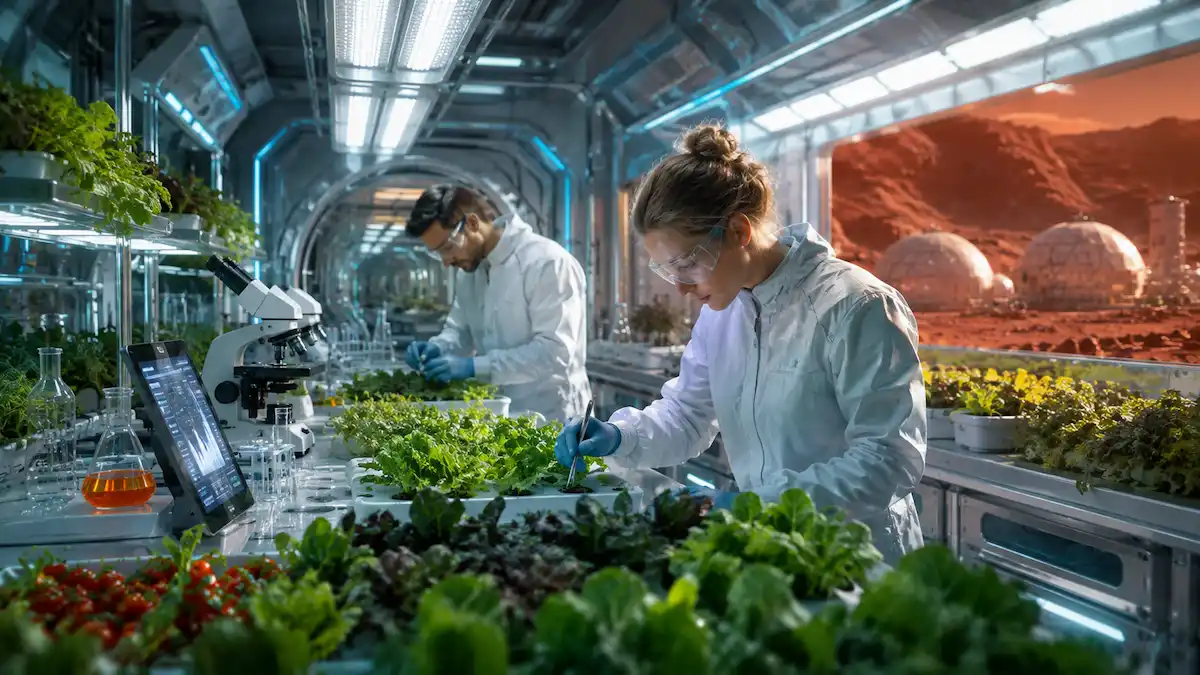
The idea of growing food on Mars sounds very futuristic, but scientists are already working on some technologies which help in making the idea possible. The important thing is that no food crop has actually been grown on Mars. But scientists have grown plants in Martian soil simulant, tested plants in space, and studied various responses of crops to the conditions which they might encounter in a Martian habitat.
The challenge is considerable, since Mars has an atmosphere with less than one percent the density of Earth’s atmosphere, temperatures averaging -63 degrees Celsius, limited access to liquid water, and ground-level radiation far greater than what Earth-bound vegetation experiences. On top of this, the ground on Mars has perchlorate salts, which are poisonous to most known forms of life.
That’s why, astronauts cannot just go out in the landscape of Mars and plant a garden, harvest, and receive food. Instead, Growing food on Mars would be started within protective habitats in which temperature, pressure, water, nutrients, and light could be regulated. The types of plants that would be used initially would most likely be utilized to supplement Earth-grown food supplies, not replace them.
Growing Food on Mars May Be Essential for Human Survival

A Mars colony may be dependent on Earth for years, but it would be challenging to transport all the meals that humans need for long voyages. That is why it is important to grow food on Mars as well as being a fresh source of food. NASA’s Space Crops research states that fresh and nutritious food, bio regenerative life-support systems and the well being of crew members were identified as key factors that contribute to the study of plant life in space.
Crops could become a part of a more advanced life support system. Plants utilize CO2 and light to produce organic matter and oxygen through photosynthesis. The plant’s edible parts can be used as food, and the plants can be used for controlled resource recycling. But, there is one problem. Plants cannot be the sole life support system, because water, nutrients, atmospheric gas, waste processing, lighting, and temperature control would still need to manage. So while growing food on Mars would be an agricultural enterprise, it would also be an engineering and life-support project. Having fresh crops could also be a psychological boost since plants grown inside the habitat would help break up the bare feeling of a dessert planet.
YOU MAY LIKE
- Milky Way’s Black Hole Is Slowly Destroying Itself to Power Cosmic Rays”
 Milky Way’s black hole may be doing something scientists never expected. It is sacrificing a piece of itself to power some of the most energetic particles in our galaxy. A theoretical study suggests that Sagittarius A*, the supermassive black hole present at the center of the Milky Way, could be using its own spinning energy… Read more: Milky Way’s Black Hole Is Slowly Destroying Itself to Power Cosmic Rays”
 - New Tesla Roadster Takes Flight — But Elon Musk’s Original Car Is Still in Space
 This week, Tesla Roadster comes twice in the news for two very different reasons. On October 15, 2026, Tesla showed off a new Roadster prototype in Texas that appeared to lift off the ground using thruster technology inspired by SpaceX. While the new Roadster was making headlines on Earth, the original red Tesla Roadster that… Read more: New Tesla Roadster Takes Flight — But Elon Musk’s Original Car Is Still in Space
 - Astronomers Find the First Green Star – Could Our Sun Also Glows Green After it Dies?
 Astronomers just found the first green star and the reason of its unusual color is surprising. Astronomers at the University of Warwick have detected a dead star that actually looks green to the human eye, something that never confirmed before research. Scientists believe that the star has gained this green color because it consumes some… Read more: Astronomers Find the First Green Star – Could Our Sun Also Glows Green After it Dies?
 - Microblazar Discovered In Our Galaxy, After 30 Years of Searching And Its Jet Is Pointed Straight At Earth
 Recently a microblazar has been confirmed in our own galaxy, Milky Way. Scientists have been investing this cosmic mystery for nearly 30 years. The study reveals that the object named IRAS 18293-0941 sits about 1200 light years away from Earth and one of its powerful jets points straight towards the Earth. It sounds danger but… Read more: Microblazar Discovered In Our Galaxy, After 30 Years of Searching And Its Jet Is Pointed Straight At Earth
 - Orionid Meteor Shower: The Ancient Shooting Stars That Left By Halley’s Comet Centuries Before You Were Born
 The Orionid Meteor Shower returns this month, and brings beautiful streaks of lights and fill the dark sky with colours. Each meteor burning up in the sky is a tiny piece of dust that left behind by the Halley’s Comet hundreds of years ago. Now centuries past, and when Earth passes through this old trail… Read more: Orionid Meteor Shower: The Ancient Shooting Stars That Left By Halley’s Comet Centuries Before You Were Born
Why Mars Is Almost Impossible to Farm?
Growing food on Mars would be much harder than here on Earth because most of the basic requirements for plants growth must be artificially created.
- The first issue is the Martian atmosphere. Mars atmosphere mostly contains carbon dioxide, but the atmospheric pressure is less than one percent of Earth’s. That means, the Martian environmental conditions are nothing like what any Earth-based crops experience. For growing food on mars, we need to place the plants inside a controlled, pressurized growing environment, rather than exposing plants directly to the harsh environment of mars.
- Another issue is temperature; Mars is a cold planet overall, and it can vary by vast margins over the course of a day or year. NASA offers an average of -63 degrees Celsius as a daytime temperature on the Red Planet.
- Water is another major limitation. While there are reserves of water ice on the planet, but acquiring and purifying it into a consumable resource would require some serious equipment. This means, for growing food on mars any astronauts would need to reuse water very carefully without wasting it.
- Radiation also becomes a problem. Mars does not have a magnetic field like Earth, and it also has a very thin atmosphere. There is nothing present that can stops energy particles from entering. So that Mars’ surface suffers radiation exposure more than Earth’s surface.
Because of all these problems growing food on Mars is not like normal farming. It is like building a safe and controlled life support system to keep people alive.
Could Martian Regolith Become Real Growing Soil?

Here things get really interesting when it comes to growing food on mars. Martian regolith contains certain minerals that could provide some raw materials to plant. Researchers have even shown that plants can germinate, and grow, in certain Martian regolith simulants. In one study, several species of plants were grown in both Mars and lunar soil simulants for 50 days, and they included tomato, wheat, cress and field mustard. Some of them also produced flowers or seeds.
However, there’s a difference between growing plants in a simulant, and actually growing food on Mars. The researchers actually state that the simulants might not accurately reflect real world conditions, and physical factors like water holding capacity, etc, are important details that we still need to figure out.
There is also the issue of perchlorates. NASA-funded researchers are calling the salts in the Martian regolith a big problem, since it can be toxic, or even fatal to many organisms. Current research is looking at how microorganisms can break down the perchlorates, and turn the regolith, or at least a simulant, into something more comparable to actual soil. That could lead to an interesting process, where microorganisms could break the raw material into something more useful. But, this is still just a research. It is not necessarily a proven method for growing food on Mars.
Why Future Mars Farms May Not Need Martian Soil?
Instead of trying to make regolith into something useful, astronauts could grow plants using hydroponic or aeroponic methods.

A hydroponic system provides water with the right amount of nutrients to plant’s roots, while aeroponics provides nutrients in a fine mist.
This could be beneficial for Mars because it is easier to control the elements needed for the plants to grow. There would be no need to worry about the chemistry of the regolith, and plants could be grown in a much smaller area. This would be necessary for growing food on Mars, because converting regolith into soil would take a significant amount of time. NASA has already experimented with controlled environments for growing plants in space, with systems such as Veggie and Advanced Plant Habitat.
However, these methods are not magic solutions. While hydroponics would take care of the water and nutrients, there would still be a need for electricity and space for plants to grow. A failure in the system such as a pump that moves water through the system could result in the death of the plant. Water recycling would also be a concern, as NASA’s studies on closed plant-growth systems suggest that plants can evaporate large quantities of water through their leaves. Controlling humidity, and capturing and reusing the water would be necessary for maintaining the health of the plant and preventing water loss. The ideal solution would be for a large amount of the water to be cycled through the system again.
Conclusion
Growing food on Mars is no longer a dream, but it is also a long way from being a reality. Scientists have already managed to grow plants in space and in Martian soil simulants but there is a little possibility of growing food on mars. Planet’s thin atmosphere, cold temperatures, radiation exposure, water limitations and perchlorate-containing regolith are the main obstacles for growing food on mars.
That is why the first step to growing food on Mars may not involve growing anything in Martian soil at all. The use of hydroponics, aeroponics, artificial lighting, water recycling, and controlled habitats could provide a far more safe method of producing fresh food supplies for astronauts on the Red Planet. Martian soil could eventually be used, if there is a way for scientists to remove the harmful elements and recycle the nutrients back into the soil.
The bigger goal is also about more than food. Successful growing of food on Mars would not only provide fresh produce for inhabitants, but also recycle resources, improve morale, and provide life support system. Humanity is still far from establishing a permanent, self-sustaining colony on Mars. But with each experiment on growing plants, plant roots, hydroponics, and closed ecosystems, researchers are getting closer to determining what humanity’s needs on the Red Planet. If humans end up living on Mars for years, instead of months, growing food on mars could be one of the technologies that determine whether permanent settlement is possible.