
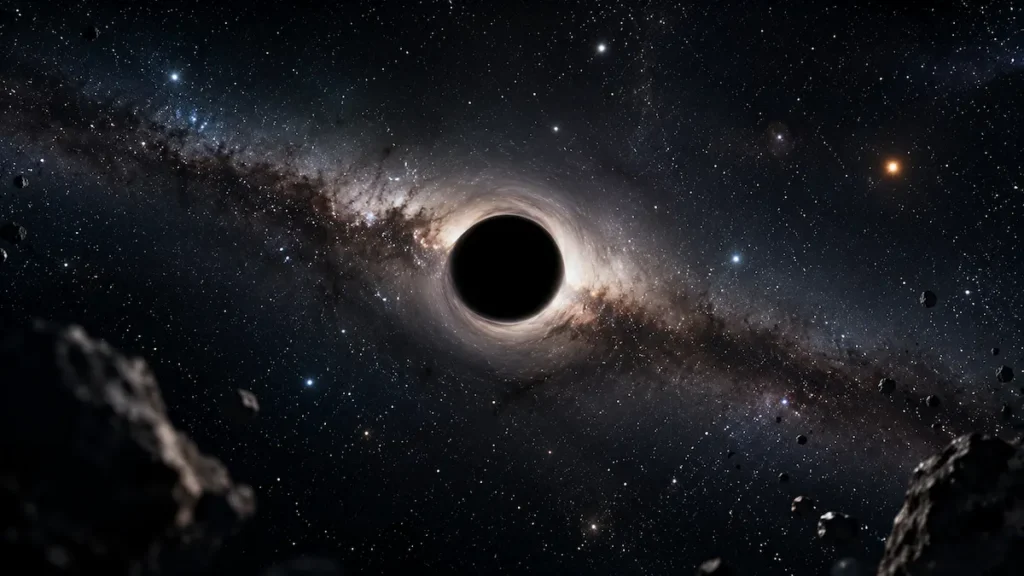
Invisible rogue black holes may sound to you like something from Hollywood science fiction movies, but scientists believe these things really exist in our galaxy. Rogue black holes are not like the black holes that we found near the stars. They are completely different; they travel alone in deep space without showing any visible light. This makes them very exciting and difficult to detect. For decades scientists have detected black holes by their behavior with their nearby stars. They pull some materials from stars and create bright X-ray emission that can be detected by telescopes. But in the case of rogue black holes, they do not perform such activity, and they drift alone in the dark space, so they remain invisible.
Recently scientists have found some evidence that proves the existence of rogue black holes in our galaxy, the Milky Way. Let’s discuss these hidden objects in detail.
Why tech companies want to establish data centers in space?
What Are Rogue Black Holes?
In simple language rogue black holes are the black holes that move completely alone in deep space without being connected to any star system. Most people think that black holes exist at the center of the galaxy and eat their nearby stars. But not every black hole sits in one place forever. Violent explosions might throw some of the black holes far away from their actual position. A powerful collision and explosion of a star forms rogue black holes. Sometimes a newly formed black hole gets kicked out by an uneven, powerful explosion in deep space. Once these black holes start traveling alone in dark space, then it becomes very difficult to find them because they do not emit any visible light that can be detected by telescopes. That’s why scientists call them invisible objects.
Why Scientists Believe Thousands of Rogue Black Holes Could Exist

Scientists believe in the existence of millions of rogue black holes because today’s powerful computer simulations suggest that these hidden objects are present in a much larger number than scientists once expected. Modern simulation allows scientists to recreate how stars, black holes, and galaxies evolved over billions of years. Billions of stars are present in our galaxy, the Milky Way. And many of them were collapsed into black holes. Scientists believe over billions of years, a large number of black holes get kicked off from their actual position by violent stellar explosions and gravitational interactions.
Scientists believe that millions or billions of black holes are present that are drifting alone through interstellar space in our galaxy. But the exciting part is most of them remain undetected. Earlier people thought most of the space was empty, but now scientists discover many hidden objects are travelling in the darkness between the stars. The invisibility of the rogue black holes makes them the most mysterious topics in modern astronomy.
How Can Something Invisible Be Detected?
One of the biggest challenges of astronomy is to detect invisible rogue black holes. Today’s normal telescopes can only detect space objects that emit or reflect light, such as stars, planets, galaxies, etc., but in the case of a black hole, it absorbs light instead of producing it. So the biggest question is how scientists detect such invisible space objects.
One of the best methods involves gravity itself. Einstein’s relativity theory states that massive objects bend space and warp the path of light passing nearby. When a rogue black hole comes in front of a distant star, according to the earth’s view, then its gravity can briefly magnify and distort the light coming from the star. Scientists call this method gravitational microlensing. In recent years some strange microlensing events have been detected by researchers. Some scientists believe that these events have some relation to the invisible rogue black holes moving in deep space alone. Although proving these discoveries is very difficult because they are visible directly through telescopes, this evidence is enough to believe that rogue black holes may truly exist in our galaxy.
Future Space Telescopes Could Reveal More Rogue Black Holes
Scientists believe as the technology evolves with time, they may improve the search methods for the invisible rogue black holes. With the help of future advanced telescopes and sky surveys, scientists could monitor millions of stars much better than ever before. This could help scientists to detect more microlensing events related to rogue black holes. Scientists are working on many projects, like dark matter, gravitational effects, and space structure. These may help in future discoveries.
Could a Rogue Black Hole Enter Our Solar System?
While reading my article, this question naturally comes to your mind. Technically rogue black holes could pass near our solar system, but scientists believe that the chances are extremely low. Our galaxy, the Milky Way, is extremely large, even if rogue black holes exist in our galaxy, but the distance between the objects is very large. Scientists believe that a nearby black hole reveals itself by gravitational effect long before reaching our inner solar system. Scientists could observe unusual orbital changes caused by distant objects, and they can also observe the hidden objects’ movements through the gravitational microlensing technique.
Conclusion
Rogue black holes travel alone silently in our galaxy without any sign of light, and they do not reveal themselves. The mystery around them is one of the most fascinating ideas in modern space science. Scientists’ present study tells that the rogue black holes could be far more common than scientists imagined in our galaxy. And they are still searching for more solid evidence for these hidden objects in space. The exciting part is humans may never see them directly through a telescope. They only detect some of the gravitational clues to detect them. Our galaxy is very large, somewhere in the darkness between the stars; these hidden black holes may already be traveling alone.
FAQ
What are rogue black holes?
Rogue black holes are the black holes that move completely alone in deep space without being connected to any star system.
Why are rogue black holes difficult to detect?
our telescopes only see objects that emits or reflect light. but black holes absorb light instead of producing it. so that it is nearly impossible to see directly and very difficult to detect them.
How do scientists detect rogue black holes?
scientists use a special method called gravitation lensing. this method involves gravity itself. Einstein’s relativity theory states that massive objects bend space and warp the path of light passing nearby. When a rogue black hole comes in front of a distant star, according to the earth’s view, then its gravity can briefly magnify and distort the light coming from the star.
Could a rogue black hole enter our solar system?
Technically yes, rogue black holes could pass near our solar system, but scientists believe that the chances are extremely low. Our galaxy, the Milky Way, is extremely large, even if rogue black holes exist in our galaxy, but the distance between the objects is very large.
Pingback: Moon Lava Tubes Could Become Humanity’s Most Powerful Hidden Shelter in Space
Pingback: What Is a Rogue Black Hole? The Invisible Wanderers Drifting Through Our Galaxy Right Now