
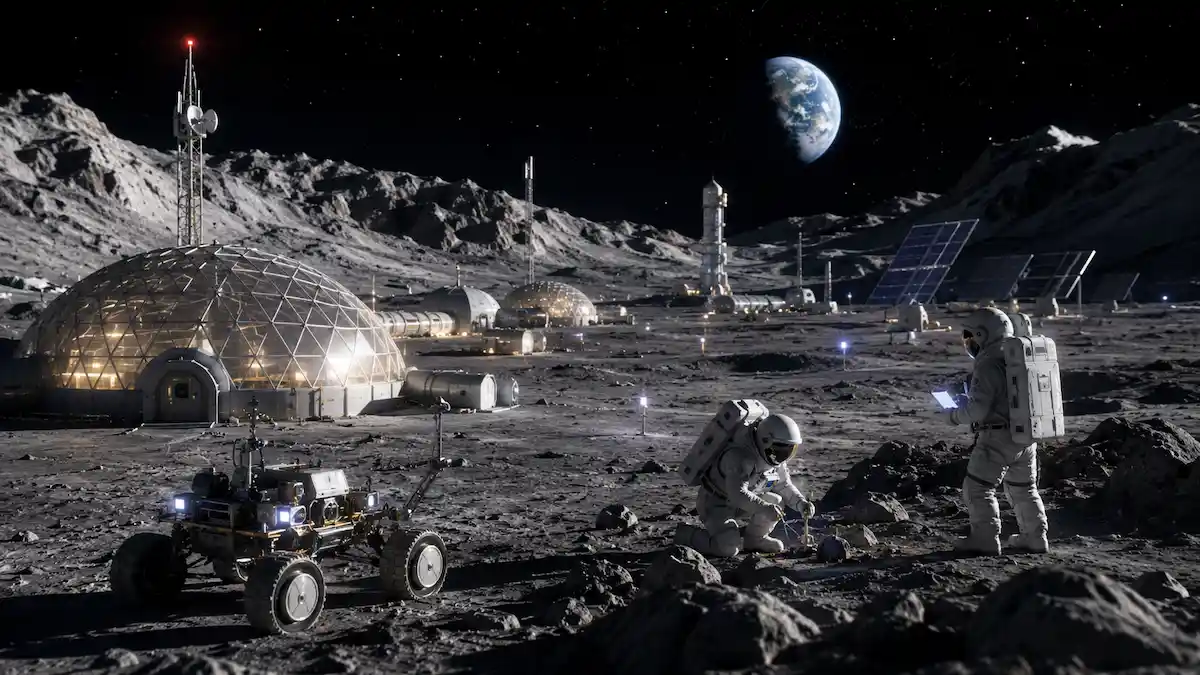
NASA wants student’s ideas for imagining the life on the moon and NASA also offers payment for best ideas. On August 14, 2026, NASA announced the 2027 edition of its Revolutionary Aerospace Systems Concepts – Academic Linkage Competition (RASC-AL). This competition invites U.S based collegiate teams for asking innovative ideas that could help the agency to shape the future of human on the lunar surface. This is also a big opportunity for students because this isn’t a classroom exercise. The ideas submit through RASC-AL, analyze directly by the NASA and use for long term planning for Moon exploration and also the best ideas will observe by industry experts.
What Is RASC-AL Competition?
RASC-AL is NASA’s one of the longest running students innovation competition. It has been running since 2002. This competition connects student’s innovation to real technology and challenges. It uses student’s creativity for advancing the space exploration. According to the NASA’s acting cross-program integration lead for the Advanced Research and Technology Division, Gabe Merrill, University’s top researchers from all over the country participate on RASC-AL competition. It gives students to design the concept for living on the moon’s surface and also gives valuable experience to future aerospace innovators or leaders.
“The competition showcases the technical excellence and creativity of the next generation of explorers and innovators” said by the Chris Jones, chief technologist, Systems Analysis and Concepts Directorate at NASA’s Langley Research Center in Hampton Virginia. The concepts developed by the RASC-AL competition are truly remarkable, showcasing their abilities and contributing to the innovation portfolio of NASA.
Theme of 2027 RASC-AL competition
In 2027 RASC-AL competition focuses on the lunar South Pole region. NASA takes great interest in this area for future exploration. It contains some shadowed craters near the lunar poles, where sunlight never reaches. These cold regions are important for resource exploration because there is possibility to find water in ice form.
This competition contains 4 themes; students must submit their proposals around one of them.
Enabling Extreme Exploration
Students will develop their ideas which help astronauts and robotic technology to operate in most difficult environment on moon.
Transit Pathway Construction
In this theme, students will create routés and infrastructure across the lunar surface.
Lunar Resource Exploration
Students will develop new ideas to explore the permanently shadowed regions of lunar craters in search of resources like ice water.
Smart and Resilient Lunar Habitat
Here, students will develop expandable and intelligent infrastructure for future astronauts.
Key Dates and What Teams Need to DO?
The 2027 RASC-AL competition timing is scheduled. Teams which are interested in participating are require to submit a non-binding notice of intent by Tuesday, October13, 2026. Then NASA will held Q&A session with experts on October 27, 2026. Complete challenge proposal along with required videos submission are due February 24, 2027. These proposals should contain innovative solutions; including original engineering based on one the four competition themes.
At last NASA will select 14 finalist teams and each will get $7,500 as wining price to cover all their expenses regarding their research. The finalist will further promoted in final phase, where they develop concepts, writing technical papers and creating posters. Then they will present their work to NASA and industry experts at the 2027 RASC-AL Forum in Cocoa Beach, Florida, June 7 to June 10, 2027. The top two teams will also rewarded an additional monetary prizes and an invitation opportunity to present their ideas at an aerospace conference later in 2027.
The RASC-AL competition is administrated by the National Institute of Aerospace on behalf of ANSA’s Advance Research and Technology Division, within the Research and Technology Mission Directorate.
How to Apply
Interested student teams are encouraged to visit the RASC-AL website at rascal.nianet.org for details and eligibility requirements. The deadline for notice of intent is this October 13, 2026.
You May Like
- Milky Way’s Black Hole Is Slowly Destroying Itself to Power Cosmic Rays”
 Milky Way’s black hole may be doing something scientists never expected. It is sacrificing a piece of itself to power some of the most energetic particles in our galaxy. A theoretical study suggests that Sagittarius A*, the supermassive black hole present at the center of the Milky Way, could be using its own spinning energy… Read more: Milky Way’s Black Hole Is Slowly Destroying Itself to Power Cosmic Rays”
 - New Tesla Roadster Takes Flight — But Elon Musk’s Original Car Is Still in Space
 This week, Tesla Roadster comes twice in the news for two very different reasons. On October 15, 2026, Tesla showed off a new Roadster prototype in Texas that appeared to lift off the ground using thruster technology inspired by SpaceX. While the new Roadster was making headlines on Earth, the original red Tesla Roadster that… Read more: New Tesla Roadster Takes Flight — But Elon Musk’s Original Car Is Still in Space
 - Astronomers Find the First Green Star – Could Our Sun Also Glows Green After it Dies?
 Astronomers just found the first green star and the reason of its unusual color is surprising. Astronomers at the University of Warwick have detected a dead star that actually looks green to the human eye, something that never confirmed before research. Scientists believe that the star has gained this green color because it consumes some… Read more: Astronomers Find the First Green Star – Could Our Sun Also Glows Green After it Dies?
 - Microblazar Discovered In Our Galaxy, After 30 Years of Searching And Its Jet Is Pointed Straight At Earth
 Recently a microblazar has been confirmed in our own galaxy, Milky Way. Scientists have been investing this cosmic mystery for nearly 30 years. The study reveals that the object named IRAS 18293-0941 sits about 1200 light years away from Earth and one of its powerful jets points straight towards the Earth. It sounds danger but… Read more: Microblazar Discovered In Our Galaxy, After 30 Years of Searching And Its Jet Is Pointed Straight At Earth
 - Orionid Meteor Shower: The Ancient Shooting Stars That Left By Halley’s Comet Centuries Before You Were Born
 The Orionid Meteor Shower returns this month, and brings beautiful streaks of lights and fill the dark sky with colours. Each meteor burning up in the sky is a tiny piece of dust that left behind by the Halley’s Comet hundreds of years ago. Now centuries past, and when Earth passes through this old trail… Read more: Orionid Meteor Shower: The Ancient Shooting Stars That Left By Halley’s Comet Centuries Before You Were Born