
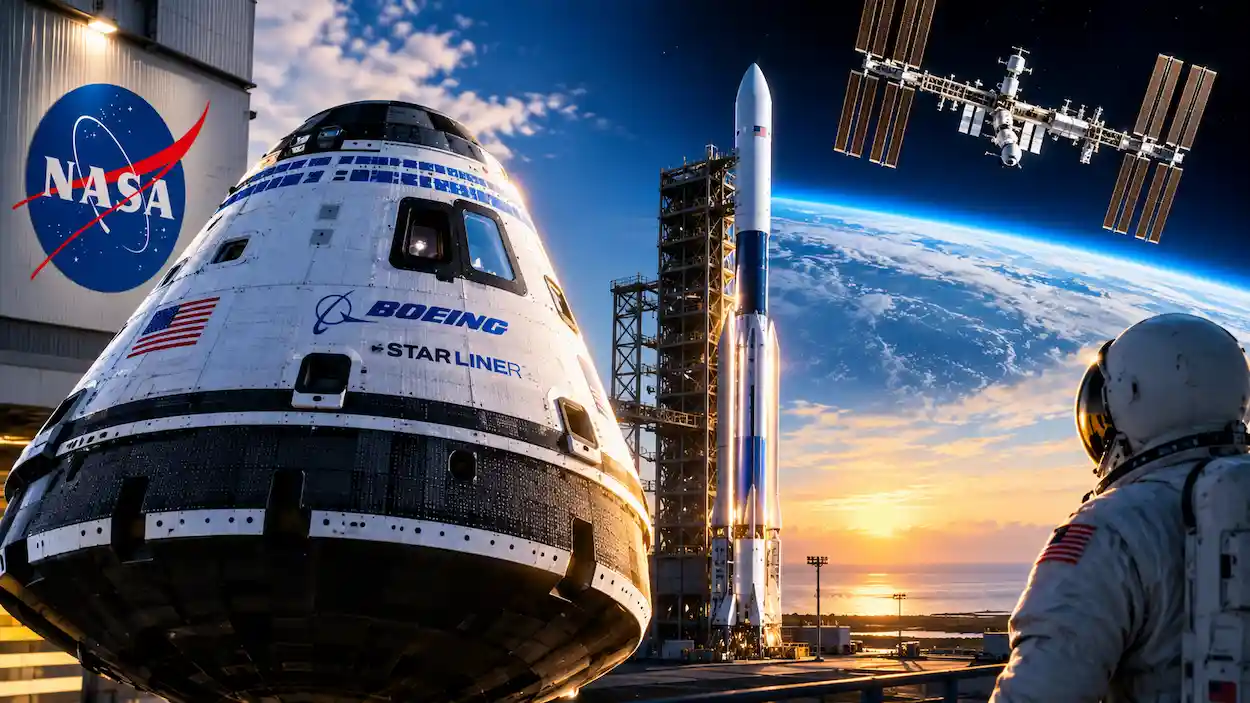
NASA Starliner Update just came out, and it answers a question many people have been asking since 2024; when will this spacecraft carry astronauts again? On Monday, September 28, NASA and Boeing held a press conference at Kennedy Space Center to share a new plan for the Starliner program. Here is the short version: an uncrewed test flight is coming as early as December 2026 or January 2027, but flights with astronauts on board won’t happen until 2028. NASA is also switching Starliner to a new rocket and picking a new commander for the mission. Let’s go through what this NASA Starliner Update says, why it matters, and why NASA is moving so carefully this time.
Why This NASA Starliner Update Was Needed
To understand this NASA Starliner Update, you need to go back to June 2024. That’s when the Starliner carried astronauts Butch Wilmore and Suni Williams to the International Space Station for the first Crew Flight Test. Scientists expected that mission was last for about only a week, but it took nine months. As the Starliner get close to the space station, it stuck into problems with its small steering thrusters and also helium leak happened in its fuel system.
Those problems were serious not small ones, so that NASA felt that it was too risky to bring astronauts back to earth from Starliner. Then SpaceX Crew Dragon capsule was used to bring Wilmore and Williams back to Earth and Starliner comes back empty. Later in the report, NASA called this failure, Type A mishap, which is a serious failure level. This is really where this NASA Starliner Update begins, since every change announced this week is meant to fix what went wrong on that flight.
What Is Actually Changing, According to This NASA Starliner Update?

The biggest news in this NASA Starliner Update is the new timeline. NASA and Boeing confirmed that an uncrewed Starliner-1 flight is planned for December 2026 or January 2027. This flight will not carry any astronauts. Its only job is to test and confirm the fixes Boeing has made, especially around heat control and the fuel system. Only if this flight goes well, then NASA will move for the flight with astronauts and if all goes as planned then flights with astronauts are expected in 2028.
Another big part of this NASA Starliner Update is about the rocket. Until now, Starliner has launched on the Atlas V rocket. But the Atlas V rocket will retire after its last engines are gone, so NASA announced for new Vulcan rocket to launch Starliner. Getting a brand-new rocket approved for human spaceflight takes a long time, and that is a big reason why mission’s schedule stretches out so far.
There is also a people update in this NASA Starliner Update. NASA announced that astronaut Woody Hoburg will lead the next Starliner mission with astronauts on board. During the press conference, Hoburg spoke about Wilmore and Williams, saying they handled their long, unplanned mission with great skill and professionalism, a kind tribute to the two astronauts who lived through the very problems this update aims to fix.
YOU MAY LIKE
- Milky Way’s Black Hole Is Slowly Destroying Itself to Power Cosmic Rays”
 Milky Way’s black hole may be doing something scientists never expected. It is sacrificing a piece of itself to power some of the most energetic particles in our galaxy. A theoretical study suggests that Sagittarius A*, the supermassive black hole present at the center of the Milky Way, could be using its own spinning energy… Read more: Milky Way’s Black Hole Is Slowly Destroying Itself to Power Cosmic Rays”
- New Tesla Roadster Takes Flight — But Elon Musk’s Original Car Is Still in Space
 This week, Tesla Roadster comes twice in the news for two very different reasons. On October 15, 2026, Tesla showed off a new Roadster prototype in Texas that appeared to lift off the ground using thruster technology inspired by SpaceX. While the new Roadster was making headlines on Earth, the original red Tesla Roadster that… Read more: New Tesla Roadster Takes Flight — But Elon Musk’s Original Car Is Still in Space
- Astronomers Find the First Green Star – Could Our Sun Also Glows Green After it Dies?
 Astronomers just found the first green star and the reason of its unusual color is surprising. Astronomers at the University of Warwick have detected a dead star that actually looks green to the human eye, something that never confirmed before research. Scientists believe that the star has gained this green color because it consumes some… Read more: Astronomers Find the First Green Star – Could Our Sun Also Glows Green After it Dies?
- Microblazar Discovered In Our Galaxy, After 30 Years of Searching And Its Jet Is Pointed Straight At Earth
 Recently a microblazar has been confirmed in our own galaxy, Milky Way. Scientists have been investing this cosmic mystery for nearly 30 years. The study reveals that the object named IRAS 18293-0941 sits about 1200 light years away from Earth and one of its powerful jets points straight towards the Earth. It sounds danger but… Read more: Microblazar Discovered In Our Galaxy, After 30 Years of Searching And Its Jet Is Pointed Straight At Earth
- Orionid Meteor Shower: The Ancient Shooting Stars That Left By Halley’s Comet Centuries Before You Were Born
 The Orionid Meteor Shower returns this month, and brings beautiful streaks of lights and fill the dark sky with colours. Each meteor burning up in the sky is a tiny piece of dust that left behind by the Halley’s Comet hundreds of years ago. Now centuries past, and when Earth passes through this old trail… Read more: Orionid Meteor Shower: The Ancient Shooting Stars That Left By Halley’s Comet Centuries Before You Were Born
The Fixes Behind This NASA Starliner Update
If you’re curious about what went wrong with the thrusters, here’s the proper explanation. Starliner’s service module uses small thrusters to make tiny adjustments as it gets close to the space station. During the 2024 flight, several of these thrusters got too hot and shut off for a while. At the same time, helium leaks affected the system that keeps fuel moving to the engines. Helium doesn’t burn, but it is needed to push fuel through the system properly, so a leak here is still a serious safety issue, even with no fire involved.
According to this NASA Starliner Update, Boeing has made changes to the spacecraft’s service module to make control heat around the propulsion system better, that caused the thruster failures earlier. Engineers also found that the helium leaks were caused by an issue with poppet seals, small parts inside the valves meant to seal tightly and keep gas from escaping. Boeing is now redesigning these seals so the same kind of leak does not happen again in future flights. Dana Weigel, who manages NASA’s Low Earth Orbit Program, said the teams now understand the cause of every propulsion problem from the 2024 flight, which is why NASA feels ready to move forward, even while staying careful.
Why NASA Is Not Giving Up on Starliner?
You might wonder why NASA is not giving up Starliner after everything that happened. The answer is simple; having a backup option. NASA’s commercial crew program was built so there would be two separate ways to send astronauts to the space station, instead of depending on just one company or one spacecraft. Right now, SpaceX’s Crew Dragon is doing almost all of that work, and NASA has already agreed to pay for extra SpaceX flights to cover the gap while Starliner is being fixed.
Keeping Starliner as a second option protects NASA from depending completely on one spacecraft to reach the space station and future destinations in low Earth orbit. This NASA Starliner Update makes that reason clear. NASA is willing to pay Boeing about $359 million more for these upgrades on Starliner and for approving the Vulcan rocket, which shows the agency still sees real value in Starliner, even after its rough start.
What This NASA Starliner Update Means Going Forward?
For now the plan is to conduct an uncrewed test flight between December 2026 and January 2027. After that NASA will carefully review the results before moving toward crewed flights starting in 2028 at the earliest. NASA has admitted that, this schedule isn’t fully guaranteed and officials have said they are still not certain exactly when Starliner will earn full approval to carry astronauts.
In the end, this NASA Starliner Update shows a program that is moving forward much more carefully than before. NASA once hoped Starliner would already be flying regular missions with astronauts by now. the agency is taking more time to fix the problems, test those fixes properly, and use an uncrewed flight before putting astronauts back on board. After what happened in 2024, this cautious approach gives NASA a chance to make sure Starliner is ready before humans fly on it again.