
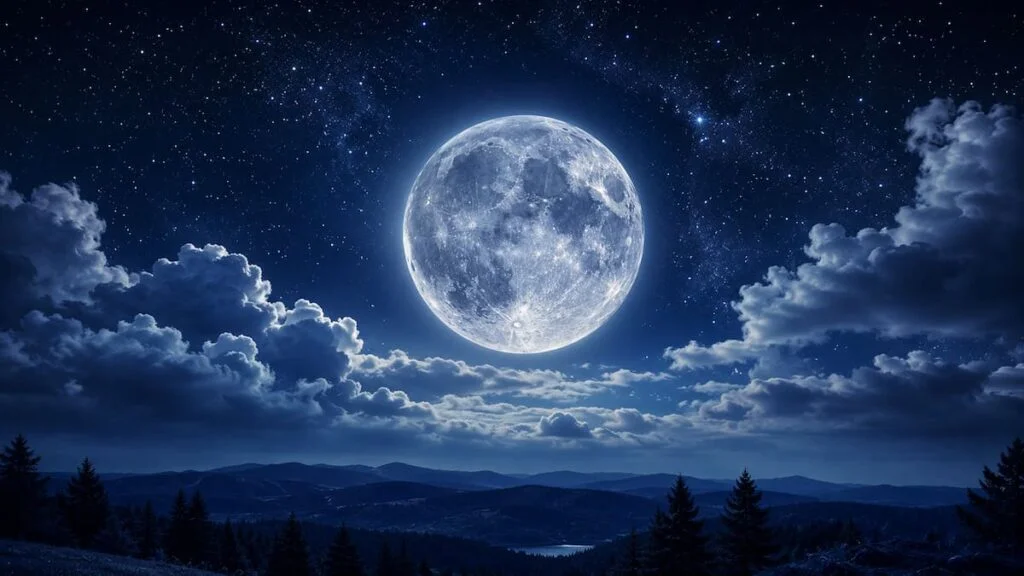
The next blue moon 2026 is almost here, and sky watchers from all over the world are waiting for one of the most beautiful full moons of the year. The next blue moon will appear on May 31, 2026. A blue moon is a rare event that happens once in every 2.5 to 3 years, when two full moons appear within the same calendar month or when there are four full moons in a single season. This moon’s color is not really blue; it’s only called blue moon. But this time blue moon comes with an extra twist, which makes it even more special. The next blue moon will also be a micromoon. It means the moon will remain slightly farther from earth this time than usual during its full phase time. So that moon will appear smaller and dimmer this time as compared to a normal full moon. This difference will not be noticed by normal people, but scientists monitor this event very closely because it will show how the relation between the earth and moon slowly changes.
If people want to see this event, they can experience it very easily. Natural events like meteor showers or eclipses require specific timing or some special conditions, but blue moon or full moon is a natural event that is very simple to observe. With clear skies, anyone can go outside, look up, and see this event directly with their eyes. This accessibility is the reason for early excitement for the next blue moon 2026.
What Is A Blue Moon?
When you all hear the name “blue moon,” you think it actually turns into blue color, but it’s not true. It does not change its color. A blue moon appears when two full moons appear in the same calendar month. The lunar cycle ends in around 29.5 days. Mostly only one full moon appears in a month. But in every few years the timing lines up in such a way that a second full moon appears in the last of the month. This second full moon is called blue moon. The next blue moon 2026 appears in the month of May. First full moon appears at the start of the month, and now the second moon appears before the month ends on 31 May.
Most people have a wrong conception regarding this event. They think the moon will glow bright blue in the sky, and the blue light will cover all the sky. But in reality the moon will glow in its usual color, and its appearance will depend on the weather conditions. In some rare cases volcanic ash and smoke particles may scatter the moonlight into a bluish color in the atmosphere, but still the effect would not be the same as an actual blue moon.
Why the Next Blue Moon 2026 Is More Unusual Than Most

The next blue moon 2026 is special because it is also classified as a micromoon. Moon is revolving around the earth in a fixed orbit, but this orbit is not perfectly circular in shape. Its orbit is a slightly oval-like shape. So, the distance between the Earth and the moon changes throughout the month. During its revolution, sometimes the moon comes near the earth, creating an event called a supermoon. At this time the moon appears larger than usual. And sometimes it moves farther from the earth, increasing the distance between them. Scientists call this situation a micromoon. At this time the moon appears smaller than usual. During the next blue moon 2026, the moon will go near the apogee; it is the farthest point of the moon’s orbit. Due to this much distance, the moon will appear smaller, decrease its brightness, and create weaker ocean tides than a supermoon. This event attracts photographers and sky watchers because blue moon does not appear every year. And this time it will also combine another special event, micromoon. It makes the blue moon even more special.
JWST recent exoplanet discovery
Best Time to Watch the Next Blue Moon 2026
According to the scientists, the best time to watch the upcoming blue moon will be shortly after the moonrise on 31 May. When the moon rises near the horizon, it first appears larger due to a special effect known as the moon illusion. This time is the best for photography or making scenery. Because buildings, trees, and mountains in the foreground help in creating a dramatic scene.
If anyone tries to take clear images without any interruption, then avoid areas with heavy city lights, check local moonrise time, use an open viewing location, and allow your eyes time to adjust to darkness. This event is grabbing all attention because even a small binocular can reveal detailed lunar features. You can see large impact craters and dark volcanic plains on the lunar surface. The next blue moon 2026 will give you a lot of time to enjoy the great view because this event will remain for most of the night.
Why Lunar Events Matter To Science
Those events are visually beautiful, like blue moon helps to keep public interest in astronomy. In simple words, lunar events help to keep astronomy alive. These lunar events inspire people to learn more about the lunar cycles, gravity effects, earth’s tides, planetary motion, and space exploration. Simply enjoying cosmic events makes many people’s interest deeper in space science. In the future, the moon will play a major role in space exploration. Space agencies like NASA are planning for future moon missions that will help in knowing the universe deeply. Scientists believe future lunar missions also help in exploring Mars. Scientists are planning to build their laboratories on the moon’s surface in the future.
A Rare Moment Worth Watching
The next blue moon 2026 may not glow bright in blue light. It knows it will break your dream to watch a bluish glowing moon, but still this event remains one of the most interesting and rare lunar events of the year. It combines the unusual effects of micromoon, and it also gives a reason to millions of people to reconnect with the night sky and leave their busy and boring lives for a moment. For a moment you can enjoy the beauty of nature. This event is a rare opportunity for photographers to capture dramatic night sky visuals. And for ordinary people, they can simply walk outside and look up to the sky and experience a rare event that does not happen every day. As May 31 comes near, the next blue moon 2026 becomes the center of attraction across the world.
Pingback: The July Full Moon Illusion Will Make the Moon Look Enormous — Here's the Strange Reason Why.