
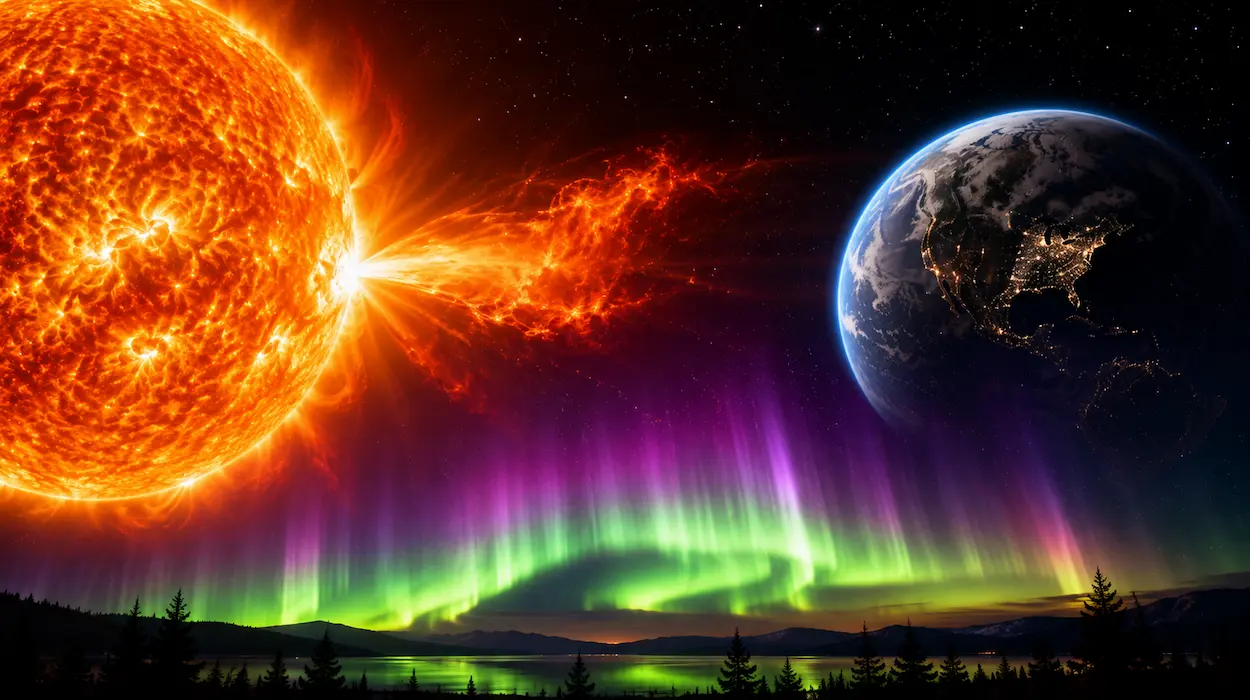
The solar flare July 2026 activity has been much stronger than usual, and some of its effects are expected to reach Earth. On June 30, 2026, the Sun produced a powerful X1.1-class solar flare from an active sunspot called AR4479. Over the next 24 hours, the same region released 10 more M-class solar flares, showing an unusually high level of activity. Because the eruptions happened one after another so quickly, space weather expert Dr. Tamitha Skov started calling it a “Machine-Gun Sun.” Several of these eruptions also launched coronal mass ejections (CMEs)—huge clouds of charged particles toward Earth. Because of this, NOAA’s Space Weather Prediction Center has issued a G2 (Moderate) Geomagnetic Storm Watch for July 3 and July 4.
If the storm becomes strong enough, people in parts of the northern United States may have a chance to see the northern lights, even in places where they are not usually visible, including parts of New York, Wisconsin, and Washington State. Here’s what this solar activity means, why it is happening, and what people on Earth can expect over the next few days.
NASA Swift Telescope Rescue Mission Is On The Way.
What Actually Happened — The Solar Flare July 2026 Explained

The solar flare July 2026 activity began with one powerful eruption, but it did not end there. On June 30, 2026, the Sun released a strong X1.1-class solar flare from an active sunspot region called AR4479. At the same time, it launched a full-halo coronal mass ejection (CME). A full-halo CME means the explosion was directed almost straight towards the Earth instead of moving away into space.
X-class flares are the strongest type of solar flares. Although an X1.1 flare is one of the smaller events in the X-class category, but still it is powerful enough to briefly affect radio communications on the side of Earth facing the Sun. That is exactly what happened after this eruption. However, this was only the beginning. During the next 24 hours, AR4479 remained highly active and produced 10 more M-class solar flares. Some of these flares also released additional CMEs that appear to be traveling at least partly toward Earth. While M-class flares are not as powerful as X-class flares, they can still have a noticeable impact on space weather. When several eruptions happen close together, the CMEs can catch up with one another and combine as they travel through space. This can create a stronger geomagnetic storm than a single CME would produce on its own.
According to current forecasts, these waves of charged particles are expected to reach Earth in stages between July 3 and July 6, 2026, making this one of the most active periods of solar flare July 2026 activity so far.
What Is a CME and Why Does It Matter?

We can better understand the solar flare July 2026, if we know what a coronal mass ejection (CME)is.
A CME is a huge cloud of hot, electrically charged gas and magnetic energy that is blasted into space from the Sun. These clouds can travel at incredible speeds, sometimes reaching millions of kilometers per hour. Several powerful CMEs were released during the solar flare July 2026 activity, and some of them are heading toward the Earth. When a CME reaches our planet, it does not strike Earth’s surface directly. Instead, Earth’s magnetic field act as a giant invisible shield, protecting us from most of the charged particles. As these particles interact with the magnetic field, they create a geomagnetic storm. This interaction is what makes the solar flare July 2026 event so important. Geomagnetic storms can produce the beautiful Northern Lights and Southern Lights, and also affecting the satellites, radio signals, and other space-based technology. The brighter the aurora depends on how powerful the CME is and how well its magnetic field connects with Earth’s. Strong solar storms can push the Northern Lights much farther south than usual. In some past events, people have even seen them from parts of Texas and Florida. The current solar flare July 2026 event is not expected to reach that level, but it is still strong enough to create a moderate geomagnetic storm and give skywatchers in several northern U.S. states a rare opportunity to see the aurora.
What to Expect — G2 Storm Conditions July 3-4
Because of the solar flare July 2026 activity, the National Oceanic and Atmospheric Administration (NOAA) has issued a G2 (Moderate) Geomagnetic Storm Watch. This means Earth could experience noticeable space weather over the next few days. A G2 geomagnetic storm is not considered dangerous for most people. However, it can have some effects on technology. Power systems in high-latitude regions may experience small fluctuations, satellites in low Earth orbit could face extra atmospheric drag, and some radio communications may become less reliable for a short time.
For most people, the most exciting effect will be the chance to see the Northern Lights. Current forecasts suggest that the solar flare July 2026 storm could make the aurora visible farther south than normal. If the skies are dark and clear, people in parts of New York, Wisconsin, Washington State, and other northern U.S. locations may be able to see this beautiful light display. However, there is still some uncertainty. Scientists know the CMEs are heading toward Earth, but they cannot fully predict how strong the geomagnetic storm will be until the solar material actually arrives. One important factor is the direction of the CME’s magnetic field.
- If its magnetic field points southward, it connects more easily with Earth’s magnetic field. This allows more energy to enter our planet’s magnetic shield, creating a stronger geomagnetic storm and brighter auroras.
- If the magnetic field points northward, Earth’s magnetic field blocks much of the incoming energy. In that case, the solar flare July 2026 event would produce weaker effects and the aurora might not spread as far south.
That is why space weather forecasts can still change. Scientists will have a much better idea of what to expect only after the CMEs get much closer to Earth.
Conclusion
The solar flare July 2026 event has become one of the most active periods of solar activity seen this year. In just a short time, the Sun produced an X1.1-class solar flare, followed by 10 M-class flares and several coronal mass ejections (CMEs) traveling toward Earth. Events like this do not happen every week, so that scientists are watching them so closely. Whether the solar flare July 2026 storm creates bright Northern Lights across parts of the United States will depend on how the incoming CMEs interact with Earth’s magnetic field. Scientists will know more once the solar material gets much closer to our planet.
If you live in a northern U.S. state and the sky is clear on the evening of July 3 or July 4, it may be worth spending a few minutes outside looking toward the northern horizon. You could be rewarded with a rare display of colorful auroras.
Stay connected with Science Scope Hub for latest discoveries of space.