
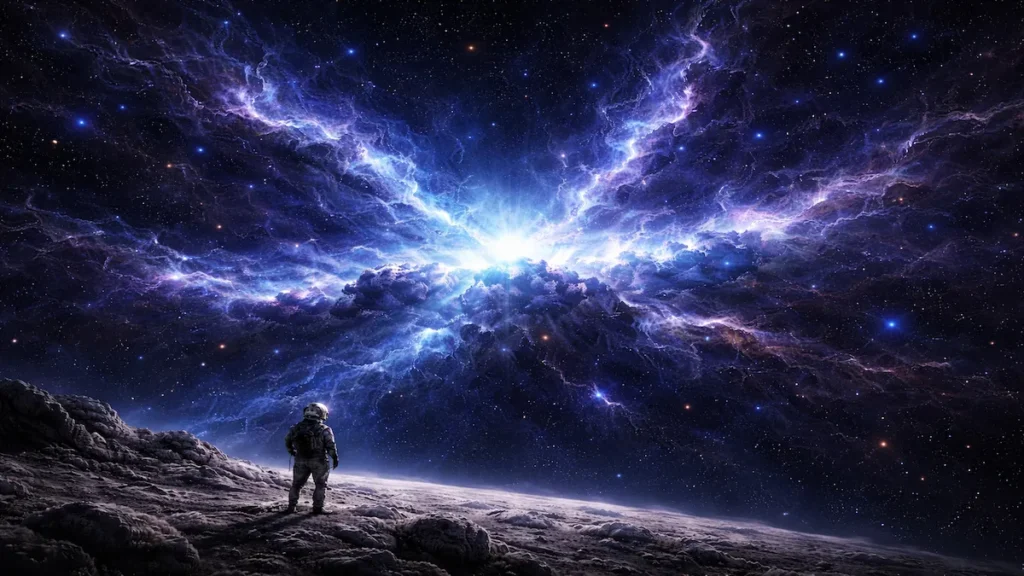
I’m sure everyone wondered why space is completely silent. It is one of the most shocking truths of the universe. Most people imagine the most violent space explosions produce deafening sounds. But in reality, even these explosions happen silently in space. It feels quite fascinating that the biggest events of the universe unfold in absolute quiet. This topic is not any mystery of deep space. It works on the sound properties. If you want to understand why space is completely silent, first you have to study about sound or how it works.
Sound is not anything that can move on its own. It needs some medium to travel. Sound travels by vibrating particles through mediums like air, water, or solids. When any object explodes or moves, it creates vibrations. These vibrations move from one particle to another, eventually reaching our ears as sound. For the existence of sound, three things are necessary. The first thing is a source of vibration (like an explosion or any movement), the second is the medium (air, liquid, or gas), and the last is a receiver (like our ears or a sound detector).
Our earth is surrounded by air, so this works well here. We can hear the sound perfectly. For example, if a bomb explodes, we can hear its sound properly because sound travels through air and then reaches our ears. But in space, it is very different. Space has no atmosphere or air as a medium. Space is like a vacuum, meaning there are no particles to carry vibrations. Even if one of the strongest explosions, supernovas, occurs, there are no particles to pass its vibration, and it happens silently.
Space Is a Vacuum
The biggest reason why space is completely silent and even the biggest explosion of the universe occurs silently is that space is a vacuum. It means space does not contain any particles. Scientifically, vacuum is a region where matter density is very low. Earth has an atmosphere with air and particles that carry vibrations and help sound travel. But in space these particles are almost missing. Space does not have enough air molecules, gas density, or physical matter; without these, sound cannot travel or be heard by someone. The nature of sound is like a wave, so it can travel by vibrating particles. Even though space is not a complete vacuum, it contains some atoms, but these atoms are extremely far apart. So that sound waves cannot travel any meaningful distance. That’s why space is completely silent.
What Happens During Cosmic Explosions?

Cosmic events are among the most powerful events in the universe. These events happen in complete silence in space. One of the most dramatic examples is a supernova. When a massive star reaches the end of its life, it explodes in a fraction of a second; its core collapses, and the outer layers are blasted with incredible force. During this explosion, a huge amount of energy and intense bursts of light and strong radiations like X-rays and gamma rays are released. This energy spreads across the space in the form of electromagnetic waves, which do not require any medium to travel. It does not produce sound.
Sometimes, even more extreme events happen, like the collision of neutron stars or black holes. These events are more powerful and can generate gravitational waves, which are ripples in the fabric of space-time itself. Again, these events produce an enormous amount of energy and radiation, but they cannot produce sound. On Earth explosions create a loud noise because air carries shockwaves, but in space air is absent, so shockwaves cannot form or travel. In simple words space has no particles to carry sound waves, so the cosmic events do not produce sound; they only release massive energy, light, and radiations. This is why space is completely silent.
Can Sound Exist Anywhere In Space?
At first, this question seems very simple: that space is completely silent. But in reality it is more interesting. Sound can exist in space but in very specific conditions.
As you all know, sound is a wave that needs a medium to travel. Most parts of the space are a vacuum where sound does not exist. But space is not completely empty. It has some regions with high gas density. Such as inside nebulae, plasma around the stars, and dense regions inside the galaxies. In these areas particles are close enough to carry sound like waves, but these waves are extremely weak to detect. So it sounds like waves can exist in some regions of space. Scientists have detected waves in hot gases around the galaxy clusters using telescopes like the Chandra X-ray observatory. These waves are sometimes described as sound, but their frequencies are too weak to hear by human ears. So technically sound can exist in space, but they are far too weak for humans to hear. This explains well why space is completely silent.
How Scientists Listen To Space
Even though space is completely silent, our scientists found methods to listen to space, but it is not real space sound. By using advanced instruments, scientists detect signals from space and convert them into sound that we understand. Sound cannot travel in a vacuum, so scientists capture other types of waves like radio waves, X-rays, plasma vibrations, and gravitational signals. Then, scientists use a process called sonification to translate these signals into sound.
Sonification allows us to hear space in a way that is naturally not possible. But remember these are not real space sounds; they are only human-made interpretations. Once NASA collected data from black holes and galaxy clusters, they converted it into a deep sound. These are not actual sounds, but they are a representation of real cosmic activity.
Conclusion
I hope now you can understand why space is completely silent. The simple answer is without any medium, sound waves cannot travel. On earth we can hear the sound because earth has a medium like air to carry sound vibrations. But space is nearly a perfect vacuum, and it has no medium to carry sound. So even the most violent cosmic events, whether they’re a star exploding or galaxies colliding, happen silently in space. The universe is full of energy, motion, and dramatic events, yet it remains completely silent to human ears. Understanding why space is completely silent changes the way we imagine the cosmos.
Pingback: The Scariest Sounds Ever Recorded In Space (NASA Audio Will Shock You)