
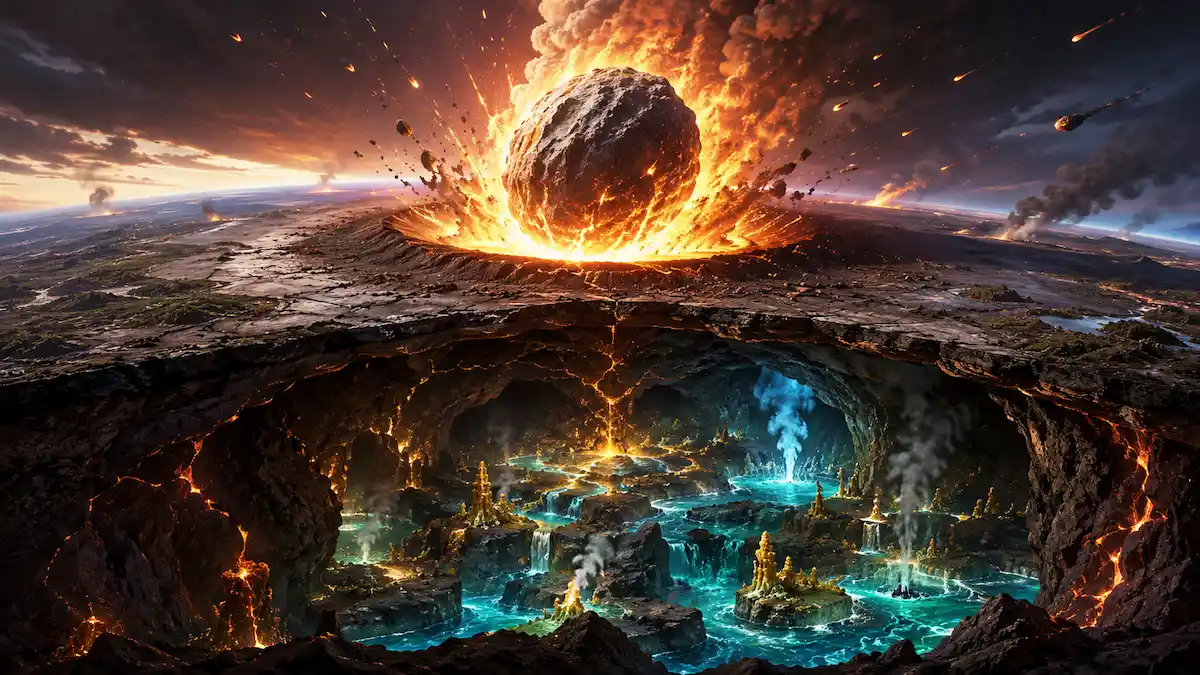
What happened after dinosaur asteroid hit earth? Most of the people think they know the exact answer. A giant piece of rock comes from the space and struck the earth, and then dinosaurs get disappeared from the earth. Over millions of years, life slowly recovered again. But new research suggests that something is missing from this theory. There was another story unfolding beneath the surface. “Scientists now believe the asteroid impact that wiped out the dinosaurs may have created a vast underground habitat that remained active for nearly 8 million years.” Deep below the famous Chicxulub crater, hot water was flowing through fractured rocks. It may have created conditions that supported the microscopic life deep below after the catastrophe above. Now after the research new questions are raising about where life can survive after a planetary disaster.
The Asteroid Impact That Changed Earth Forever
To understand what happened after dinosaur asteroid hit Earth, we need to go back about 66 million years.
A massive asteroid roughly 10 kilometers (6 miles) wide comes from the space and hits the earth’s surface near the Yucatán Peninsula in Mexico. That asteroid impact created the Chicxulub crater. It is one of the largest impact structures on our planet. When asteroid struck to earth, enormous amount of energy was released. Scientists estimated that energy was approximately equivalent to energy produce by billions of atomic bombs together. The immediate effects were devastating.
Massive earthquakes, powerful Tsunamis and superheated debris blasted into atmosphere and then fell back to earth’s surface. Wildfires may have spread across huge areas of the globe. Within a very short period around 75% of all species on Earth disappeared, including the non-avian dinosaurs that had dominated the planet for more than 160 million years. For many years scientists only focus on the destruction on the earth. But now some researchers revealed that the impact was created something much unexpected deep under the ground.
The Hidden World Beneath the Chicxulub Crater

After studying the crater carefully, scientists find the answer what happened after dinosaur asteroid hit Earth. Earlier when the massive asteroid hits the earth, the immense force shattered rocks deep underground. These cracks in rocks become pathways for water to move through the earth’s crust. At the same time huge amount of energy release from the collision. This combination of intense heat and fractured rocks created a system. Scientists call it hydrothermal system. As the result hot water was flowing underground through the cracks and minerals.
Hydrothermal system often exists today on earth. It becomes the cause of hot springs, geysers, and hydrothermal vents. These environments are often rich in chemical energy and can support life even without sunlight. Scientists have known this crater underground hydrothermal system for long but the surprising discovery is how much time this system was lasted. It explains well to question, what happened after dinosaur asteroid hit earth.
The Incredible 8 Million Year Secret
Earlier, scientists think the hydrothermal system under the Chicxulub crater was only lasted for a short time after the impact. But new research suggest new thing. Scientists collected minerals from deep drilling inside the crater and study them carefully. Then scientists found some evidence that proves the hot water flowing deep under the ground for approximately 8 million years. This duration is very long than scientists estimated before. Some minerals form only under specific temperature conditions. Scientists studied these minerals like clues from the past. By looking at the chemicals inside them and how those chemicals changed over millions of years, scientists were able to underground conditions existed long before. These results clearly showed that the impact crater was remained geologically active for long time (approx 8 million years) after the asteroids hits the earth.
This discovery is the main answer to question what happened after dinosaur asteroid hit Earth, because it shows that the impact did more than just cause destruction. The impact also created an underground environment that lasted for millions of years and it provide a place to some forms of life to survive and recover.
Could Life Have Survived Underground?

It is the most excited part of the discovery. Today, scientists know that microbes have the capability to survive even in harshest environment on earth. Microbes have been found deep underground, inside rocks, around volcanic vents, and in hydrothermal systems where sunlight never reaches. Like plants these organisms don’t use sunlight to survive. They obtain energy from chemical reactions involving minerals and hot water. The Chicxulub hydrothermal system may have provided similar conditions. Hot water moving through mineral-rich rocks could have provided energy and essential nutrient for microbes. While scientists did not directly found any fossilized microbe from this underground habitat. But they believe that underground environment appears capable of supporting life.
If microbes did live there, they might survive for millions of years, while earth was recovering its ecosystem above the ground after one of the worst mass extinctions in history. I hope it helps you to understand what happened after dinosaur asteroid hit earth.
The Recovery of Life After the Impact
The asteroid impact marked the end of the dinosaurs, but it did not wipe out all life on Earth. As the environment slowly became better, the animals and plants that survived began to spread and adapt to new habitats. Small mammals that survived started to evolve and diversified rapidly. Birds, which are the descendants of certain dinosaurs, also started to develop and change over time. In the oceans, life slowly recovered as sunlight returned and food chains were rebuilt. Over millions of years, Earth’s ecosystems transformed completely. The world built after the extinction was completely different from the world before the asteroid attack. In fact, the asteroid helped change the course of life on Earth. If asteroid had never strike on earth, dinosaurs might still have dominated the planet. Without it, mammals may never have become the dominant group of animals, and humans might never have appeared. In a way, the asteroid impact helped reshape the future of life on Earth. Recovery of life is also a important part to understand what happened after dinosaur asteroid hit earth.
FAQ
1. What happened after dinosaur asteroid hit Earth?
After the asteroid hits the Earth about 66 million years ago, it caused massive wildfires, earthquakes, tsunamis, and a global climate crisis. Around 75% of all species went extinct and brought the age of the dinosaurs to an end. However, new research suggests the impact also created a vast underground hydrothermal system that remained active for nearly 8 million years and provide suitable conditions for microbes to survive.
2. What was the asteroid that killed the dinosaurs?
The asteroid that caused the dinosaur extinction is known as the Chicxulub impactor. Scientists estimate it was about 10 kilometers (6 miles) wide and struck near present-day Mexico’s Yucatán Peninsula, creating the Chicxulub crater.
3. How long did the Chicxulub hydrothermal system last?
According to recent research, the hydrothermal system created by the asteroid impact may have remained active for approximately 8 million years. This is much longer time than scientists estimated before.
4. Could life survive after the dinosaur-killing asteroid impact?
That day many species went extinct, but still life did survive on Earth. Scientists also believe that microbes may have lived within the underground hydrothermal system beneath the Chicxulub crater, where hot water and minerals could have provided a suitable habitat.
5. What is a hydrothermal system?
A hydrothermal system is a network of hot water flowing through underground rocks and fractures. These systems can contain minerals and chemical energy that support microbial life, even in the absence of sunlight.
Conclusion
So, what happened after dinosaur asteroid hit Earth?
The answer is far more fascinating than scientists once believed. The asteroid caused one of the biggest mass extinctions in Earth’s history. It killed about three-quarters of all species and brought the dinosaur age to an end. But after the impact, a new unexpected story begins under the ground. The impact created a vast underground hydrothermal system inside the Chicxulub crater. After studying many years scientists now think this underground environment stayed active for almost 8 million years. And it provides a safe place and suitable conditions for microbes to survive. So, the asteroid’s story is not only about destruction. It is also about survival, recovery, and life finding ways to continue in difficult conditions. Even after 66 million years, scientists are still uncovering new secrets from the day an asteroid changed Earth forever.