
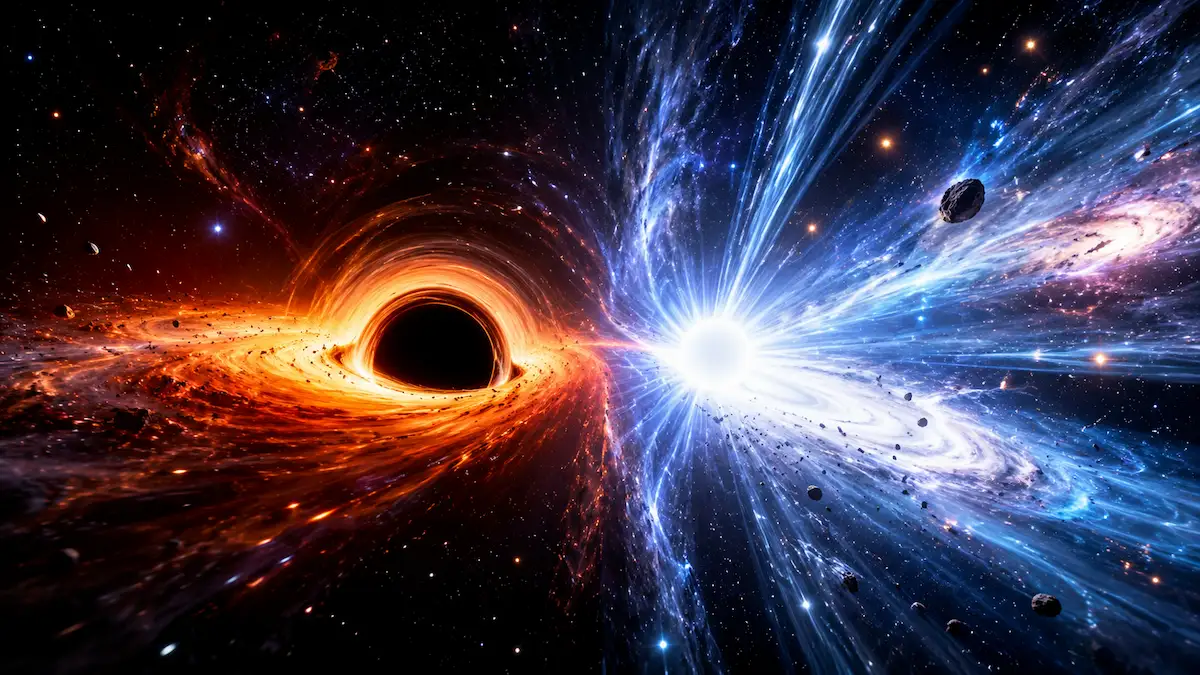
The white hole vs black hole question is one of the most searched topics in space science right now. And honestly it is such an interesting topic.
Scientists have confirmed that black holes are real. They also photographed black holes. You’ve probably seen the famous 2019 photograph that has a glowing orange ring surrounding a dark center. It is the only and first direct image of a black hole that scientists ever captured. Scientists have even spotted one black hole at the center of our own galaxy.
White holes are different. Nobody has seen them. Nobody has photographed one. There is no direct evidence that they exist. Many physicists will tell you that they probably don’t exist, at least not in the universe we can observe.
The strange part is the mathematics of Albert Einstein’s General Relativity allows both possibilities. The same equation and the same theory predicted both black holes and white holes. So what exactly is the white hole vs black hole difference?
White Hole Vs Black Hole — The Simple Version
Here is the easiest way to understand white hole vs black hole in one paragraph. Think both of them as totally opposite.
A black hole is a region in space where the gravitational force is very powerful, nothing can escape once it crosses the boundary called event horizon. Any matter, any information and even a single ray of light can’t escape from a black hole. Nothing comes out ever.
A white hole is the exact mathematical opposite. At least in theory white hole would work the opposite way. Nothing can enter from the white hole. Instead, matter and energy would only move outward and being expelled continuously into the space. It’s like a cosmic fountain that never stops flowing.
In simple terms, if black hole acts like a cosmic vacuum, then white holes would act like a cosmic fountain. One pulls everything in and never lets it escape. The other pushes everything out and never allows anything to enter. That’s the white hole vs black hole difference in simplest form.
Pink Planet unsolved mystery since 13 years
How Does A Black Hole Actually Work?

Before diving deeper into the white hole vs black hole comparison, let’s make sure the black hole side is completely clear.
A black hole forms when a very massive star that contains at least 8 times mass of our sun runs out of its fuel and reaching at the end of its life. After that it cannot support itself and collapses under its own gravity. The collapse triggers a supernova explosion, blasting the outer layers into space, while the core collapses inward. If enough mass remains, the collapse continues until it becomes a singularity. It is a point where matter is compressed to an extreme density and our current laws of physics completely break down. Around this singularity sits the event horizon. It is called point of no return. Once anything crosses this boundary, escape becomes impossible. Not even the light escapes from it. Event horizon is not like any physical boundary or wall that can be touched. It’s an invisible boundary where escape permanently becomes impossible.
So What Exactly Is A White Hole?

Now the strange part of white hole vs black hole difference comes.
A white hole is a theoretical object that works completely opposite to the black hole. It does not allow anything to enter from outside, but matter, energy, and light could flow out of it. The idea didn’t come from observations. It came from mathematics. When Einstein’s equations of general relativity were applied to black holes, mathematician Martin Kruskal extended those solutions in 1960 to cover all regions of space and time and discovered a complete mathematical model that included a strange mirror image of a black hole.
You can understand by thinking of it this way. General relativity’s equations work the same whether you run time forward or backward. When you run a black hole forward in time, matter falls in and nothing can escape. But if you run those same equations backward in time, the result is something that ejects matter instead of swallowing it. Theoretically time-reversed version of a black hole is, is what we call a white hole. If anyone sees white hole from distance, it might look similar to black hole. It has mass. It could spin. Gas and dust might orbit it. But if you observe it constantly for a long time, then you noticed that matter and energy erupting outward in a continuous stream that would be impossible for a black hole.
White Hole Vs Black Hole — Side By Side
| Feature | Black Hole | White Hole |
| Matter behavior | Pulls everything in | Pushes everything out |
| Can things enter? | Yes — never escape | No — nothing can enter |
| Can things exit? | No | Yes — constantly |
| Exists in reality? | Confirmed | Never observed |
| Formed how? | Stellar collapse | Unknown |
| Predicted by | General relativity | General relativity |
| Singularity inside? | Yes | Theoretically yes |
Was The Big Bang A White Hole?
It is the most exciting part in entire debate of white hole vs black hole comparison.
Some physicists strongly believe the “Big Bang”, the starting point of our universe was actually a white hole event. At first it sounds surprising, but if we think what happened during the big bang. It was the time when an enormous amount of energy and matter suddenly expanded outward from a single point, filling the universe and creating everything what we see today. That is exactly what a white hole does. It is very similar to white hole behavior.
This idea comes from certain theoretical models based on general relativity. In some models, our observable universe could exist inside a much larger structure. From an outside perspective, that structure might resemble a black hole. The Big Bang was the white hole on the inside that outpouring and created everything we see around us. This perspective is only a theory, not a scientist’s proven fact. There is no solid evidence that proves, big bang might be a white hole. Most cosmologists do not consider it the leading explanation for how the universe began. It is the essential part of the whit hole vs black hole debate.
Conclusion
White hole vs black hole is one of the most fascinating debates in all of modern physics. It’s not because one is imaginary, but because both comes from the same equation: Einstein’s theory of general relativity.
They emerge from the same equation, so they could not be more different. “Black holes pull and White holes push”. A black hole pulls everything inside and not let them escape and white hole, if it exists would do the opposite. It constantly emits matter outside and don not allow anything to enter inside.
Black holes are real, scientists have their actual photographs. But they don’t have any evidence that prove white hole actually exists in our universe. White holes are real only equations, physically unconfirmed, and possibly never to be found. Still scientists are studying them constantly. Nobody knows what the next photograph will show. The white hole vs black hole debate may one day be settled by an image nobody saw coming.
Stay connected with Science Scope Hub to uncover new mysteries of the universe.
Pingback: How Rare Is It To See A Shooting Star? The Fascinating Science Behind A Wish Upon A Star
Pingback: What Happened After Dinosaur Asteroid Hit Earth? The Incredible 8 Million Year Secret Finally Revealed