
What does umbra mean?
Have you ever heard the word “umbra” while reading about eclipses and wondered what it means? Don’t worry—it’s actually very simple. Once you understand it, the whole business of how eclipses work suddenly clicks into place.
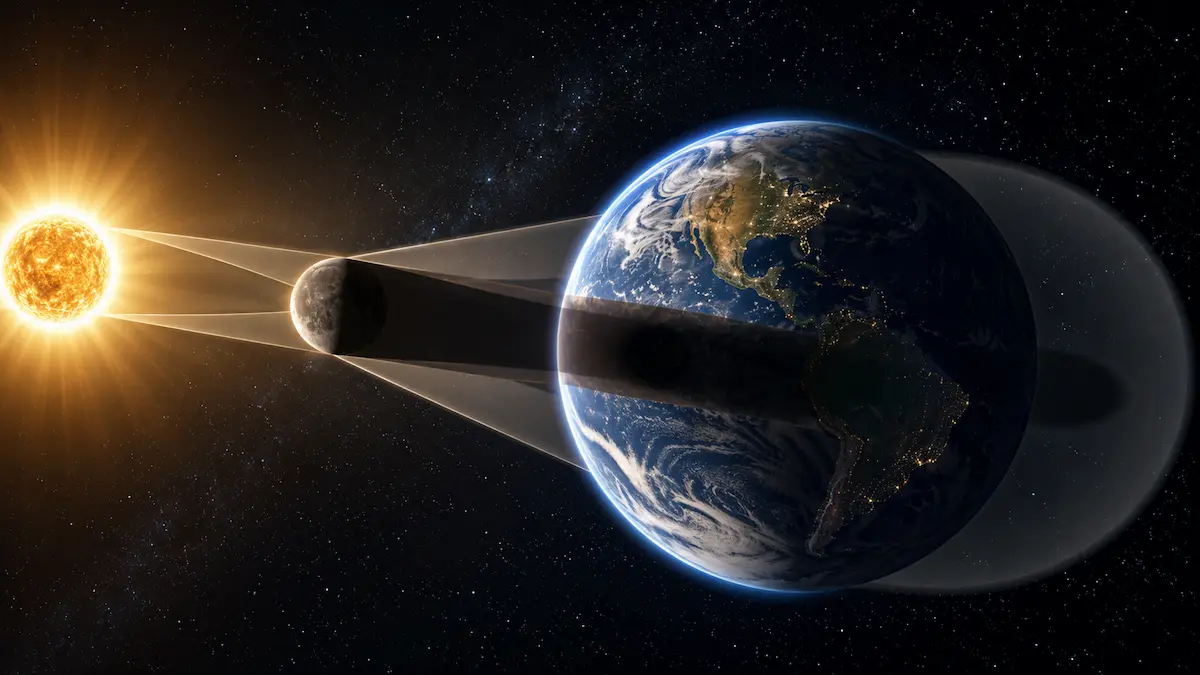
The word umbra comes from Latin and it means “shadow.” In astronomy, it refers to the darkest part of a shadow, that block all the light. Imagine you are standing under the tree, on a sunny day. The darkest shadow of the tree is something like the umbra. During a solar eclipse, moon comes between the earth and the sun. Then moon cast its shadow on the earth. The darkest part of that shadow is what we call “umbra”.
On August 12, 2026, the Moon’s umbra is going to sweep across Greenland, Iceland, and Spain in one of the most spectacular total solar eclipses in years. Understanding what does umbra mean will completely change how you experience the next eclipse. Let’s break it all down.
What Does Umbra Mean In Astronomy?
During the eclipse, if we talk about the umbra, it means the darkest inner part of the shadow cast by an object in space. To understand what does umbra mean, place your hand in front of a light source.
You’ll notice the shadow forms on the wall having two parts. First is darker region and second is lighter region. This dark region of the shadow is called umbra and the lighter region of the shadow is called penumbra. Umbra is the inner part and penumbra is the outer part of the shadow. Umbra does not allow to pass even a single ray of light. But penumbra is the lighter region so some light passes from it. Every object’s shadow contains umbra and penumbra both, whether the object belongs to earth or in space.
Now consider sun as the light source, and earth and moon as the object. During a solar eclipse, moon comes between the sun and earth. Moon cast its shadow on earth and it also has umbra and penumbra. If you are inside the umbra region you can’t see the sun because it completely blocks the sunlight. It means inside umbra moon cover the sun completely and you experience a total solar eclipse. If you go outside the umbra region and inside the penumbra region, then part of sun become visible to you. Because penumbra does not blocks the light completely. I hope now you get the answer “what does umbra mean?” The complete darkness that can turn the day suddenly into night makes the umbra more special.
Difference between Umbra and Penumbra.
What Does Umbra Mean for the 2026 Solar Eclipse?
Here’s the story gets really interesting. On August 12, 2026, a total solar eclipse will pass over the parts of Arctic Ocean, Greenland, Iceland, Portugal, and northern Spain. Upcoming eclipse is special because it is the first time in decades when a total solar eclipse crosses mainland Europe — the first totality in mainland Europe since 1999. Only the people under the umbra region will see the total solar eclipse. People outside the umbra region only see partial eclipse. Only for few minutes, inside the umbra day will turn to night. The moon’s shadow moves incredibly fast around 3,400 kilometers per hour across the surface of the Earth. This speed is about four times faster than the speed of a commercial airplane. Because of this speed, totality lasts only a few minutes in any one place. The path of the umbra is usually quite narrow, often less than 150 miles (240 km) wide. So the difference is simple: inside the umbra we experience total solar eclipse and outside the umbra we experience partial solar eclipse.
What Does It Actually Feel Like to Stand in the Umbra?
For anyone still wondering what does umbra mean in real life, this is the answer — and the answer is extraordinary. When the Moon’s umbra passes over you during a total solar eclipse, the experience is very different from watching a partial eclipse. As the eclipse reaches totality, the sky suddenly becomes dark. It doesn’t feel like a normal sunset—it feels as if someone quickly turned down the lights. The temperature can drop noticeably within seconds. The horizon glows orange in every direction because you’re inside a shadow only 150 miles wide, sunlight is still shining outside the Moon’s narrow shadow.
Then the Sun’s Corona appears. It is the Sun’s outer atmosphere and looks like a white halo around the dark Moon. It is very rare; you can never see it in normal conditions because sun’s surface is too bright for us to see. During totality, some planets and bright stars may also become visible in daytime. But this moment doesn’t long last because the Moon’s shadow moves away, and the bright sun comes back. After seeing one, most people often want to see another.
FAQ
1. What does umbra mean in simple terms?
Umbra comes from Latin and means “shadow.” In astronomy, it refers to the darkest, innermost part of a shadow cast by an object in space. it is like a zone where the light is completely blocked and if you are inside the umbra region during eclipse, you experience total darkness in daytime.
2. What is the difference between umbra and penumbra?
The innermost and darkest part of the shadow, which blocks the light completely, is called umbra. Inside umbra you experience a total solar eclipse.
The outer and lighter region which allows some light to pass through it, is called penumbra. Inside penumbra you experience a partial solar eclipse.
3. Where will the umbra fall during the 2026 solar eclipse?
During the August 12, 2026 total solar eclipse, the Moon’s umbra, will crosses over the parts of the Arctic Ocean, Greenland, Iceland, Portugal, and northern Spain. Path of the umbra is usually quite narrow, often less than 150 miles (240 km) wide.
4. What is the antumbra?
The antumbra is the third type of shadow, extending beyond the tip of the umbra. When the Moon is far away from Earth than usual. So it appears slightly smaller in the sky and cannot completely cover the Sun. People standing in the antumbra see an annular solar eclipse instead of a total eclipse. During this type of eclipse, the dark Moon sits in front of the Sun, but a bright ring of sunlight remains visible around its edges. This glowing ring is called “ring of fire”.
Conclusion
So, what does umbra mean? The umbra is the darkest part of a shadow, where all light is completely blocked. I hope now you know exactly what does umbra mean in both the simplest and most scientific sense. It is like a zone where light is completely blocked, suddenly day turn into night and sun’s corona become visible to all for some time. People who are outside the umbra but still inside the larger, lighter shadow called the penumbra will only see a partial eclipse. The Sun will look partly covered and slightly dimmer, but it won’t become completely dark.
So what does umbra mean for sky watchers on August 12, 2026? The Moon’s umbra will sweep across Europe at 3,400 kilometers per hour. If you are present in Greenland, Iceland, or northern Spain on that day. You’ll know exactly what it means to stand in the umbra.
Stay connected with Science Scope Hub for exploring the science behind the universe’s most spectacular events