
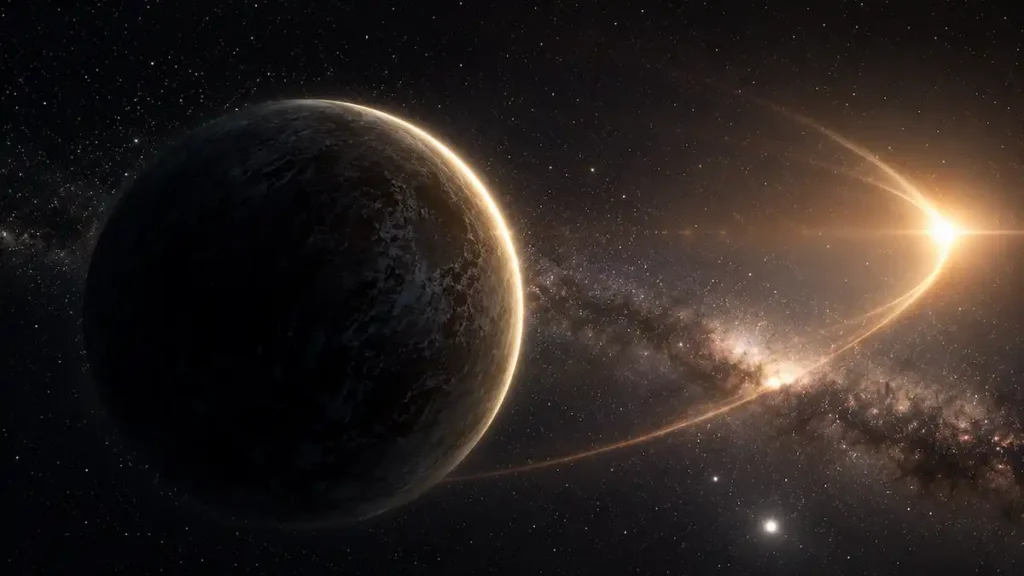
Rogue planet is one of the most surprising concepts in modern astronomy. Unlike our planet Earth that orbits the sun at a predictable speed, a rogue planet is not bound to any star and it moves unattached through the galaxy. The amazing thing is that sometimes scientists can even observe them, when they have no bright star nearby to reveal their location. This creates a major issue for astronomers. The thing is that nearly all exoplanet detection methods are based either on the planet’s orbital mechanics or atmospheric features. But a rogue planet has no star to orbit. It may be extremely cold, faint, and almost impossible to see directly.
So what can astronomers do to observe such a mysterious object? The surprising thing is that there is one technique in astrophysics allowing us to do that, which is based on one of the coolest predictions of Einstein’s relativity called “gravitational microlensing”.
Why Rogue Planets Are So Difficult to Find
To detect an exoplanet is very challenging. It’s rare to spot a planet because it’s usually significantly smaller and dimmer than the stars it’s orbiting. Therefore astronomers use indirect methods to observe them in vast space. One of these methods is called the transit method. If the planet passes in front of the star, it will block some of its light, so we can see it. By this way astronomers can detect the size of the planet.
Another method is known as a radial velocity. It’s similar to the previous one, but astronomers are looking for a slight wobble in a star’s motion, caused by the gravity of an orbiting planet.
However, neither of these methods won’t work for a rogue planet. There is no star that the planet can pass in front of, it doesn’t have a star to wobble beside or around. The planet may also be too cold and faint to detect through its own light. This means astronomers need a completely different approach.
The Gravitational Trick That Reveals a Rogue Planet

This is where the gravitational microlensing comes to action.
Gravitational microlensing becomes handy when an object’s gravity bends the lights coming from another object according to Einstein’s theory of relativity. A rogue planet could be discovered because if a distant star behind a rogue planet from Earth’s point of view is bright enough then a rogue planet could be able to bend the light from that star towards Earth. Since the gravity is bending the lights coming from the star, the star would appear to be brighter. When astronomers are observing the skies, they may spot a star that suddenly becomes brighter than usual and then dims again to its original brightness. The brightness would last only for a few hours or days. The planet may not be revealed itself but its effect on the star appears clearly.
Gravitational microlensing is one good way to find rogue planets because the method does not require the planet to orbit a star or produce enough light to be seen directly. According to NASA, microlensing can help in detecting planets beyond our solar system which would have been really challenging and impossible to photograph or seen directly.
How the Microlensing Signal Works
“Gravitational microlensing is explained with the help of the statement that a massive object is able to deflect light and change the shape of the spacetime”. It is done in accordance with the predictions of Einstein’s theory of the general relativity.
For the purpose of understanding gravitational microlensing, it is required to imagine a distant star that is placed in space behind a rogue planet from earth’s point of view. In this case, a planet can deflect some of the star’s light due to its gravity and make it appear brighter than it typically does. On Earth, scientists can observe the brightness of the background star behind the rogue planet. Astronomers carefully watch the brightness of stars that is temporarily increased due to gravity of a rogue planet, and this temporary brightening is called a microlensing event. When the distant star becomes brighter, it appears as if there was a planet in the way, though, in reality, it is challenging to see such a planet. In this way, astronomers determine the mass of the planet due to the shape of the signal.
On the other hand, the signal’s duration is crucial for understanding how big the planet is. In cases when the duration is too short, it is possible to assume that a discovered object is not a planet, but a low-mass star. Astronomers state that a rogue planet can produce the signal that lasts only for several hours or days. The reason why astronomers watch for these signals is that they can see a background star that would be unavailable for observations otherwise. For example, millions or billions of stars need to be watched for in order to find rogue planets that mimic the appearance of low-mass stars.
How Does a Planet Become Rogue?
A rogue planet could have been formed as a part of planetary system that orbits a star, like the Earth and Jupiter orbit the Sun. In fact, planetary systems can be unstable in their early stage when large planets can gravitationally interact with each other. At this stage when the system is still forming, planets can get ejected from the system, and becoming a rogue planet. Astronomer think that a planet becomes rogue is through a powerful gravitational encounter with another planet. When two massive planets pass close to each other, their gravity may change their orbit. If one can is stronger, it can push another planet out of the planetary system. Then there is no star to bind it and it becomes a rogue planet. Astronomers call it planetary ejection. Computer models show that interactions between young planets are capable of scattering one planet out of the system.
The second way of a rogue planet formation is that some of these planets might have formed around a star that later failed to ignite as a sun. When an interstellar gas cloud collapses, it can sometimes give birth to a planetary-mass object, but there is still an open question how often such objects are actually formed, and whether they should be considered planets at all.
However, understanding rogue planet origins can tell us a lot about how planetary systems evolve, and interact with each other.
Why NASA’s Roman Space Telescope Could Change the Search

NASA’s Nancy Grace Roman Space Telescope could greatly assist our understanding of rogue planets. Due to the Roman’s ability to find planets using gravitational microlensing, the Roman would be able to observe these types of planet even in the case of a rogue planet. Unlike standard forms of detection, gravitational microlensing has the ability to detect a planet even without a host star. The Roman will be used to observe massive numbers of stars towards the center of the Milky Way, and scientists will be on the lookout for small dips in brightness from when a planet like mass object would pass in front of a star. The planet or a stellar mass object would then bend the light of the star behind from its gravity, and would cause a brightening effect.
This is useful, due to the fact that most of the signals that indicate a planet on a free course are very short lived signals that only last a few hours to a few days. With the proposed method of surveying from the Roman, scientists would have a better chance at seeing the event due to the increased frequency and amount of objects that are being watched. The Roman’s observations could also determine the frequency of these types of planets, and their mass range. NASA researchers have estimated that the Roman could find up to hundreds of Earth Mass free planets if observing the best cases
Conclusion
It is very difficult to detect a rogue planet, because it lacks the light source from a nearby star to see, and may even emit very little light itself. However, astronomers have discovered a way to detect these nearly invisible planets in space. Here is the story. According to the article, astronomers can “see” these planets via a natural phenomenon called graviational microlensing, which help scientists to detect the brief moment when a rogue planet’s gravity bends and magnifies the light from a distant background star. This method has already provided evidence for free-floating planetary-mass objects, and future missions such as NASA’s Nancy Grace Roman Space Telescope could dramatically expand the search.
There could be a significant number of these objects in the galaxy, but more research needs to be done before we can tell how common they actually are. Astronomers are hoping to use NASA’s Nancy Grace Roman Space Telescope to spot these rogue planets, and the telescope may allow us to discover much more than just isolated planets.