
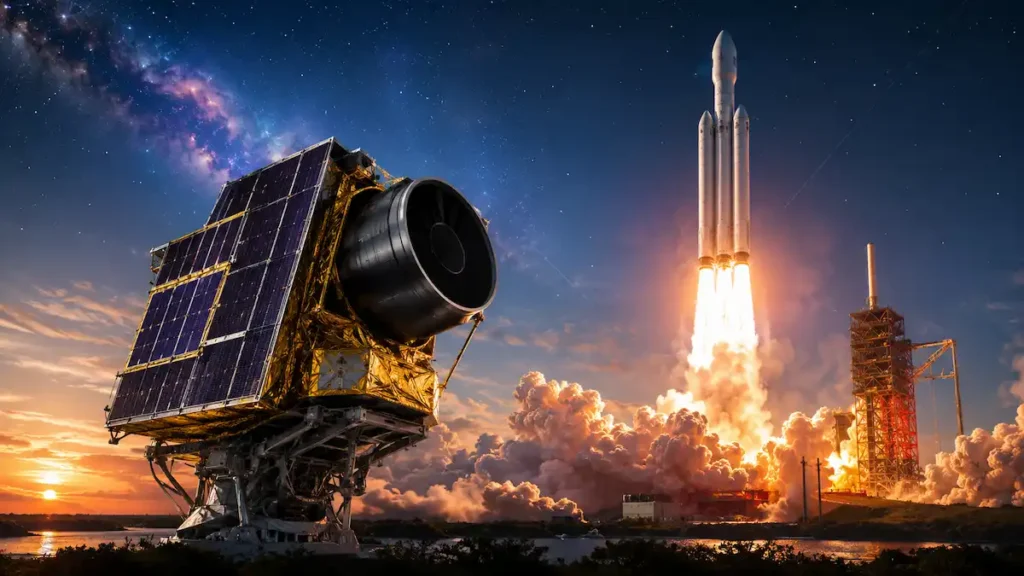
The NASA Roman telescope launch update is now entering an important final phase. NASA has completed a major prelaunch milestone by loading approximately 290 gallons of hydrazine fuel into the Nancy Grace Roman Space Telescope and the observatory is currently getting ready for its final launch preparations. NASA and SpaceX are currently targeting no earlier than August 30, 2026, for sending the telescope into space on a Falcon Heavy rocket from Launch Complex 39A at Kennedy Space Center in Florida.
The launch is significant because Roman isn’t just any ordinary space telescope. Its wide field of view will be the key to exploring many fields of science, including dark energy, dark matter, exoplanets, galaxies, and black holes. It will also lead to a new era in the discovery of planets that manage to escape from the attention of other telescopes.
NASA Roman Telescope Launch Update: What Is Happening Right Now?
The latest NASA Roman telescope launch update shows that the spacecraft has reached one of the most important stages before liftoff. On July 25, technicians at NASA’s Payload Hazardous Servicing Facility in Florida completed the careful loading of approximately 290 gallons of hydrazine fuel into Roman. That fuel will not power the Falcon Heavy. Instead, Roman will use that fuel after separating from the rocket to perform maneuvers during its journey to its final operating location and to maintain its orbit there.
NASA also says that technicians will soon attach Roman telescope to the equipment that will secure it to the rocket’s upper stage. After that, the telescope will be placed inside the rocket’s protective payload fairing. This fairing will protect the telescope from the aerodynamic forces, heat and other harsh conditions during the launch and the journey.
These steps may look simple, but they are very important. You cannot launch a telescope in space by just placing it in a rocket. You need to check the instruments, fuel, solar panels, insulation and many other things to make sure they work.
When Will the Roman Space Telescope Launch?
According to the latest NASA Roman telescope launch update, the Roman Space Telescope is scheduled to launch no earlier than August 30, 2026, at 7:26 a.m. EDT (11:26 UTC). The launch vehicle will be a SpaceX Falcon Heavy, and the spacecraft will take off from Launch Complex 39A at NASA’s Kennedy Space Center in Florida. The first chance to launch is noteworthy because the Roman mission will now launch months earlier than the schedule. NASA described August date as “nine months earlier than their original launch window.”
Of course, a target date is not the same as a guaranteed launch date. Weather, technical issues, range availability, or other problems could still delay the mission. That is why NASA’s wording remains “no earlier than” rather than treating August 30 as an absolute launch date. For readers following the NASA Roman telescope launch update, this means the date can still change if NASA or SpaceX encounters a problem.
Why Is NASA Using Falcon Heavy?

As the NASA Roman telescope launch update moves closer to launch, the choice of rocket is also important. Roman is a big and valuable observatory, so NASA needs a powerful rocket to launch it to the destination. And currently SpaceX’s Falcon Heavy is one of the most powerful rockets in the world for the orbital launches. That’s why NASA will use Falcon Heavy in this mission. The rocket will take Roman telescope out of the orbit and push it toward the Sun-Earth Lagrange point 2, commonly called L2. Falcon Heavy provides the high launch capacity needed to send Roman on its required trajectory while carrying the spacecraft safely into space.
Roman will be placed at the point that is about 930,000 miles (1.5 million km) from the Earth, and it is located away from the Sun. The observatory will orbit L2 at a point where gravitational forces allow spacecraft to maintain a stable orbit around the L2 region, which requires only a small amount of fuel to maintain the trajectory. This distant location also has an important scientific advantage. It will give an opportunity to the Roman telescope to observe the universe without being interrupted by the Earth’s atmosphere.
What Will Roman Do at L2?

One of the most important parts of the NASA Roman telescope launch update is what happens after Roman reaches its destination. After reaching L2, the Nancy Grace Roman Space Telescope will begin one of the most ambitious wide-field surveys ever attempted from space. NASA expects Roman to measure light from billions of galaxiesduring its mission lifetime. The telescope will also collect enormous amounts of data that scientists can use for research far beyond its primary goals.
Roman has a 2.4-meter primary mirror which is almost the same size as the Hubble Space Telescope but the difference is with their Wide Field Instruments. Because of the Roman’s Wide Field Instrument it will be able to capture much more images of the universe than the Hubble can. NASA states that the Roman’s field of view is at least 100 times bigger than the Hubble’s. That is a big difference and plays a large role in what the Roman is used for.
Hubble is famous for producing deep, detailed images of relatively small regions of the sky, but Roman is more like a cosmic surveyor. The Roman is able to capture huge images over and over, being able to depict things such as galaxy clusters and other large objects. NASA estimates that the Roman will be able to observe billions of galaxies over the course of its mission. The Roman will also be able to produce a wealth of information for scientists to use.
Roman Space Telescope and the Search for Dark Energy
Another focus area which is discussed by the NASA Roman telescope launch update is dark energy, or the mysterious idea linked to the accelerating expansion of the universe. Astronomers are aware of the fact that the universe is expanding; however, it was discovered that the expansion rate was higher than expected. Dark energy seems to be the reason for this irregularity, although researchers have yet to understand its nature and whether it has remained constant throughout the universe’s history.
The Roman space telescope will address this issue by analyzing galaxy clusters, supernovae, and galaxies in general, observing their distribution patterns in order to better comprehend the nature of dark energy. It is expected that the results may support the existing assumptions in relation to dark energy, contributing to the understanding of gravity and the history of the universe.
Roman vs. James Webb: Why Both Telescopes Matter
The NASA Roman telescope launch update does not mean that Roman will replace the James Webb Space Telescope, as these telescopes are built for two different purposes. The James Webb Space Telescope is better at examining multiple objects at a high level of detail, while Roman is meant for exploring many objects at once. Roman will also operate primarily in infrared wavelengths and will have a much wider field of view. Its observations can identify interesting targets across enormous areas, after which Webb or other observatories can study selected objects in greater detail.
In that sense, Roman and Webb can work together rather than compete. Roman can help create a broad cosmic map, while Webb can take a closer look at particularly interesting targets.
NASA Roman Telescope Launch Update: Why This Mission Matters
The latest NASA Roman telescope launch update is more than just a countdown to the August 30 mission. Having finished fueling, the spacecraft is now days away from the moment it was launched. Roman could change how astronomers study the universe by virtue of its wide field of view, its remarkable infrared vision, and its ability to quickly scan the skies for signs of other planets. Roman would allow us to peer into the universe and see things humans hadn’t been able to see before, from dark energy to other worlds that are too faint or distant for ordinary telescopes to make out. The NASA Roman telescope launch update is also exciting because the telescope may find things that have never been discovered before. A mission that will survey such a large part of the universe is likely to produce findings that go beyond its original scientific goals.
But what may be even more interesting are the surprises that await further down the road. As soon as the Roman telescope begins its journey back to earth with all of its information, astronomers will surely be able to see the universe in a whole new way, leading to many exciting findings that were not even imagined during the making of this mission.
For now, the next major milestone is simple; to get the roman telescope to the launch site and into space. If all goes according to schedule, August 30, 2026, could very well be the dawn of a new era in the history of space exploration for wide field astronomy.
Stay connected with Science Scope Hub for more updates and space mysteries.