
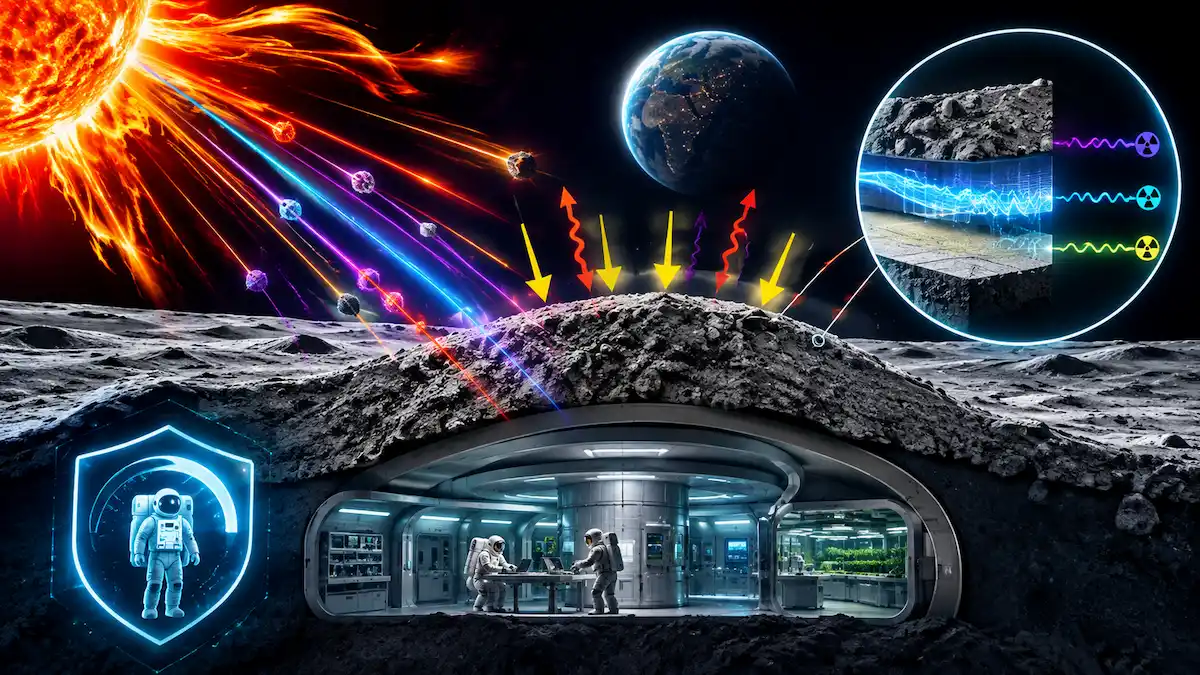
Moon base radiation could become a big problem for keeping astronauts safe while spending long periods of time on the lunar surface. Unlike earth, the Moon has little atmosphere and no global magnetic field to shield the inhabitants from things like ultraviolet radiation, solar particle events and galactic cosmic radiation. NASA is already looking into shielding technology as well as using local materials to reduce the risk of Moon base radiation.
That doesn’t mean NASA is set on astronauts literally living underground. While buried habitats, regolith-covered structures and natural lunar caves are some of the options that have been studied, they were done so in order to mitigate the challenges of the lunar environment. In facts the Moon base radiation is a long-term human health issue.
How NASA moon bases will survive long lunar nights.
Why Moon Base Radiation Is So Dangerous?
On our own planetary home, life has two great natural shields that protect us from radiation – the atmosphere, and the Earth’s magnetosphere. Our atmosphere helps, but the real security comes from magnetic field on our Earth. The Moon has neither of these luxuries. That’s why NASA has determined that radiation is one of the primary challenges to astronauts for missions to the Moon.
Their findings include that the radiation comes in many forms and sources, including UV radiation, solar particle events, and galactic cosmic rays. Solar particle events can be especially troublesome because they are produced by our own sun during solar flares, and they consist of high-energy particles that travel at near-light speed. Galactic cosmic rays are also high-energy particles, but these are more powerful than solar particles, and come from beyond our solar system. This makes moon base radiation a serious challenge for longer missions that lasts for weeks, months or years. After all, a brief visit is nothing compared to a prolonged stay. Astronauts can handle a little radiation, but if a base were built on the Moon, then the crew would be subject to radiation for extended periods of time. Because of this, experts at NASA are looking for shielding to reduce the risk of radiation exposure to astronauts on long-duration missions.
YOU MAY LIKE
- Milky Way’s Black Hole Is Slowly Destroying Itself to Power Cosmic Rays”
 Milky Way’s black hole may be doing something scientists never expected. It is sacrificing a piece of itself to power some of the most energetic particles in our galaxy. A theoretical study suggests that Sagittarius A*, the supermassive black hole present at the center of the Milky Way, could be using its own spinning energy… Read more: Milky Way’s Black Hole Is Slowly Destroying Itself to Power Cosmic Rays”
 - New Tesla Roadster Takes Flight — But Elon Musk’s Original Car Is Still in Space
 This week, Tesla Roadster comes twice in the news for two very different reasons. On October 15, 2026, Tesla showed off a new Roadster prototype in Texas that appeared to lift off the ground using thruster technology inspired by SpaceX. While the new Roadster was making headlines on Earth, the original red Tesla Roadster that… Read more: New Tesla Roadster Takes Flight — But Elon Musk’s Original Car Is Still in Space
 - Astronomers Find the First Green Star – Could Our Sun Also Glows Green After it Dies?
 Astronomers just found the first green star and the reason of its unusual color is surprising. Astronomers at the University of Warwick have detected a dead star that actually looks green to the human eye, something that never confirmed before research. Scientists believe that the star has gained this green color because it consumes some… Read more: Astronomers Find the First Green Star – Could Our Sun Also Glows Green After it Dies?
 - Microblazar Discovered In Our Galaxy, After 30 Years of Searching And Its Jet Is Pointed Straight At Earth
 Recently a microblazar has been confirmed in our own galaxy, Milky Way. Scientists have been investing this cosmic mystery for nearly 30 years. The study reveals that the object named IRAS 18293-0941 sits about 1200 light years away from Earth and one of its powerful jets points straight towards the Earth. It sounds danger but… Read more: Microblazar Discovered In Our Galaxy, After 30 Years of Searching And Its Jet Is Pointed Straight At Earth
 - Orionid Meteor Shower: The Ancient Shooting Stars That Left By Halley’s Comet Centuries Before You Were Born
 The Orionid Meteor Shower returns this month, and brings beautiful streaks of lights and fill the dark sky with colours. Each meteor burning up in the sky is a tiny piece of dust that left behind by the Halley’s Comet hundreds of years ago. Now centuries past, and when Earth passes through this old trail… Read more: Orionid Meteor Shower: The Ancient Shooting Stars That Left By Halley’s Comet Centuries Before You Were Born
The Moon’s Own Soil Could Become a Radiation Shield
One of the most interesting solutions to the Moon base radiation problem may well be located right underneath the feet of astronauts.

It is known as lunar regolith, which is a layer of rocks, dust, and other materials covering the moon surface. This layer is abundant on the moon, yet it is very challenging to work with due to its abrasiveness, electrostatic charge, and other difficulties. NASA has been working on various technologies to deal with lunar regolith and dust. For radiation shielding, however, this challenge may well present an opportunity. NASA suggests that the loose material on the moon surface can be used as a layer of protection.
The underlying physics is relatively simple — thicker the layer of material, the more energetic photons and particles will need to penetrate through it to reach the target on the other side. Therefore, it may be possible to create a lunar equivalent of a radiation safe zone by piling up enough regolith over it. As a result, lunar architecture can take a different form than originally anticipated. Instead of building a structure with thick walls made of materials brought from Earth, it may be easier to make a tent-like structure and cover it with regolith.
Another option would be to bury the lunar base. This approach may be much more effective than trying to build a shielded habitat from the materials brought from Earth. In this case, the majority of shielding would actually be on the moon. NASA has been considering regolith as a potential material for shielding. The agency looked into regolith overburden options for the development of lunar habitats. A NASA presentation on Galactic Cosmic Radiation Shielding suggests that thick regolith shielding can be used for continuous presence on the moon surface and fight against moon base radiation.
However, there is no specific standard thickness, which would be needed to reliably shield a habitat from radiation. It would have to be defined for each structure, based on its size, desired safety level, and other factors.
Why Moon Base Radiation Shielding Can’t Block Everything?

A common myth about the moon base radiation is that adding a thick wall would solve it all. But this is not the case because different forms of radiation can be shielded better by different materials. A sheild that is designed to protect astronauts from a coronal mass ejection doesn’t necessarily protect them from all forms of cosmic radiation. It’s not enough to just add more material. In some cases, you might get the opposite effect if you add more material for energetic particles. This occurs when the particle interacts with the shielding material and creates secondary radiation. Therefore NASA’s research on radiation uses different shielding materials or combinations of different materials, such as regolith and hydrogen. Some approaches suggest mixing regolith with polyethylene to make better shielding.
Therefore, engineers would need to consider not only the thickness of a particular shielding layer but also what kind of materials to use. NASA’s research on radiation uses different shielding materials or combinations of different materials, such as regolith and hydrogen. Some approaches suggest mixing regolith with polyethylene to make better shielding. So that, scientists will focus on multiple materials for shielding the moon base radiation rather depending on moon dust fully.
Could Lunar Lava Tubes Become Natural Shelters?
There is another possibility that sounds almost like science fiction: using natural caves beneath the Moon’s surface to protect from moon base radiation.

Billions of years ago, the moon was covered in volcanic activity. This caused lava to flow across the surface, creating tunnels. Astronomers believe that we can use them as shelter while exploring the moon. NASA’s Lunar Reconnaissance Orbiter has found over 200 pits on the moon. Some of these pits are believed to be openings to underground caves. NASA claims that a cave opening or pit would be good for shielding an astronaut from cosmic rays, solar radiation and micrometeorites. This is very useful for the shielding from nasa moon base, since the shielding power of a natural ceiling is way greater than that of a manmade wall.
Now, scientists have not yet found a cave that they could use as shelter. A lava tube would have to be explored before any colonization could begin. Scientists would have to know it’s size, safety, entrance and how could we go there. The construction of a colony within this cave would be very difficult. Because of moon base radiation on the surface, a cave or a pit would be a great shelter for astronauts.
Lunar Dust Creates Another Reason to Protect the Habitat
Moon base radiation is not the only reason why engineers may want to protect astronauts from the surface. Lunar dust is also another reason.
According to NASA, it is highly abrasive and electrostatically charged, meaning that it can stick to anything, equipments or surface and it’s sharp particles can cause mechanical and operational issues. NASA’s Electrodynamic Dust Shield was able to demonstrate a possible solution to remove the lunar regolith from surfaces during the Firefly Aerospace’s Blue Ghost Mission 1 in 2025.
Keeping the dust outside from the base is extremely important for future NASA moon base. A lunar habitat would need to be located underground or otherwise heavily insulated from the outside elements. Airlocks and specialized dust removal equipment would be essential. To establish such a structure would not be easy, but it would be beneficial to have a more isolated area from the hostile environment of the lunar surface. Therefore, Moon base radiation shielding could be a part of an even greater project to insulate astronauts from the dangers of the outside.
Conclusion
The idea of underground bases on the moon sounds like fiction, but the science behind the idea is quite realistic.
While their home may not be totally underground, but astronauts can be kept safe there from moon base radiation and other outside elements. Future lunar base plans may utilize regolith, underground shelters, specific shelters for solar storms, and natural structures in the ground to protect themselves from moon base radiation, as well as other dangers on the moon. The best part is much of the material needed for the moon base radiation shielding does not come from earth because the moon already has plenty of regolith lying around. That could make Moon base radiation protection a rare example of turning a lunar problem into part of the solution.
And if humanity’s stay on the moon longer than few years, those first lunar homes are likely to be found not on the surface, but far below it, shielded by tons of regolith from the moon base radiation that has kept us safe. Solving Moon base radiation problem may ultimately determine not just where astronauts live, but how safely they can remain there for years.