
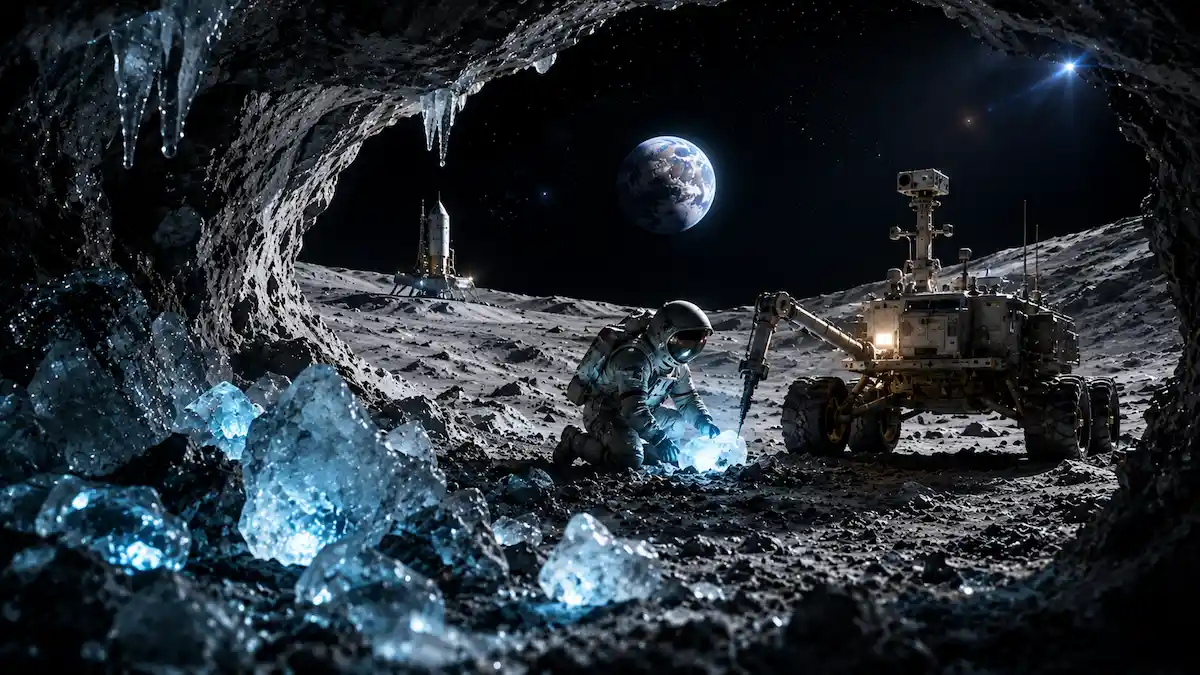
Water ice on the Moon has become a very attractive target for researchers. While scientists have long suspected that there was water on the moon, but the challenge will be identifying where the ice is on the surface, estimating it’s quantity, and determining whether it can be harvested by astronauts.
This debate has taken on new urgency in 2026, as China prepares to send Chang’e-7 to the lunar South Pole to look for deposits of frozen water hidden in shadowed craters, while NASA promotes numerous endeavors to find and analyze water ice. While both nations appear to be racing one another to gain exclusive access to the bounty of the lunar poles, the real prize is much bigger: technological innovation and scientific discovery.
Why Water Ice on the Moon Has Become So Important?
Water is far more precious on the Moon than it is on Earth because all material must be brought up from the Earth through Earth’s gravity well. A lunar base would require drinking water, oxygen, radiation shielding, and fuel. Transporting all of these things from Earth would be incredibly resource intensive. That’s why water ice on the moon could be so vital to us. Water can be broken down into two essential elements, hydrogen and oxygen. The latter of the two would be useful for the survival of astronauts, and both could be used for fuel for rockets, if refined. This can be done through advanced technology and is called In-situ Resource Utilization.
By doing this, we wouldn’t have to rely solely on Earth for our resources. However, there is a difference between having found certain resources and having them be immediately accessible. The article does say that finding water ice on the moon would be vital, but it doesn’t mean that astronauts on the ground could simply wander into a crater and find bags of ice waiting to be taken. The ice could be hidden, or buried underneath the ground, or it could simply not be in large deposits. NASA notes that more surface work will need to be done before they can even begin to think about the logistics of obtaining lunar ice.
The Moon’s South Pole Is Where the Search Gets Serious

The most likely places for water ice on the Moon are around the poles, and especially the South Pole. There is also an explanation for this, moon’s rotational axis is tilted only by 1.5 degrees. Because the Moon’s axis is tilted by such a minuscule amount, sunlight barely reaches the horizon in the polar regions. This means that at the bottom of some craters, there may be places where light cannot reach no matter which time of year it is. These places are referred to as Permanently Shadowed Regions, or PSRs.
Being that cold places tend to be ideal conditions at the bottom of some craters, there could be pockets of water-ice that are trapped inside these shadows. NASA’s Lunar Reconnaissance Orbiter has found some especially interesting places on the Moon for finding signs of water-ice. The Lunar Exploration Neutron Detector on board, also called LEND, can see the atoms of hydrogen from neutrons in the atmosphere above the moon. It is important to consider why the South Pole is a particularly good candidate for hosting these ice deposits. The South Pole has both extremely cold regions that may preserve water ice on the Moon and other regions that are not shadowed which might be useful for providing solar power.
China Is Sending Chang’e-7 Into the Search for Lunar Ice

Here’s the news to report on now: China’s new Chang’e-7 mission. China is now preparing for launch from Hainan on a Long March 5 rocket. As it stands right now reports say the launch window for China’s Chang’e-7 mission is expected to open on August 24, 2026. The spacecraft is a multipurpose vehicle which will include an orbiter, lander, rover, and a small hopping Vehicle.
Their destination is the moon’s south pole region for them to explore and find water ice on the moon despite the challenges of the terrain presents. This specific hopping probe has potential. Because a standard rover can have difficulty negotiating such difficult uneven and dark craters at the pole, while a small vehicle would be able to travel from point to point and even up and down the craters. Reports say the vehicle being built for this mission has the ability to go to these shadowed places and return to more sunlit areas to recharge solar power. This makes for more than just another landing mission on the moon. It’s a mission to go into the deep darkness in search of water ice on the moon.
NASA Is Taking a Different Approach to the Same Problem
China is not the only one attempting to investigate the presence of water ice on the Moon.

NASA has partnered with other countries in the development of Lunar Polar Exploration (LUPEX) to further learn about water ice on the moon. This mission is led by the JAXA with support from the ISRO, and NASA is supplying the Neutron Spectrometer System, an innovative system used to detect hydrogen signatures of possible water ice on the moon. The rover is scheduled to arrive on the moon no earlier than 2028.
The most crucial detail is that the instrument does not able to “see” water ice directly. Hydrogen has an effect on the neutron, allowing us to see where hydrogen is abundant on the lunar surface. Since hydrogen is one of the atoms of water molecules (H₂O), this information can be utilized to find out valuable locations of water ice on the moon. NASA claims that while orbital sightings have already identified traces of water near the poles of our lunar companion, missions conducted from the surface can provide much more detailed information about the distribution and abundance of water on the moon. This is a vital discovery for NASA. While the knowledge of there being water on the moon is one thing, but knowing exactly where it is and how much, is a much more valuable piece of information for astronauts preparing for a trip to the moon’s surface, don’t you think?
Scientists Still Don’t Know How Difficult Lunar Ice Will Be to Extract
This is where things get interesting. Finding ice on the moon doesn’t necessarily mean finding an enormous underground reservoir. In fact, NASA’s water research represents several different issues. Water can be found in several different places and forms. Some of it may found in places like the deep shadows where it can be kept insulated, but other water signatures were found elsewhere. Therefore scientists aren’t exactly sure where exactly water can be found, nor how much or little can be found, nor how much is available for usage. So there are several questions with answers:
| Questions | Answers |
| Is there water? | Well, scientists say yes. |
| Where is it? | We aren’t sure yet. |
| How much is there? | Well, that depends on the area. |
| How deep is it? | This is another major question for surface missions. |
| Can astronauts extract it? | This may prove to be a challenge also. |
This contrast between water that scientists have found and water that would be beneficial to astronauts, is one of the most important parts of this entire article.
We Already Have Strong Evidence That Water Exists
The modern search for water ice on the moon didn’t start with Chang’e-7. There were several missions that added to the evidence. For example, NASA’s Lunar Prospector found hydrogen-rich areas near the poles on the moon, and later missions found more evidence. Another mission, India’s Chandrayaan-1, carried NASA’s Moon Mineralogy Mapper, which found direct evidence of water ice in the shadows of the moon’s poles. Researchers there even found signs of solid ice, not just water vapor. Then there was NASA’s LCROSS mission in 2009. They didn’t just look at one of the dark craters near the South Pole, they actually crashed into Cabeus crater. The scientists looked at all the material shot up by the impact and they found water. The mission even found some of the most conclusive evidence that the water was in the shadows. So in summary, the race isn’t to find out if there’s water ice on the moon. The race is to find out just how much water is there.
Why Lunar Ice Could Eventually Become Rocket Fuel?
The most important thing about the water ice on the moon is that its importance goes far beyond than just keeping astronauts hydrated. If the water could be extracted from the ice, perhaps it could be split into hydrogen and oxygen through electrolysis. Hydrogen and oxygen are used as fuel in rockets anyway. So this could provide a way to fill the fuel tanks of spacecrafts without needing to transport it all the way from Earth. This could allow a spacecraft to go to the moon, and then use the fuel from the ice to propel itself into other areas, instead of just wasting it by landing back on Earth. But, this is all speculation, and may not come to pass. The technology to dig out, distill, and transport the necessary materials has yet to be developed and tested.
Conclusion
The discovery of water ice on the moon has transformed the lunar south pole into a hotbed of human activity. But finding water is only the beginning. Scientists seeking to make the moon a long-term prop for human excursions on Earth and beyond will need to know how much water there is, where it is located, how deep it is and whether it can be extracted for various uses.
That’s why the enterprises – including China’s Chang’e-7 and NASA-assisted endeavors – that want to examine the moon’s southern reaches are so valuable. They are not just looking for water, but for ways to turn it into a resource that will allow it to serve its true purpose: fueling humanity’s travels. If scientists can figure out how to create water, oxygen and even rocket fuel from the ice found on the moon, the moon may be able to supply more than just a cool place for a picnic. It could also be a launching pad for other explorations, including journeys to Mars.
The real “race to the moon” may be about finding water, but the true goal of humanity’s travels may well be to put it to work.