
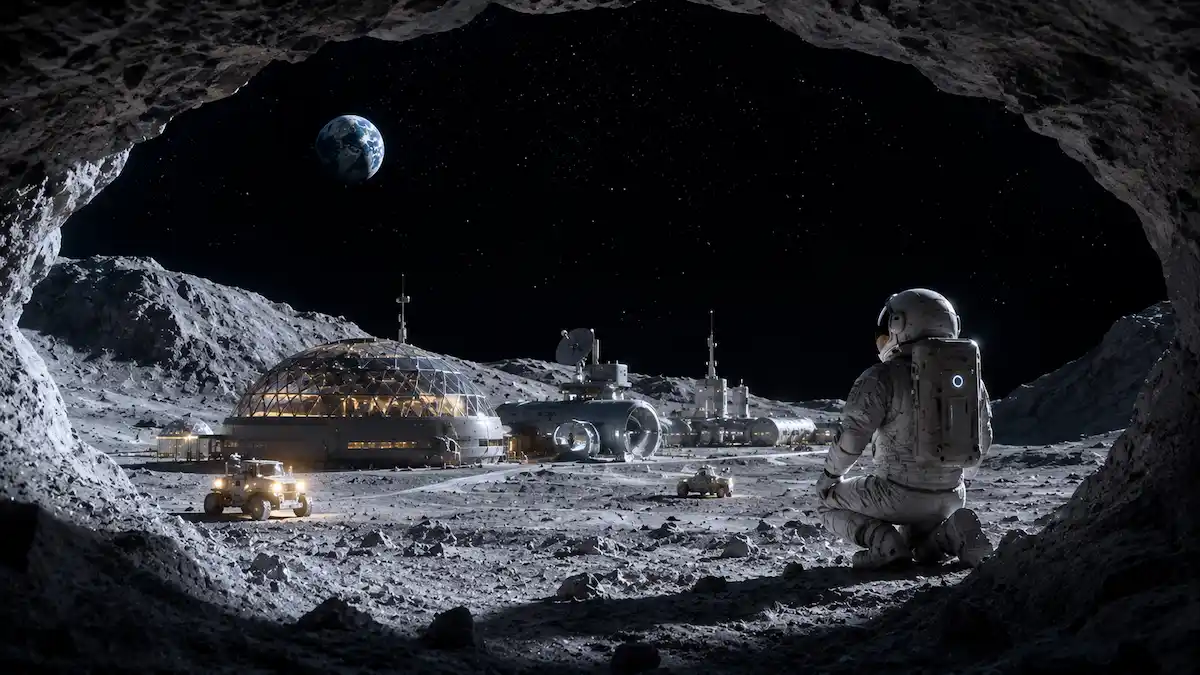
What is NASA Moon Base? It is NASA’s idea of building humanity’s first outpost on the Moon, around the South Pole, where astronauts will live and work, testing technologies for use on Earth and other worlds. However, NASA Moon Base is a project that NASA wants to create humanity’s first lunar outpost, capable of supporting humans. They want to create a lunar base that goes beyond previous Apollo missions, which were short visits. It is an interconnected network of power, communications, transportation infrastructure, habitats, cargo, unmanned and manned spacecraft, and scientific experiments. NASA says that they want to establish a lunar base, but the base is a process. This process is expected to last several decades, starting with robotic, unmanned missions and leading to expeditions led by humans. So, what is NASA Moon base, it is not to be thought of as a completed lunar city.
The first steps will involve robotics, technology testing, cargo delivery, communications, power, and surface transportation. These systems are required to support astronauts, which means that NASA Moon Base cannot be viewed as just “a house on the Moon.” Astronauts will need life support systems such as air inside some kind of structure since there is virtually no atmosphere on the moon to allow them to breathe. The base would also need power, heating, communication, transportation, life-supporting equipment for the astronauts, food, water, scientific machines and research equipment, and protection from the elements. In fact, NASA’s own concept of the Moon Base is a process. The text says, “Our thoughts on the Moon Base are evolving.” The word evolving means the improvements will be made over time; it is not something that was designed to be completed as soon as possible.
Why Is NASA Planning the Moon Base Near the South Pole?

Interpret the meaning of what is NASA Moon Base also explain why NASA is considering the moon south pole for its location. The lunar South Pole is one of the moon’s most isolated places geographically. Since the axial tilt of the moon is much lower than that of the Earth, the sun appears to rise and set at very low angles, casting long shadows. As a result, there are some areas with deep craters which contain permanently shadowed areas amenable to sustaining volatile compounds such as water ices. At the same time, the South Pole has regions with higher elevations which may be exposed to nearly continuous solar energy.
This is perhaps the main reason why the South Pole was considered for the establishment of a NASA moon base and research center. Other regions could have abundant solar power sources, while the permanently shadowed areas could be mined for water. NASA must also consider the inherent risks and dangers of the South Pole, which include rough terrain, significant slopes, large disparities in temperatures, long shadows, and permanently shadowed regions. They acknowledge that creating the moon base will require innovative methods, equipment, and engineering techniques due to these challenges. In short, what is NASA Moon Base determines its location since the conditions at different sites determine the ease of access, availability of resources such as sunlight and water, landing sites, and research opportunities.
YOU MAY LIKE
- Milky Way’s Black Hole Is Slowly Destroying Itself to Power Cosmic Rays”
 Milky Way’s black hole may be doing something scientists never expected. It is sacrificing a piece of itself to power some of the most energetic particles in our galaxy. A theoretical study suggests that Sagittarius A*, the supermassive black hole present at the center of the Milky Way, could be using its own spinning energy… Read more: Milky Way’s Black Hole Is Slowly Destroying Itself to Power Cosmic Rays”
 - New Tesla Roadster Takes Flight — But Elon Musk’s Original Car Is Still in Space
 This week, Tesla Roadster comes twice in the news for two very different reasons. On October 15, 2026, Tesla showed off a new Roadster prototype in Texas that appeared to lift off the ground using thruster technology inspired by SpaceX. While the new Roadster was making headlines on Earth, the original red Tesla Roadster that… Read more: New Tesla Roadster Takes Flight — But Elon Musk’s Original Car Is Still in Space
 - Astronomers Find the First Green Star – Could Our Sun Also Glows Green After it Dies?
 Astronomers just found the first green star and the reason of its unusual color is surprising. Astronomers at the University of Warwick have detected a dead star that actually looks green to the human eye, something that never confirmed before research. Scientists believe that the star has gained this green color because it consumes some… Read more: Astronomers Find the First Green Star – Could Our Sun Also Glows Green After it Dies?
 - Microblazar Discovered In Our Galaxy, After 30 Years of Searching And Its Jet Is Pointed Straight At Earth
 Recently a microblazar has been confirmed in our own galaxy, Milky Way. Scientists have been investing this cosmic mystery for nearly 30 years. The study reveals that the object named IRAS 18293-0941 sits about 1200 light years away from Earth and one of its powerful jets points straight towards the Earth. It sounds danger but… Read more: Microblazar Discovered In Our Galaxy, After 30 Years of Searching And Its Jet Is Pointed Straight At Earth
 - Orionid Meteor Shower: The Ancient Shooting Stars That Left By Halley’s Comet Centuries Before You Were Born
 The Orionid Meteor Shower returns this month, and brings beautiful streaks of lights and fill the dark sky with colours. Each meteor burning up in the sky is a tiny piece of dust that left behind by the Halley’s Comet hundreds of years ago. Now centuries past, and when Earth passes through this old trail… Read more: Orionid Meteor Shower: The Ancient Shooting Stars That Left By Halley’s Comet Centuries Before You Were Born
How Will NASA Build the Moon Base?
A significant portion of what is NASA Moon Base will be concerns how NASA intends to build it. The National Aeronautics and Space Administration (NASA) will not be launching a single spacecraft carrying all the necessary equipment for the construction of an entire base. Rather, NASA is planning on a progressive build, using robotic and commercial lunar landings to deliver much needed supplies and research. NASA’s Moon Base plan will utilize commercial companies to launch lunar landers bringing NASA’s science, technology, and infrastructure to the surface. The companies, Blue Origin, Firefly Aerospace, Intuitive Machines, and Voyager Lunar Systems, are all making advancements towards landing their cargo on the moon’s surface to help with the build. This is how NASA is building its Moon Base.
The Moon Base plan will also utilize Astrobotic, Firefly Aerospace, and Intuitive Machines, to conduct four new NASA delivery missions to the Moon in late 2028, as part of NASA’s Moon Base program. With this the NASA can test equipment and systems before relying on them to get humans to the surface. A rover can test the terrain, a communication system can be trialed, power equipment can be tested and operated, scientific equipments investigate the environment, and cargo lander can take useful hardwares. Each becoming a piece of the greater Moon Base plan. Every mission can be a part of something bigger.
Why Will Robots Arrive Before Humans?

When people think what is NASA Moon Base, they envision humans arriving first and getting to work. While the end-goal is human exploration, the process is much more drawn out. There are many tasks that robots can perform to make the job safer for astronauts.
NASA has a plan to send multiple robotic missions to the moon South Pole to conduct surveys, look for resources such as water, test equipment, and more. For example VIPER, a robotic rover designed to search and map out water ice and other volatiles around the South Pole. NASA currently has VIPER scheduled to arrive sometime in the late 2020s as part of the Commercial Lunar Payload Services program. In addition to VIPER, NASA is working on another project called MoonFall. This project has four propulsive drones that will survey the South Pole. NASA stated that these drones will allow them to make detailed terrain maps and gather information to make future missions and the Moon Base safer.
What Systems Will NASA Moon Base Need to Work?
The answer to the question “what is NASA Moon Base” becomes apparent when considering the systems necessary to support astronauts’ lives.
Power will be the most critical one. Solar power may be appropriate in many cases, but polar regions see periods of both sunshine and darkness. Therefore, NASA is working on power technologies for astronauts and lunar surface vehicles that can handle extreme conditions.
Another matter is transportation. If astronauts are to explore a large region, they cannot stay at a place near their ship. NASA has selected two companies, Astrolab and Lunar Outpost, to design and build vehicles capable of conveying personnel and equipment within the lunar surface, particularly the South Pole. These vehicles can also allow for independent or remote operation whenever required.
The issue of communications becomes another challenge. NASA mentions that the South Pole region is associated with “communication challenges with Earth”. The solution involves the creation of a relay network that will allow communications and navigation capabilities for astronauts.
Finally, there is the matter of habitats and life-support systems that are capable of withstanding a vacuum, temperature extremes, radiation, and dust. This is why the answer to the question “what is NASA Moon Base” is better understood as an infrastructure project than a construction project.
How Could the Moon Base Help NASA Reach Mars?
Perhaps the most compelling reason for NASA Moon Base is that the Moon can provide NASA with a nearby test stand for experimenting with technologies that will be needed for much more challenging missions.
NASA would like to send humans to mars in the future and it is much farther away and such an outpost would allow astronauts to get used to the idea of being so far from home. Astronauts training on the moon would allow them to test everything from habitats to power supplies, vehicles on the surface, robotic technology, communications, food supplies, and much more. A NASA spokesperson explains: “The Moon Base is a proving ground for deeper space exploration; the technologies we develop there will contribute to our capabilities, enabling us to pursue a Mars-forward exploration strategy.” This makes what is NASA Moon base about more than a scientific endeavor. It is also about testing how humans can live on another world.
Conclusion
So, what is NASA Moon Base at the core?
It is NASA’s idea of transition from what we have been doing to more permanent, human presence on the Moon. The plan involves sending both robotic and commercial missions to the lunar surface; includes scientific, power, communication, transportation, habitation, and other types of research; and builds to increasingly more complex missions near the lunar south pole. The most important thing to know about what is NASA Moon Base is that it will not happen overnight. They are starting to lay the groundwork for it, testing technologies and approaches that allow them to meet each mission’s unique challenges. But it is likely to become a reality if their work proceeds as planned. It will become our first, ongoing, permanent outpost beyond Earth, from which humans will be able to engage in a wide range of scientific, technological, economic, and human factors related to exploring and living on another world. And this is why what is NASA Moon Base is likely to be among the most important endeavors of our time.