
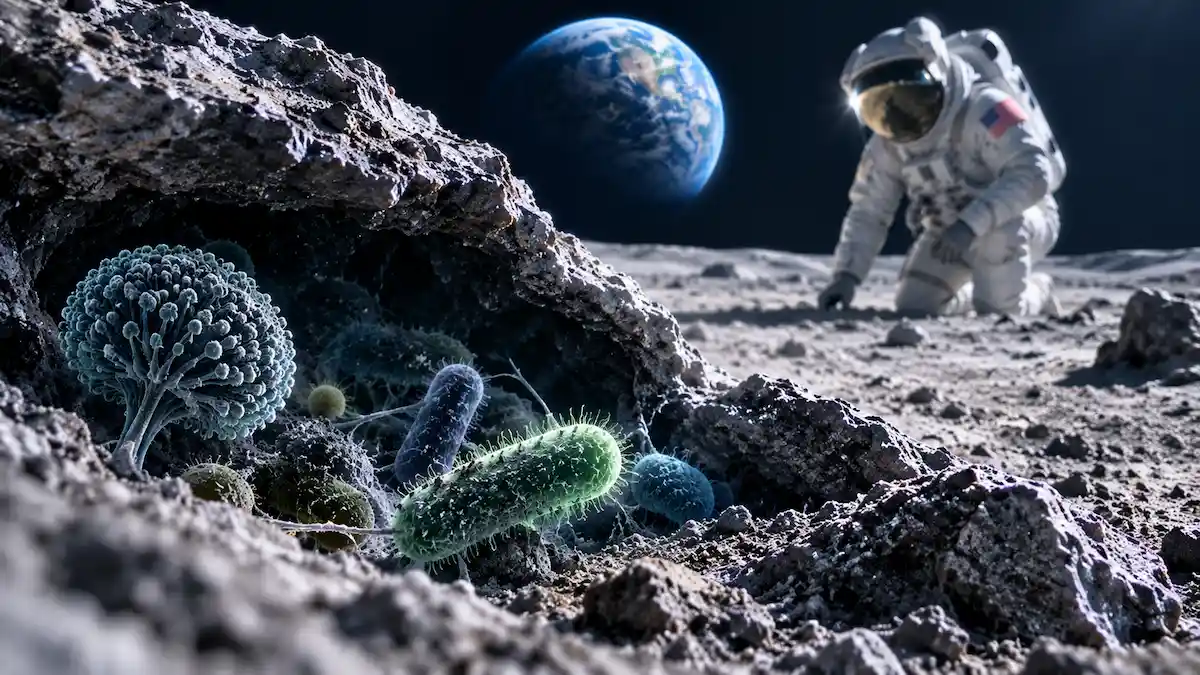
Can microbes survive on the Moon? The answer is more surprising than a simple yes or no. NASA published a new study on August 19, 2026, in Science Advances. The new research suggests that there are some places on the Moon where Earth microbes carried by astronauts could live there for at least 24 hours. But this research does not find that those microbes could grow and thrive, or even survive beyond that period. It is also notable that there are pockets of protection on the lunar surface to allow some form of life to persist and flourish, for a very short time.
That finding is significant, since the Moon is an inhospitable place, with little air, extreme UV radiation, temperatures that vary wildly, and radiation from space impacts. But NASA’s models have found various “survivable” places on the moon, such as wide crater bottoms and tiny areas as small as a footprint. This means that “Can microbes survive on the Moon?” is a critical question for NASA.
Why Moon Base Radiation Could Force Astronauts to live Underground
What NASA Actually Discovered?
Aspergillus niger, Bacillus subtilis, Staphylococcus aureus, Deinococcus radiodurans, and selected Fusarium species were studied by new research. Instead of taking the microbes into the moon, scientists analyzed the heat and UV resistance of these organisms and got compared it with the modeled temperatures and radiation levels of the lunar South Pole.
This area was divided into three regions: Nobile Rim, Connecting Ridge, and De Gerlache Rim, and for each of them, an elevation profile was defined. It was found that due to the South Pole’s topology, there were areas with lower temperatures and sunlight exposure which were not taken into account by previous studies. Lunar South Pole’s topography allows for some regions to be quite cold and remain shielded from UV radiation. While those conditions would still be too harsh for unprotected organisms, they could provide a less stressful environment for some microorganisms.
This is the key to understand “can microbes survive on the Moon?” The answer is, not the entire lunar surface suddenly becomes suitable for microorganisms, but rather the research suggests that in some cases, it could be much less hostile.
Why the Moon Is Such a Brutal Place for Microbes?

Organism which evolved on earth is surrounded by environment consisting of an atmosphere, water, and some protection from the sun. The Moon doesn’t have any of these luxuries.
First off, the sun emits UV light, which can cause harm to any organism. In fact, UV light is used for sterilization because it can destroy or disable microorganisms. A microbe on the surface of the moon is likely to be exposed far more UV radiation than a microbe here on Earth. Another problem an unprotected microbe on the moon would encounter with the extreme temperatures. With practically no atmosphere to moderate the temperature, the surface of the moon could quickly become inhospitable to any microbe present there. Finally, the lack of protection from space radiation would kill any microbe on the moon’s surface in a very short time. The sun produces high energy particles, like other stars, and other various cosmic sources. A microbe on the moon would be exposed to all of these.
Therefore, this question “can microbes survive on the moon?” cannot be answered with a simple yes or no. It depends on the organism, it’s location, how much sunlight is present, how much shielding is there, and how long the microbe is there.
YOU MAY LIKE
- Milky Way’s Black Hole Is Slowly Destroying Itself to Power Cosmic Rays”
 Milky Way’s black hole may be doing something scientists never expected. It is sacrificing a piece of itself to power some of the most energetic particles in our galaxy. A theoretical study suggests that Sagittarius A*, the supermassive black hole present at the center of the Milky Way, could be using its own spinning energy… Read more: Milky Way’s Black Hole Is Slowly Destroying Itself to Power Cosmic Rays”
 - New Tesla Roadster Takes Flight — But Elon Musk’s Original Car Is Still in Space
 This week, Tesla Roadster comes twice in the news for two very different reasons. On October 15, 2026, Tesla showed off a new Roadster prototype in Texas that appeared to lift off the ground using thruster technology inspired by SpaceX. While the new Roadster was making headlines on Earth, the original red Tesla Roadster that… Read more: New Tesla Roadster Takes Flight — But Elon Musk’s Original Car Is Still in Space
 - Astronomers Find the First Green Star – Could Our Sun Also Glows Green After it Dies?
 Astronomers just found the first green star and the reason of its unusual color is surprising. Astronomers at the University of Warwick have detected a dead star that actually looks green to the human eye, something that never confirmed before research. Scientists believe that the star has gained this green color because it consumes some… Read more: Astronomers Find the First Green Star – Could Our Sun Also Glows Green After it Dies?
 - Microblazar Discovered In Our Galaxy, After 30 Years of Searching And Its Jet Is Pointed Straight At Earth
 Recently a microblazar has been confirmed in our own galaxy, Milky Way. Scientists have been investing this cosmic mystery for nearly 30 years. The study reveals that the object named IRAS 18293-0941 sits about 1200 light years away from Earth and one of its powerful jets points straight towards the Earth. It sounds danger but… Read more: Microblazar Discovered In Our Galaxy, After 30 Years of Searching And Its Jet Is Pointed Straight At Earth
 - Orionid Meteor Shower: The Ancient Shooting Stars That Left By Halley’s Comet Centuries Before You Were Born
 The Orionid Meteor Shower returns this month, and brings beautiful streaks of lights and fill the dark sky with colours. Each meteor burning up in the sky is a tiny piece of dust that left behind by the Halley’s Comet hundreds of years ago. Now centuries past, and when Earth passes through this old trail… Read more: Orionid Meteor Shower: The Ancient Shooting Stars That Left By Halley’s Comet Centuries Before You Were Born
The Moon’s Shadows May Be the Biggest Clue
The most interesting part of this research is the role of lunar shadows.

Sunbeams have a different behavior near the South Pole since the Moon’s axis is tilted at a very small angle. Thus, sunlight comes at low angles and is unable to reach many places along the horizon, being blocked by mountains, crater rims, ridges, and other features. These local areas of shadow can be critical for the survival of various organisms. The range in the models found by NASA predicted that it could be from a few miles across the floor of a crater to a region the size of a human footprint. They are not suggesting that researchers will find places with colonies of various life forms. Instead, there may be a chance for some forms of bacteria to keep surviving. This research will help answer the question of “can microbes survive on the moon” much better. It is not about whether some microorganisms can live on the lunar surface. The primary issue is whether some forms of microscopic life can survive in small, naturally protected locations.
One of the microorganisms from the study could be a good candidate to be the first form of life on the moon. Aspergillus niger, a black mold, had the highest resistance to UV light among the tested organisms. Thus, NASA’s models predicted that it may have a chance at surviving even in partially illuminated areas.
Humans Could Accidentally Bring Microbes to the Moon

The question becomes even more interesting when humans begin to explore moon. The human body hosts millions of bacteria and other microorganisms on the skin or inside the body. Contamination control measures can’t stop every single microbe from escaping into the environment. It creates a challenge for future moon missions.
Robotic spacecraft can be subjected to more rigorous cleaning procedures. NASA has used heat to sterilize some spacecraft, but temperatures would have to exceed 400 degrees Fahrenheit (about 204 degrees Celsius) to kill the bacteria that might be found on a human body. But off course, humans can’t be sterilized in this manner. This raises not only an astrobiological issue, but a planetary protection issue.
If Earthly microbes could be introduced to a habitable environment on the moon, some might survive for longer than scientists expect. If it happens these microbes could contaminate scientifically important sites on the lunar surface, and this makes harder for scientists to study those places in their natural state.
Why Lunar Contamination Could Affect Future Discoveries?
The moon may not have any life, but scientists want to study the chemistry of the moon without mixing any of their own biological materials into it.
Imagine a future mission found some strange organic material in a permanently dark spot on the moon. If humans have already visited there and accedently brought some microscopic organisms on that place, then how would scientist tell the material originally from the moon or caried from the earth. This is why scientist would like to set a baseline, so scientist could know what is on the moon naturally and what is not. NASA scientists have noted this and believe it is important because in future, scientist may confuse in separating the chemicals from Earth and chemicals from the moon.
The question “can microbes survive on the moon” is important because it also helps scientists to understand how microbes may survive or thrive in the harsh conditions of space so that scientists would know what to expect on a future journey to Mars. If the human race ever goes to Mars in search of life, and if scientists would find any biological material they need to examine it properly to find the material is genuinely Martian and not something accidentally brought from Earth. So that the question “can microbes survive on the moon” is more than about the lunar microbes.
Conclusion
Can microbes survive on the Moon? According to a new NASA study, some Earth microbes can survive for at least one day in certain shaded areas around the lunar South Pole. But that is not the same thing as saying that microbes can grow, thrive, and multiply there.
What the NASA researchers have found more importantly is a potential for survival. A shadowy crater floor, a protected depression, or even just a small indentation in the surface can be just enough to provide a survivable niche for a hardy microbe. That makes can microbes survive on the Moon a valuable insight, not just because of the potential for life on the Moon, but also because now we are returning to the Moon, our own microbes may be making their own contributions to the lunar landscape, making it important for us to understand where those microscopic invaders can survive. And the value of the insight goes further. The Moon may seem barren and desolate from millions of miles away, but NASA’s research suggests that the answer to “can microbes survive on the Moon?” may just be a matter of finding a shadow.