
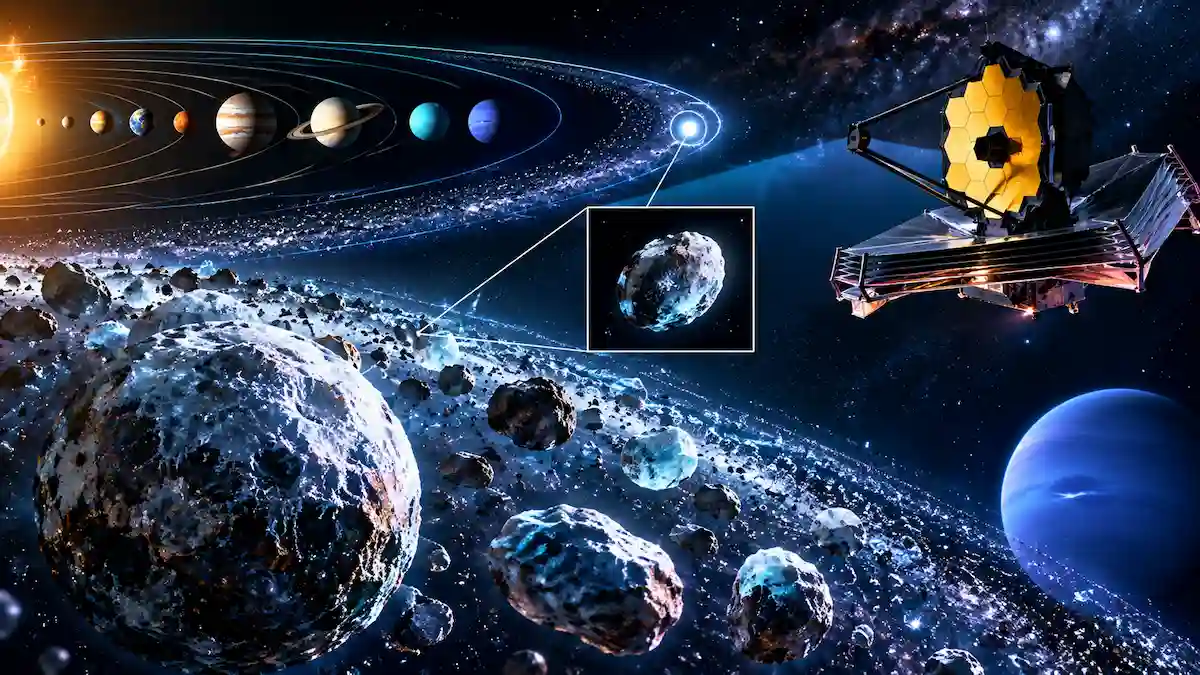
What if some of the universe’s smallest objects hold secrets about its formation? Thanks to the James Webb Space Telescope, astronomers have found 27 tiny worlds beyond Neptune for the first time. This discovery tells us about the most out-of-reach places in our solar system. These objects are too dim for most telescopes to easily spot them, but their size, color, brightness, and orbital distribution may help us understand how our solar system’s building blocks came together. This discovery is valuable because these 27 tiny worlds beyond Neptune are part of a category of objects called trans-Neptunian objects, also known as TNOs, and they orbit in the far reaches of our solar system, and many of them have been hanging around in their dark and cold environment for billions of years, ever since the solar system began to take form.
Scientists Just Found a Vast Magma System on Mars Hidden Deep Beneath the Surface
JWST Found 27 Tiny Worlds Beyond Neptune

This discovery came from the NASA’s James Webb Space Telescope using the telescope’s Near-Infrared Camera (NIRCam). The researchers have utilized a sophisticated method known as shift-and-stack to identify these objects, which are usually too dim to be captured in a single exposure by Webb. The result of this research is a sample of 27 trans-Neptunian objects, one of the largest and most comprehensive studies of these distant solar system bodies ever made. The faintest object in the study has an estimated diameter of about 10 kilometers, assuming a surface reflectivity, or albedo, of 15%. These objects are large when compared with asteroid’s size, but on a solar system scale, these are comparatively small objects to detect from the Earth.
These objects are very challenging to observe because of their low brightness, caused by the enormous distance between them and us. Even the distant Neptune is on average 30 times farther away from the sun than the Earth, and these TNOs are even travel much farther. So that very little sunlight reaches to them and they reflect a very small amount towards Earth. As a result, the researchers were only able to detect the biggest and brightest TNOs, because they had enough light to be seen by Webb. Thus, the discovery of these 27 tiny worlds beyond Neptune adds more number of known objects. It also allows scientists to investigate the distribution of sizes in the solar system that was previously difficult to observe.
Webb and Hubble Telescope Are Working Together
Finding distant objects is one thing but scientists have to know about their composition is complex one and how their surface interact with light. Webb and Hubble are become useful together in this regard because they can observe different electromagnetic spectrum.
The Hubble Space Telescope was focused on visible and ultraviolet light, while the James Webb Space Telescope was designed to examine infrared light. The combined observations of both telescopes provide information about the surface structure and thermal effects of these faint solar bodies. The information about color and temperature is important to distinguish two similar objects. Scientists believe that many such worlds as the 27 tiny worlds beyond Neptune are present in the outer solar system, so their careful study and statistical description are necessary.
YOU MAY LIKE
- Can Fire Burn in Space? What Happens to Flames Without Gravity
 Can fire burn in space? The answer depends on where you are. In the empty vacuum of space, normal fire cannot burn because there is no air or oxygen to support normal combustion. But inside a spacecraft, fire is possible because the cabin contains oxygen. The interesting part is; flames in space behave very differently… Read more: Can Fire Burn in Space? What Happens to Flames Without Gravity
- Can You Cry in Space? How Your Tears Behave in Zero Gravity
 Can you cry in space? Yes, you can! Your eyes still produce tears in orbit, just like they do on Earth. But here’s the surprising part: the tears don’t roll down your cheeks. Instead, they stick to your eyes and gather into a small, wobbly ball of water. It might sound funny, but it can… Read more: Can You Cry in Space? How Your Tears Behave in Zero Gravity
- What Kills You First in Space? It’s Not What the Movies Show
 What kills you first in space? Not freezing, and definitely not exploding like you see in movies. The honest answer is much quieter: you’d run out of oxygen and pass out in about 10 to 15 seconds. Movies love showing astronauts freezing solid or bursting like balloons, but real science says space is more patient,… Read more: What Kills You First in Space? It’s Not What the Movies Show
- Why Is Space Silent? The Surprising Reason, and the Strange Exceptions
 Why is space silent? The answer is simple: sound needs something to travel through, but space is almost completely empty. Think about the last space movie you watched. A spaceship explodes, flames spread everywhere, and a loud boom shakes the theater. But in real space, that explosion would produce no sound. You would only see… Read more: Why Is Space Silent? The Surprising Reason, and the Strange Exceptions
- White Dwarf Double Ring: A Rare Dead Star Hints at the Sun’s Future
 White dwarf double ring is something extraordinary that astronomers had never seen before. A dead star surrounded by two separate rings of planetary debris. The unusual system was found around a white dwarf called J1328−1450, located about 1,600 light-years from Earth. Using the European Southern Observatory’s Very Large Telescope in Chile, researchers spotted these two… Read more: White Dwarf Double Ring: A Rare Dead Star Hints at the Sun’s Future
Why These Tiny Objects Could Preserve the Solar System’s Past?
The outer solar system can be thought of as an ancient relic. When our solar system first formed some 4.6 billion years ago, there was a huge amount of space junk including pieces of rock and ice remained after the main planets had assembled. Some of them were scattered, collided, or attached with larger bodies. While other survived and travelling in distant orbits. The 27 tiny worlds beyond Neptune are just some of the many space leftovers. These leftovers are actually important as the deep cold of the outer solar system is far beyond the reach of the powerful gravity and heat of the inner solar system. This means that some categories of TNOs (trans-Neptunian objects) may preserve their geology and characteristics from ancient solar system. Recent studies by both the James Webb and Hubble space telescopes are proving this theory. In one study, astronomers used both the Webb’s infrared telescopes and Hubble’s optical telescopes to study small TNOs that were spotted by the Webb. Because 13 out of 27 tiny worlds beyond Neptune were also seen again by the Hubble, scientists could analyze the colors of these objects in great detail. Researchers couldn’t find any evidence that these colors suddenly changed due to collision at smaller size. This means that the small worlds on the edges of the solar system may have similar material composition when they originally formed. And that’s why 27 tiny worlds beyond Neptune are more fascinating and worthy of study than their small sizes probably suggest.
A Surprising Look at the Smallest TNOs
One of the most interesting results of the latest research is that Webb is beginning to detect the faintest possible members of the TNO population. The other team that used JWST’s NIRCam to discover 27 TNOs reported detecting extremely faint objects. They also found that both dynamically cold and hot TNO populations have characteristic luminosity distributions. That is, the brightness of these objects follows particular trends. These terms refer to the orbital characteristics of the TNOs.
- Dynamically cold populations have a lower orbital inclination and eccentricity, on average, which means that their orbits are more predictable.
- On the other hand, dynamically hot populations have a higher orbital inclination and eccentricity.
It is important to note these differences because scientists thinks that two population may formed under different conditions in early solar system. Studying the 27 tiny worlds beyond Neptune gives researchers more data points at the faint end of these populations. That can help test models of how small bodies formed and how Neptune and the other giant planets influenced them.
A recent analysis of the cold-classical population found that its mass distribution can be described across a very wide range of masses, although there are major uncertainties. The researchers emphasized that current observations are not yet enough to provide a definitive test of specific planetesimal-formation models. This caution is important since scientists are not claiming that these 27 tiny worlds beyond Neptune have solved the mystery of how the Solar System formed. They are providing researchers with a much better set of clues.
Conclusion
The discovery of 27 tiny worlds beyond Neptune does not mean that Webb has found the original materials from which Earth or the other planets were formed. The findings also do not definitively indicate how the Solar System was formed. But They provide incredibly valuable insight from a region of the Solar System that has remained difficult to observe. These objects may have been hanging out in space for a long time, isolated from the warmth of our sun, allowing them to retain some clues from ancient solar system. Using the infrared light, Webb can peer through the vast distances to see objects that have proven challenging for Hubble to observe. And by combining both telescopes astronomers can now study smaller and fainter members of this population in far greater detail.
These 27 tiny worlds beyond Neptune may present in smaller size, but their very existence represents incredible value. As astronomers continue to use Webb in the outer Solar System, astronomers could discover many more faint objects and begin building a much clearer picture of the population beyond Neptune. In addition, every new finding presents an opportunity to increase our understanding about how our planetary neighborhood came together billions of years ago. Most compelling possibility is that these 27 tiny worlds beyond Neptune might turn out to be the most interesting objects in the Solar System.