
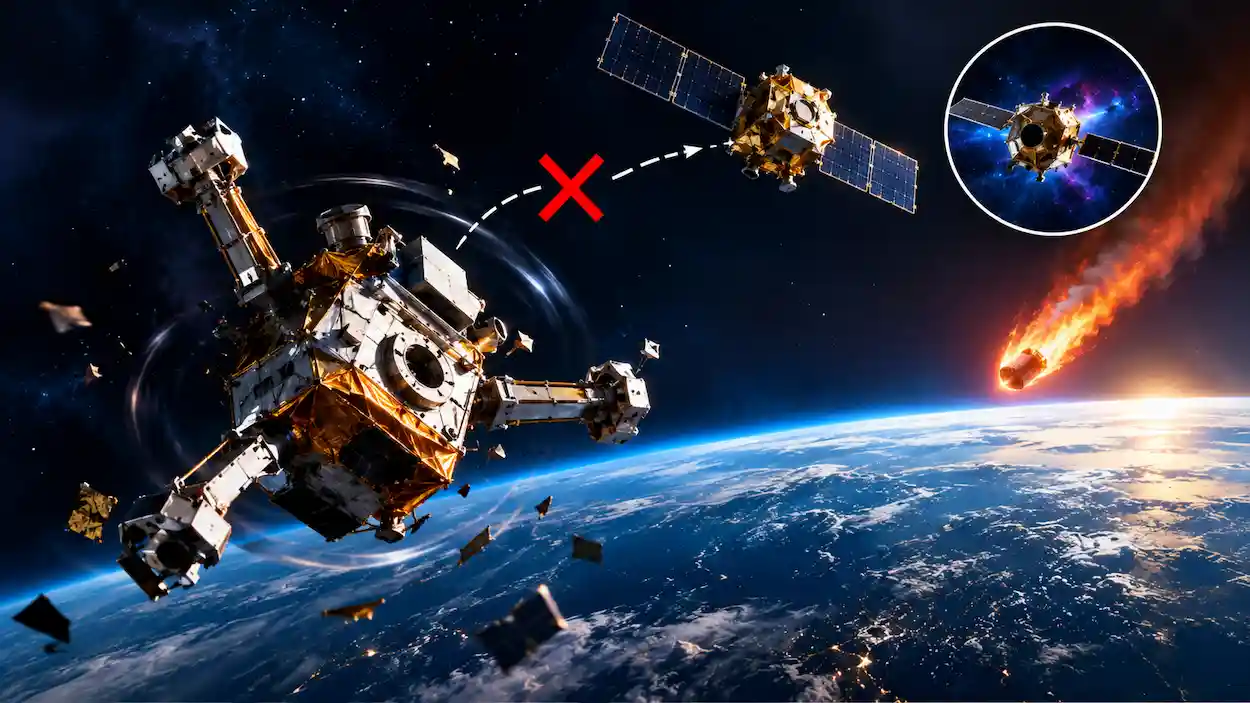
The Swift Telescope Rescue Mission has failed, and scientists expect that NASA’s Neil Gehrels Swift Observatory fall back to earth and burn in the atmosphere by early November.
A company name, Katalyst Space Technologies was handling the rescue mission, which cost about $30 million. In the mission, they planned to use a robotic spacecraft name LINK to reach and lift the observatory to the higher and safer orbit. But the plan failed, LINK was launched on July 3. But it has some hardware problem so it started spinning out of control and it also ran out of fuel. So NASA cancelled this rescue plan on August 19. This robotic spacecraft LINK itself got burned in the Earth’s atmosphere on September 25.
The best part is Swift observatory is still working. But scientists expect that it’s science observations end in October as it’s orbit shrink. Now let’s take a deep dive into Swift observatory. Why it falling and what really happens to Swift telescope rescue mission?
Why NASA Wanted Swift Telescope Rescue Mission?
Swift observatory was launched in November 2004, and planned to run this mission only for 2 years. But it continued working for nearly 22 years, a long period than what planned. Its main work is to detect gamma ray bursts. This happens during some of the most energetic explosions in the universe, like when massive stars collapse or when the collision of the densest objects, called neutron stars happen. This burst is only last for a few seconds or a few minutes and after it fades away quickly.
Swift contains three telescopes and they work together to observe gamma rays, X-rays, ultraviolet and visible light. Its wide view instrument always searching for the sudden burst in the sky. And when it detects one, then it located it’s all telescopes at that location. And it also send an alert signal to other observatories so they can also observe that sudden burst. In simple terms Swift act as a lookout and immediately tells astronomers when something happens. It is very important because gammas burst doesn’t lasts for long time, they disappear quickly. So to get informed about the event within minutes is very essential to collect valuable data and not miss the event completely. That’s why Swift telescope rescue mission was so important to NASA.
Why Swift Started Falling?

Swift observatory revolves around the Earth in low Earth orbit, where thin atmosphere drags it. Normally this drag is very small but when sun becomes more active then it heats the upper atmosphere, by which it expands. This creates more drag on the satellites and makes them to reduce altitude faster. This exactly happen to Swift observatory. Due to increase solar activity upper atmosphere creates more drag and NASA had to reduce its observations earlier this year to slow its descent. This is the problem for which the Swift telescope rescue mission was built to solve.
Earlier astronauts could repair the spacecraft in it’s orbit. For example, Hubble was repaired for five times between 1993 and 2009 by space shuttle crews. But the shuttle program has ended and Swift observatory was never designed to repair in space. So NASA contact a private company called Katalyst Space Technologies and give $30 million contract for Swift telescope rescue mission. If the mission successful then this would be the first time when a commercial spacecraft grab and rescue a government mission. That’s why the Swift telescope rescue mission attracted so much attention.
How the Swift Telescope Rescue Mission Went Wrong?
NASA gave the contract to Katalyst company for Swift telescope rescue mission. But company had only nine months for building and launching the spacecraft. This duration is very short for building an entire new spacecraft. This new robotic spacecraft called LINK. It was launched on July 3 and it traveled on a rocket called Pegasus XL. This rocket is unusual because instead of launching from the ground it is released from an aircraft in mid-air and had not flown since 2021.
Problems started just after few weeks. On July 28, NASA reported that spacecraft has some hardware issues so it start spinning out of control and communication also becomes patchy. LINK has xenon-gas thrusters, their main objective was to push Swift to higher orbit. But after this spinning problem engineer used these thrusters to get through this problem. LINK’s reaction wheels which are small running wheels that help to turn and control spacecraft’s movement without using fuel also failed. So later spacecraft ran out of fuel. On August 19 NASA and Katalyst both agreed to dismiss the Swift telescope rescue mission.
The CEO of the Katalyst company, Ghonhee Lee called the project a high-risk, high-reward challenge and expressed pride for the milestone that LINK spacecraft achieved. LINK reentered the atmosphere less than three months after its launch. The Swift telescope rescue mission was an ambitious attempt carried out on a very tight schedule and space rarely forgives that kind of pressure.
What Happens to Swift Now?

The surprising part is, Swift is still working. Observatory stops its operations before the rescue mission attempt. But it again started collecting information again in August. On September 25 NASA reported that all three science instruments of Swift observatory started working again. But it does not have much time. NASA expected that its altitude will drop about 185 miles in early to mid-October. Then it becomes very difficult to take any observation from it and it will stop working. Scientist expects that Swift will reenter earth’s environment in early November. So even the Swift telescope rescue mission failed, still scientists have some weeks to gain some valuable information from the telescope. Once it will enter the earth’s atmosphere it will burn up and scientists lose their early warning system. With the end of Swift telescope rescue mission, scientists have to find another way to fill that major gap.
Conclusion
Swift observatory contributes nearly 22 years in observing some of the most powerful and instant events happen in the space. This duration is far beyond than its original 2 year plan. From the very beginning this Swift telescope rescue mission is very challenging. Although it failed but it was a first major mission that space industry may need much more in future. On early November when the Swift telescope enter the Earth’s atmosphere, this Swift telescope rescue mission will close forever and becomes NASA’s one of the hardest working observatories.