
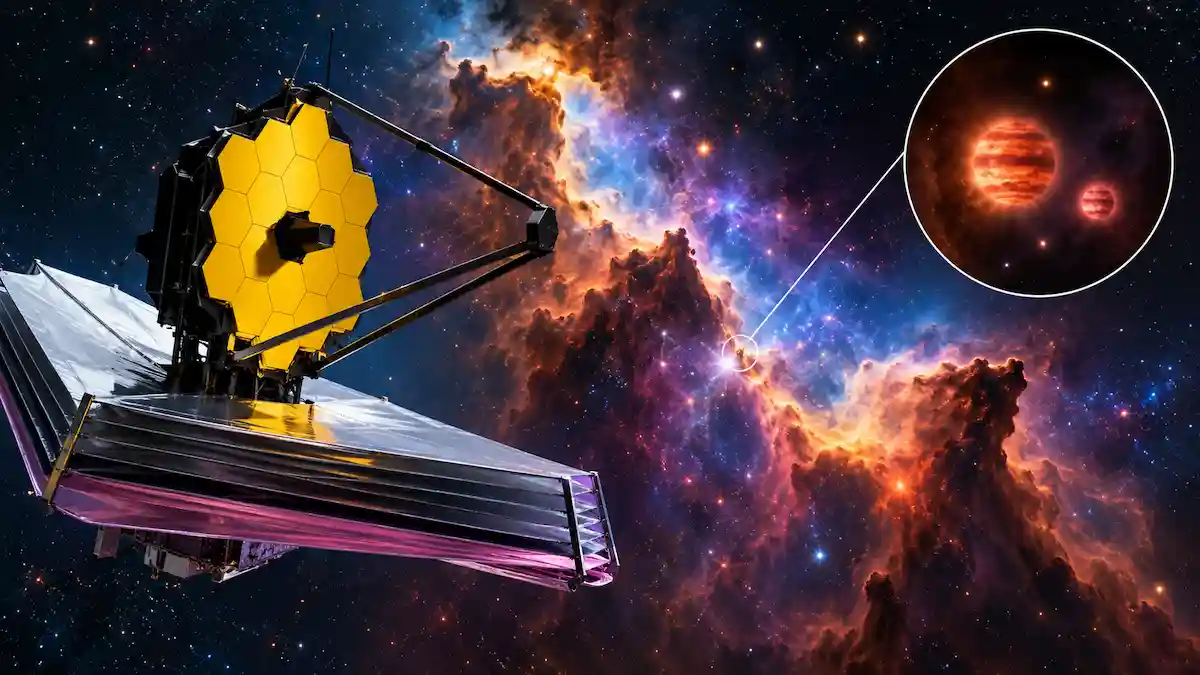
NASA’s James Webb just found the smallest brown dwarfs ever discovered. JWST spotted a group of brown dwarfs in the young star-forming region IC 348. Scientists estimate these objects are so light that their mass is only about twice the mass of Jupiter. These objects are too small to become normal stars, but they may have formed in the same kind of region where stars are born. That makes the discovery especially interesting. This new discovery makes it even harder to tell the difference between a “dwarf star” (also called failed star) and a giant, lonely planet. Let’s break down what Webb actually found and why it matters.
What Webb Actually Found in This Star Nursery
The smallest brown dwarfs were spotted in IC 348, a young star-forming region of interstellar gas and dust cloud which is located about 1,000 light-years away from Earth, in the constellation Perseus. Webb discovered that these objects have mass only about two times of Jupiter’s mass. It makes them smallest brown dwarfs ever found.

Brown dwarfs are also called failed stars. This nick names makes them more mysterious. They aren’t enough massive to maintain fusion process for long time. A star forms when a huge cloud of gas and dust collapse under its own gravity. As the material contracts, the core becomes denser and hotter. If enough material collects, the core eventually becomes hot enough for sustained hydrogen fusion. That’s how a star born and shine for millions or billions of years.
A dwarf star is also begins with same process but it does not collect enough material to sustain hydrogen fusion. So that it never become a real star. NASA describes that mass of brown dwarfs lies between the mass of stars and planets. But it’s formation process is similar to stars formation.
Here’s the interesting part, masses of these smallest brown dwarfs can overlap with the range of giant planets. Jupiter is about 318 times more massive than Earth, but has only about one-thousandth of the Sun’s mass. A brown dwarf with roughly twice of Jupiter’s mass is incredibly small compared with even the lightest stars.
How Astronomers Confirmed These Are the Smallest Brown Dwarfs Yet?
Finding such distant and faint objects is not an easy task. By using powerful infrared vision, James Webb Telescope made it possible to spot them. In 2024, scientists used Webb’s NIRCam to study this young star forming region, IC 348. Scientists search for very faint objects with strange colour patterns. Brown dwarfs are unique, they are much easier to in infrared light. It happens because they are cool and very faint, so they emit very less visible light than stars. But still they produce infrared light. And James Webb is specially designed to detect infrared light. That’s why James Webb can detect distant and faint objects easier than older telescopes.
Then in 2025, scientists used NIRSpec instrument to study the most promising objects more closely. NIRSpec spread the light from the observed objects into a spectrum, which works like a fingerprint. Using this fingerprint, they determined the temperature, and composition of the objects and estimated their mass. The follow-up observations were crucial to the research, as they confirmed that these are the Smallest Brown Dwarfs Yet, not the young and cool stars, or other types of objects.
A Brown Dwarf With Its Own Planet-Forming Disk

Most surprising part of this discovery is that; these newly discovered smallest brown dwarfs have a disk of material around it, just like stars. These disks are made up of gas and dust, which come together later and form planets. Finding a disck around an object which is just a little more massive than jupiter, raises one interesting question, “Could planets actually formed around the smallest brown dwarfs?” It sounds so strange, because we always imagine planets are revolving around the stars. But this discovery changes the whole scenario, where smaller planets revolve around a planet sized object. Scientists are still studying whether this process can really happen.
Quick Refresher: Star, Brown Dwarf, or Planet?
If you are new to this topic and know nothing. Then the easiest way to understand them is to se their formation process and what’s going inside them. A true star requires enough massive to start their hydrogen fusion process. Even the smallest stars need atleast 8% of the Sun’s total mass, to sustain hydrogen fusion process. This process is the nuclear reaction that makes stars to shine for millions or billions of years.
Brown dwarfs doesn’t have enough massive or material to sustain hydrogen fusion, so they never become true stars. But some can briefly fuse deuterium (heavier isotope of hydrogen) in their early life.
Planets are different, they form in the leftover material present in the disk around a star instead of collapsing directly from a cloud.
These Smallest Brown Dwarfs Yet sit near the confusing boundary between stars and planets, that’s why astronomers are interesting in them and making so much debates around this topic.
YOU MAY LIKE
- Milky Way’s Black Hole Is Slowly Destroying Itself to Power Cosmic Rays”
 Milky Way’s black hole may be doing something scientists never expected. It is sacrificing a piece of itself to power some of the most energetic particles in our galaxy. A theoretical study suggests that Sagittarius A*, the supermassive black hole present at the center of the Milky Way, could be using its own spinning energy… Read more: Milky Way’s Black Hole Is Slowly Destroying Itself to Power Cosmic Rays”
- New Tesla Roadster Takes Flight — But Elon Musk’s Original Car Is Still in Space
 This week, Tesla Roadster comes twice in the news for two very different reasons. On October 15, 2026, Tesla showed off a new Roadster prototype in Texas that appeared to lift off the ground using thruster technology inspired by SpaceX. While the new Roadster was making headlines on Earth, the original red Tesla Roadster that… Read more: New Tesla Roadster Takes Flight — But Elon Musk’s Original Car Is Still in Space
- Astronomers Find the First Green Star – Could Our Sun Also Glows Green After it Dies?
 Astronomers just found the first green star and the reason of its unusual color is surprising. Astronomers at the University of Warwick have detected a dead star that actually looks green to the human eye, something that never confirmed before research. Scientists believe that the star has gained this green color because it consumes some… Read more: Astronomers Find the First Green Star – Could Our Sun Also Glows Green After it Dies?
- Microblazar Discovered In Our Galaxy, After 30 Years of Searching And Its Jet Is Pointed Straight At Earth
 Recently a microblazar has been confirmed in our own galaxy, Milky Way. Scientists have been investing this cosmic mystery for nearly 30 years. The study reveals that the object named IRAS 18293-0941 sits about 1200 light years away from Earth and one of its powerful jets points straight towards the Earth. It sounds danger but… Read more: Microblazar Discovered In Our Galaxy, After 30 Years of Searching And Its Jet Is Pointed Straight At Earth
- Orionid Meteor Shower: The Ancient Shooting Stars That Left By Halley’s Comet Centuries Before You Were Born
 The Orionid Meteor Shower returns this month, and brings beautiful streaks of lights and fill the dark sky with colours. Each meteor burning up in the sky is a tiny piece of dust that left behind by the Halley’s Comet hundreds of years ago. Now centuries past, and when Earth passes through this old trail… Read more: Orionid Meteor Shower: The Ancient Shooting Stars That Left By Halley’s Comet Centuries Before You Were Born