
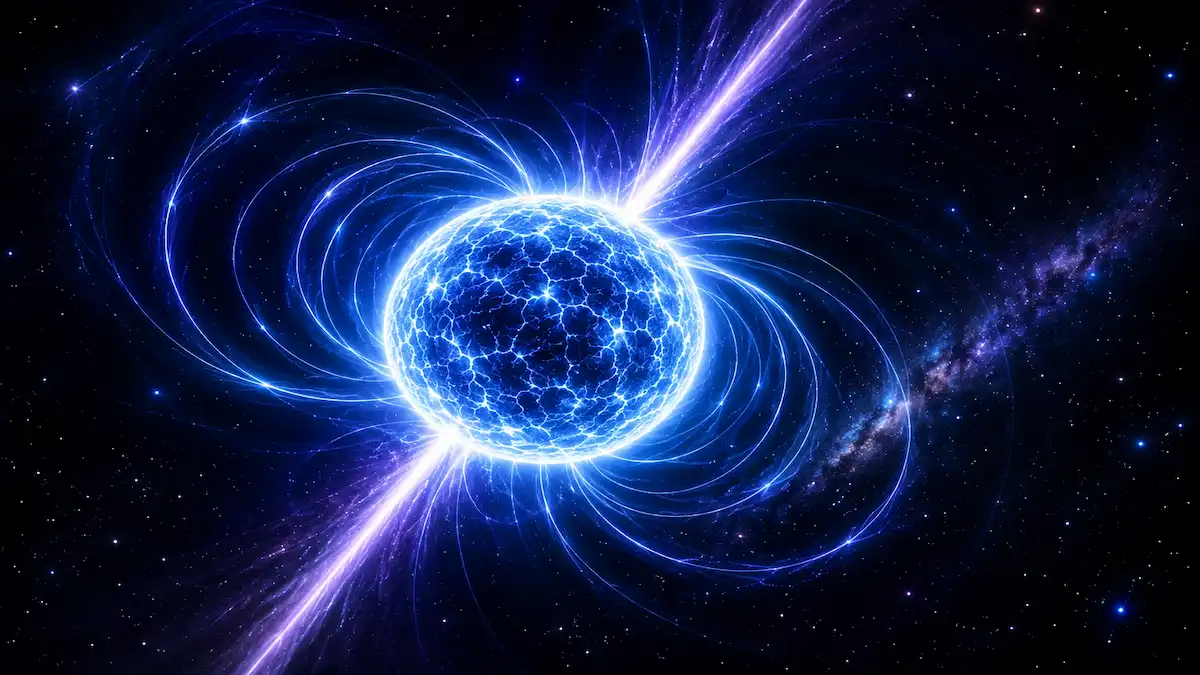
Why are Neutron Stars So Dense? Imagine holding a single teaspoon of material that weighs about one billion tons on Earth. It sounds impossible but this is what the scientists say about the density of a Neutron Star. This is absolutely fascinating and it is difficult to believe that something like this could be even possible. It is a great mystery of our Universe and only few people have figured it out. A neutron star is the result of collapsing a massive star under its own gravity.
The simple answer to “why are neutron stars so dense?” is that gravity crushes an enormous amount of matter into an incredibly small space. A typical neutron star is 1.4 times heavier than our sun, and a diameter of only 20 km (12 miles) compared to the sun’s 1.39 million km .That’s like compressing more than 1 Sun’s worth of matter into something the size of a city! The average density of a neutron star is 10¹⁷ kg/m 3, which is nearly 100 trillion times denser than water and close to the density of the matter in the center of an atom. Therefore, it is not surprising that neutron stars are so dense. The density of a neutron star is depend on, how massive stars die, how gravity compresses matter and how quantum physics changes the structure of atoms during the collapse.
It All Begins With the Death of a Massive Star

To understand why are neutron stars so dense, we have to comprehend the process which creates them. Every star balances two powerful forces throughout their lifetime. The gravity pulls mater inward while the energy produced by the nuclear fusion at the core pushes outwards. These two forces cancel each other so that star remains stable for millions or billions of years. But this state cannot last forever, as eventually, the fuel in the core runs out.
The star which is 8 to 20 times bigger than our sun can produce heavier elements inside their core. At last they produce iron. Unlike other elements, iron does not release energy when fused. This means that the star can no longer resist gravity. The balance is shifted, and gravity wins, causing the core to collapse in on itself at an incredible speed. This collapse takes less than a second and reduces core to a dense ball of neutrons about a few tens of kilometers wide. At the same time, the outer layers of the star exploded away in the form of a core-collapse supernova, one of the brightest explosions in the universe. And the dense remnant of the core left behind that is called a neutron star, one of the densest objects in the universe. This catastrophic collapse is the first major reason why are neutron stars so dense.
Gravity Plays Major Role
The collapse of a giant star not only makes it shrink in size but also changes the matter that constitutes it. The structure of atoms is different inside a neutron star. The space that is usually empty in an ordinary atom is now filled with neutrons. This happens because during the formation of a neutron star, gravity pulls matter with such a force that atomic nuclei swallow the electrons that orbit around them and turn them into neutrons. This process, which is called electron capture, results in atoms losing their identity. Inside a neutron star, matter is not organized into atoms but forms a massive lattice of neutrons. This transformation explains why are neutron stars so dense. There is hardly any empty space between neutrons in a neutron star. They are much closer to each other than atoms in ordinary matter. The density of neutron-star matter is close to the density of the nucleus of an atom. Such a degree of compression was only possible because of the strong gravity. This gravity crushes atoms into nuclei and nuclei into neutrons, making the matter inside a neutron star extremely dense. Scientists compare this matter to a huge atomic nucleus the size of a city.
What Stops the Collapse — Neutron Degeneracy Pressure
The next obvious question is now arises, if gravity is so powerful then why does the collapse of the star stops. Why doesn’t a neutron star keep collapsing into a black hole? The answer hides in quantum mechanics. A force called neutron degeneracy pressure that prevents neutrons from being squeezed.
Neutron belongs to a particle group which is called fermions. According to Pauli Exclusion Principle, two identical fermions (same neutrons) can’t exist in the same quantum state. According to this rule an extremely strong resistance, called neutron degeneracy pressure produced when gravity squeezes neutrons closer together. Unlike the pressure caused by nuclear fusion in regular stars, neutron degeneracy pressure doesn’t rely on heat. Instead, it’s a quantum mechanical effect. When gravity tries to compress neutrons beyond a certain limit, neutron degeneracy pressure pushes back with enormous strength and it allows neutron stars to maintain their density. This delicate balance between gravity and quantum mechanics is another fundamental reason why are neutron stars so dense. Without the neutron degeneracy pressure preventing their total collapse, every neutron star would inevitably collapse into a black hole.
What Is Actually Inside a Neutron Star?
One of the most interesting discoveries about investigating why are neutron stars so dense is what lies beneath their surface. A neutron star has layers — and the deeper you go, the stranger it gets.
Crust
First there is the outer crust. This part of the neutron star is about one kilometer thick. In this layer, nuclei exist but they contain much more neutrons than in ordinary matter. Atoms are also arranged in a very tightly packed crystal. According to the theories, crust of a neutron star is about billion of times stronger than steel.
Due to the intense gravity, even a small object would fall into the surface, it would strike with enormous amount of energy. For example, if you dropped a marshmallow on the neutron star, it would hit with the energy of a nuclear bomb.
The Outer Core
Below the crust, matter becomes even stranger. The pressure is even greater, allowing the neutrons to dominate over other particles. Atomic nuclei are destroyed in this zone resulting in a super dense fluid of neutrons. However, physicists believe that this fluid possesses some very exotic properties. For example, it could be a super fluid which means it has zero friction. Also, some of the protons in the core might form a superconductor which is a material that has zero resistance to electric current.
The Inner Core
The inner core of the neutron star is something that remains very mysterious to scientists. They know that density is incredibly high. Matter is far more packed than anything humans have encountered on Earth. In this layer, the pressure is several times greater than the density of a normal nucleus. Physicists have various ideas of what might exist in the inner core. Some say that there are particles called hyperons that have greater mass than neutrons that exist in the core. In addition to this, there are theories stating that neutrons split into their constituent parts in the core creating state called quark-gluon plasma or quark matter — a state of matter that normally only existed in the first microseconds after the Big Bang.
How Dense Is a Neutron Star Compared to Other Things?
The easiest way to understand why are neutron stars so dense is by comparing them with familiar materials.
| Object | Approximate Density |
| Water | 1,000 kg/m³ |
| Iron | 7,874 kg/m³ |
| White dwarf | ~10⁹ kg/m³ |
| Atomic nucleus | ~2.3 × 10¹⁷ kg/m³ |
| Neutron star | ~10¹⁷ kg/m³ |
Among all the stable objects in the universe, neutron star is the densest one.
Extreme Gravity, Magnetic Fields, and Rapid Rotation
The same physics that explains why are neutron stars so dense also explains many of their extraordinary properties.
Extreme gravity
A neutron star has more mass than the sun’s mass. And it is only about 20 km wide. As a result its gravity on the surface is about 200 billion times stronger than Earth’s. If anyone would land on its surface, they crushed instantly by extreme gravity.
Powerful Magnetic Fields
Neutron stars have magnetic fields up to a billion times stronger than Earth’s. Some neutron stars are called magnetars, and they have strongest magnetic fields in the universe. These fields are strong enough to twist the atom’s structure from halfway across the solar system.
Rapid Rotation
Neutron stars also rotate at high speed. When the core of a star collapses to form a neutron star, it decreases its size. So, due to the conservation of angular momentum neutron star spins very fast. Some neutron stars such as millisecond pulsars can rotate hundreds of times per second. The fastest rotating pulsar we’ve found so far is able to rotate 716 times per second.
Final Thought
The answer to the initial question “why are neutron stars so dense?” begins with a massive star’s death cycle. The process that leads to the formation of neutron stars commences with the formation of a massive amount of gas as a result of nuclear fusion ceasing at some point. Gravity then takes over, which causes the stellar core to contract under its own weight, until the force of the pressure is enough to resist the gravity. The electrons get squeezed against each other and combine with protons to form neutrons. All the space in the matter is removed as a result, leaving behind matter of almost similar density as that of the core of an atom. There is a point when the contraction of neutrons is stopped as a result of neutron degeneracy pressure along with the strong nuclear force repulsion being able to resist gravity.
Understanding why are neutron stars so dense is not only about explaining a remarkable astronomical object. It also helps scientists to explore the limits of gravity, quantum mechanics, and nuclear physics.
Stay Connected with Science Scope Hub for more space mysteries and missions.